How to Write an Invoice as a Freelancer: A First-Invoice Walkthrough
August 30, 2026
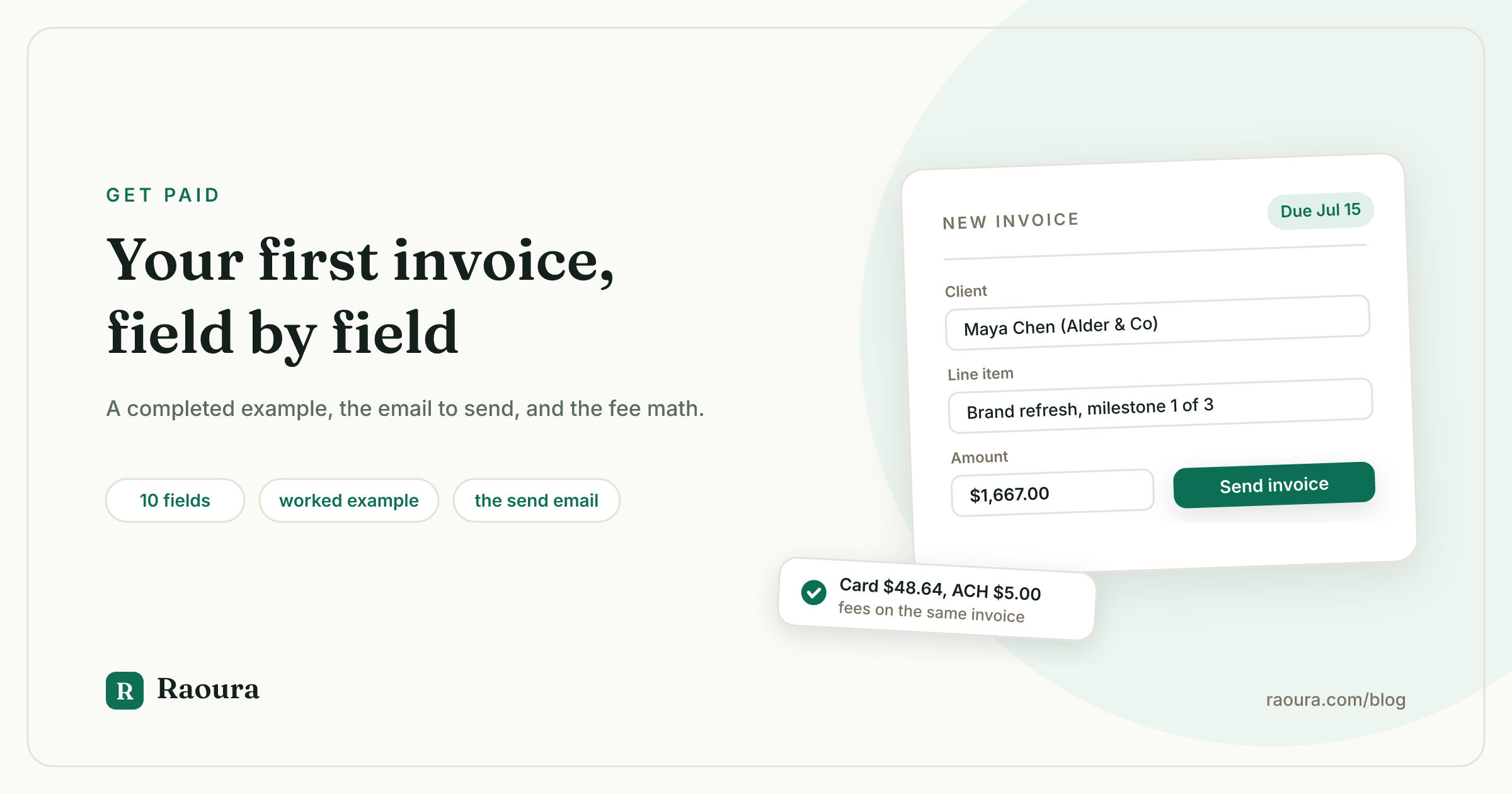
Your first invoice is a strange document to write. It is the moment your work turns into a number, and the guides that rank for this question are weirdly unhelpful about it. We fetched the four top-ranking "how to write an invoice" guides in July 2026: not one of them shows a single completed example invoice, one renders its own six how-to steps as empty list items, and every one of them ends in a signup pitch for the publisher's software.
So this is the walkthrough those pages skip. You will see a finished invoice with real numbers on it, field by field, plus the email that carries it, what the payment itself costs you, and what to do in the days after you hit send. By the end you can write invoice number one in about fifteen minutes, and the system behind it will still be working at invoice number one hundred.
What an invoice actually is (and is not)#
An invoice is a payment request built from 10 fields, and it is neither a contract nor a receipt: it cannot create terms your client never agreed to, and it does not prove anyone paid. The contract sets the price, the deadline, and any late fee; the invoice restates them and asks for the money; a receipt (if anyone asks) confirms the money arrived.
That ordering matters more than any formatting choice. A late fee that appears for the first time on an invoice is generally unenforceable, because the client never agreed to it. If you skipped the contract step, fix that before your next project with a freelance contract template; for this invoice, bill what was agreed in writing, even if that writing is an email thread.
One more calibration: in the US there is no federal law dictating what an invoice must contain. The IRS's only interest is that your records "clearly show your income and expenses," and it lists invoices among the supporting documents that substantiate gross receipts. Contrast the UK, where GOV.UK prescribes the contents: a unique identification number, both parties' names and addresses, a description, the supply date, the invoice date, the amounts, and VAT where it applies. If your client is overseas, the rules and the fees both change, and invoicing international clients covers that fork.
Collect these 4 things before you write a line#
Four questions asked at project kickoff prevent most first-invoice delays: who pays, what reference they need, what tax form they want, and how you will take the money. Each is one sentence to ask and a week of waiting if you skip it.
- Who actually pays. Your day-to-day contact often is not the person who pays bills. Ask "Who should invoices go to, and should I copy anyone?" Invoicing the wrong inbox is the most common self-inflicted delay there is, because your invoice sits in someone's forwarding queue instead of the payment queue.
- PO or reference number. Companies with accounting software may require a purchase order number on the invoice before their system will accept it. No PO number, no payment, and nobody will tell you until you chase.
- The tax form. US clients who pay you $600 or more will usually ask for a W-9 so they can file a 1099-NEC for you at year end. Fill it in with an EIN, not your Social Security number; an EIN is free from the IRS and takes minutes online, and it keeps your SSN out of email attachments forever.
- The payment method. Decide how the money arrives before the invoice exists: a payment link, ACH details, or both. The section on fees below shows why offering bank transfer alongside card is worth one extra line on the invoice.
The 10 fields, in order#
A complete freelance invoice has 10 fields, and the three that move payment speed most are the exact due date, the line items that mirror your agreement, and the payment link. Here is each field and the job it does:
| # | Field | What it does |
|---|---|---|
| 1 | Your business block (name, address, email, phone) | Matches your contract identity so the paper trail is continuous |
| 2 | Bill to (client legal name, attn: the payer) | Routes the invoice to the person who can actually pay it |
| 3 | Invoice number | Lets their accounting system file, track, and not reject it |
| 4 | Issue date | Starts the clock and anchors your records |
| 5 | Due date, as an exact calendar date | Removes the ambiguity clients read in their own favor |
| 6 | Line items mirroring the contract language | Makes the invoice instantly recognizable, not a puzzle |
| 7 | Subtotal, tax if applicable, total due | The number, stated once, with tax broken out |
| 8 | Terms line (restating agreed late fee, if any) | Reminds; the contract enforces |
| 9 | Payment method (link and/or ACH details) | Turns "I'll get to it" into a one-click act |
| 10 | A closing line: thanks plus what happens after payment | Gives them a reason to pay now instead of eventually |
Two of these deserve one more sentence each.
For the due date, write "Payment due by August 1, 2026," never "Net 30" or "due upon receipt": vague terms get read generously, and QuickBooks' 2025 Late Payments Report found 60% of small businesses offering longer payment terms report cash flow problems, versus 40% of those collecting immediately. Seven to fourteen days is the working window for solos; the full argument is in payment terms that get you paid in days, not months.
For the invoice number, use the year plus a counter (2026-001), never reuse a number, and feel free to start the counter above 001 if you would rather not advertise that this is your first invoice.
If you want this as a copy-paste document with every field annotated in more depth, the freelance invoice template is the same system as a fill-in-the-brackets file, ungated.
A completed example invoice#
Here is a finished first invoice: milestone 1 of 3 on a $5,000 brand refresh, billed at $1,667, due 14 days after issue. The scenario: Jordan Reyes, a freelance brand designer, signed a $5,000 brand refresh with Maya Chen at Alder & Co, billed by milestone in thirds ($1,667 + $1,667 + $1,666), with a 1.5% monthly late fee in the signed agreement. Milestone 1 just got approved.
INVOICE 2026-042
Jordan Reyes, doing business as Reyes Design Studio
41 Fern St, Portland, OR 97201 · jordan@reyesdesign.studio · (503) 555-0142
Bill to: Alder & Co LLC, attn: Maya Chen (maya@alderandco.com)
Reference: Brand refresh agreement signed June 12, 2026
Issue date: July 1, 2026
Payment due: July 15, 2026
| Description | Qty | Rate | Amount |
|---|---|---|---|
| Brand refresh, milestone 1 of 3: discovery, logo concepts, and brand kit (per agreement of June 12) | 1 | $1,667.00 | $1,667.00 |
Subtotal: $1,667.00
Sales tax: $0.00 (Oregon; services not taxable)
Total due: $1,667.00
Terms: Payment due by July 15, 2026. Overdue balances accrue a late fee of 1.5% per month, per our agreement of June 12.
Pay online: [payment link]. Prefer bank transfer? ACH details on request.
Thank you! Once payment clears, I will start milestone 2 (brand guidelines and templates), targeting August 5.
Read it once more and notice what it is doing:
- The line item quotes the agreement's own words and names the milestone, so Maya recognizes it without opening a single old email.
- The due date is a calendar date.
- The late fee line points back to the agreement that makes it enforceable.
- The tax line exists even at $0.00, because showing you considered it beats silently omitting it (most US states do not tax most freelance services, but some tax design, software, or digital goods, so check your state's revenue department once rather than guessing forever).
- The closing line ties payment to something Maya wants: milestone 2 starting.
The deposit note, since first projects should have one: if you took an upfront deposit, that deposit was its own invoice before work began, and later invoices reference it ("less deposit paid June 15"). How much to take is covered in how much deposit a freelancer should charge.
The email that carries it#
The invoice email needs three sentences: what this is, when it is due, and how to pay, with the amount and due date visible in the subject line before anyone opens anything. Copy this:
Subject: Invoice 2026-042 from Reyes Design Studio, $1,667 due July 15
Hi Maya,
Milestone 1 is approved, so here is the invoice: $1,667, due July 15. You can pay by card or bank transfer at the link below (bank transfer saves fees on my end, but whichever is easier for you works).
[Pay invoice 2026-042]
Once payment clears I will kick off milestone 2, targeting August 5. Thanks!
Attach the PDF too if you are sending from email rather than an invoicing tool; accounting departments file attachments, not links. What you should not do is bury the invoice in a longer project update. One email, one job.
What getting paid costs you#
On the $1,667 example invoice, a card payment costs $48.64 in processing fees while an ACH bank debit costs $5.00, a $43.64 difference on a single invoice. Fees are the tax on convenience, so know the menu before you pick a default (verified against Stripe's current pricing page, July 2026):
| Method | Fee | Cost on $1,667 | You keep |
|---|---|---|---|
| Stripe, ACH debit | 0.8%, capped at $5.00 | $5.00 | $1,662.00 |
| Stripe, US card | 2.9% + $0.30 | $48.64 | $1,618.36 |
The practical play for a first invoice: include the card link anyway, because a card payment today beats a fee-free payment that never arrives, and offer ACH as the cheaper path on invoices above about $1,000. The wider comparison, including PayPal's rates, is in Stripe vs PayPal for freelancers.
Whatever processor you choose, the money should flow directly into your own account. Some client platforms route payments through their own books and take a cut on top of processing; why that arrangement deserves a hard no is laid out in why your client tool should never touch your money. (Disclosure: Raoura is our product.) It is also the reason Raoura connects your own Stripe account instead of processing payments itself: the client clicks pay, and the money lands with you, with no platform cut.

This is what field 9 looks like when it works: the example invoice from this article as the client sees it, one button, four ways to pay, money straight to your Stripe.
After you hit send#
Bonsai's analysis of invoices from 100,000+ freelancers found 29% are paid at least a day late, but more than 75% of late invoices are paid within 14 days of the due date, so a prompt, calm reminder recovers most of them. The numbers behind that, and who gets paid latest, are in freelance late payment statistics; the Bonsai data also shows 90% of late invoices resolve within a month.
Three habits from day one:
- Store every invoice you send. The IRS does not mandate a format, but invoices are the supporting documents behind the income you report, so keep the PDFs somewhere that survives a laptop.
- Nudge the day after the due date, not a week later. Silence teaches clients your due date was decorative. The exact wording is in the payment reminder email templates, and the cadence that works is in the 3-7-14-30 reminder schedule.
- Know the ladder before you need it. If a reminder does not land, there is a defined path from friendly nudge to late fee to demand letter, laid out in the unpaid invoice escalation ladder. And if you freelance for clients in New York, Illinois, or California, state freelance payment laws now give your invoice legal teeth.
The prevention system that makes all of this rare, deposits, terms, and process, lives in how to get clients to pay invoices on time.
Writing invoice number two, and twenty#
Your first invoice takes fifteen minutes; the real cost shows up later, because every subsequent invoice needs its number tracked, its due date remembered, and its reminder sent while you are heads-down in billable work. A document template handles the writing. It does not notice that invoice 2026-045 is nine days overdue.
That memory is what invoicing software is actually for, and it is worth exactly nothing on invoice one and quite a lot by invoice twenty. (Disclosure: Raoura is our product.) In Raoura, the walkthrough above collapses to a form: pick the client, describe the line item in your agreement's words, set the amount and due date, and send. Numbering, the payment link into your own Stripe, and the reminders you approve before they go out are handled, for $17 a month flat.
But the system in this article is the product; the software just runs it for you. A freelancer with a Google Doc, exact due dates, and a payment link will out-collect one with expensive software and "Net 30" every time.

The 10 fields, reduced to the four you actually type: Raoura fills in your business block, the numbering, and the payment link automatically.
Verified July 2026. Primary sources: Stripe current pricing page, IRS recordkeeping guidance, GOV.UK invoicing rules, QuickBooks 2025 Late Payments Report, Bonsai late payment analysis of 100,000+ freelancers. Competitor observation (no completed example invoice on any of the four top-ranking how-to guides; Xero's six how-to steps render empty) checked against live pages July 2026. Fee math computed on Stripe's published rates. This article is general information, not legal or tax advice.
Frequently asked questions
When should I send my first invoice?
The moment the billable event happens: deposit at signing, milestone invoice at milestone approval, final invoice at delivery. Same-day invoicing signals that your billing runs on a system, and waiting a week teaches the client that dates are soft.
What do I write on an invoice for freelance work?
Ten fields: your business block, bill-to, invoice number, issue date, an exact due date, line items that mirror your agreement, subtotal and tax and total, a terms line, how to pay, and a closing line saying what happens after payment.
Do I need invoicing software for my first invoice?
No. A clean document with the 10 fields, an exact due date, and a payment link beats software used badly. Software earns its keep once you have several invoices in flight and reminders to remember.
Do freelancers charge sales tax?
Usually not, but it depends on your state and your service. Most US states do not tax most freelance services; some tax design, software, or digital goods. Check your state revenue department once, then encode the answer in every invoice, even as a $0.00 line.
What if the client asks for a W-9 before paying?
Normal for US clients paying you $600 or more; they need it to file a 1099-NEC. Send the W-9 promptly with an EIN rather than your SSN. The request is a sign their accounting process is real, which is good news for getting paid.
Should I invoice before or after the work is done?
Both, structured: a deposit invoice before work starts, then milestone or final invoices as work completes. Never let the full project value ride on one invoice at the end.
What happens if the invoice just does not get paid?
Reminder the day after the due date, then a firmer note, then the escalation ladder: late fee if your contract has one, demand letter, small claims if the amount justifies it. Most late invoices resolve in the first two weeks; the ladder exists for the ones that do not.
---
Run your client work in one place
Send a proposal, get it signed, invoice, and get paid, with a branded portal your clients will actually use. One flat plan at $17/month, and we never take a cut of your payments.
Try Raoura free for 14 daysNo credit card required. Set up in minutes.
Keep reading
The Virtual Assistant Contract: 24 Clauses, Scored Against Every Template Ranking for This Search
We scored the four pages that publish actual virtual assistant contract text against 24 clauses a VA agreement needs. Twenty-four of 96 possible slots were filled. The best single template managed 7 out of 24. Twelve clauses appear in none of them, including every clause about the thing that makes VA work different from other freelance work: you are holding your client's passwords and running their inbox. One popular template also tells you a contract fixes your independent contractor status, then mandates client-set 9 to 5 weekday hours in the same document. Here is the clause-by-clause version, with the classification test the DOL is actually applying in 2026, the data protection terms nobody drafts, and the retainer mechanics that decide whether unused hours roll over.
Stripe vs PayPal for Freelancers: Every Fee Verified (2026)
Every page ranking for this comparison either prints in-person retail rates, contradicts itself, or skips the numbers freelancers actually pay. We read the current Stripe and PayPal pricing pages line by line, ran a $3,000 invoice through every rail, and found a $1,764 per year gap between the cheapest setup and the default one.
The Pause Clause: How to Stop Work When an Invoice Goes Overdue
Stopping work is the strongest move a freelancer has against a late-paying client, and the least understood. Here is the legal doctrine that lets you pause even without a clause, the exact clause to add so you never have to rely on doctrine again, the day-by-day timing, and the two emails that keep the pause professional. Verified against primary sources in July 2026.