Do You Really Need a Contract for Small Projects?
July 19, 2026
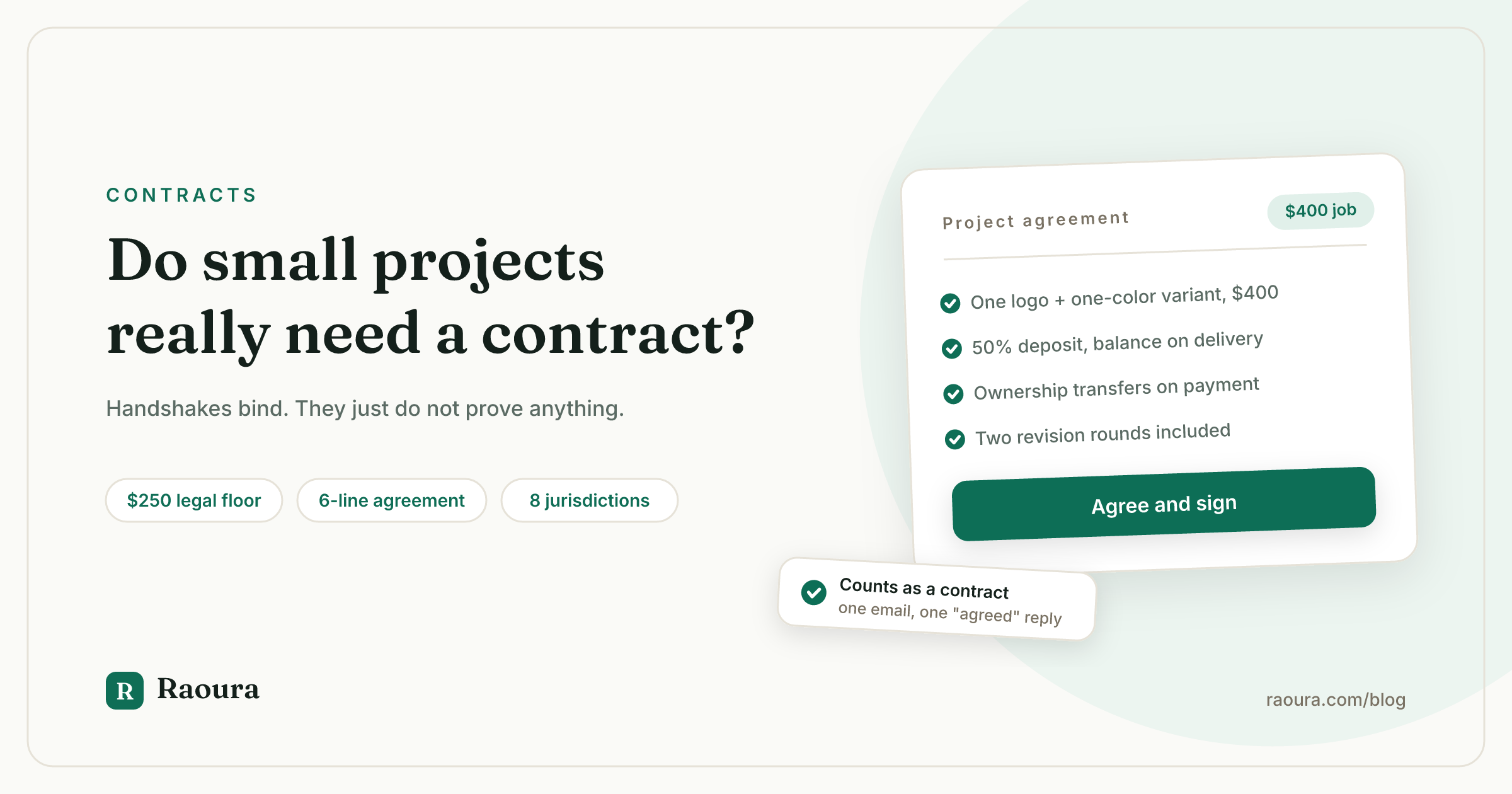
A $400 logo. A two-hour edit. A landing page for a friend of a former client. You know you should send a contract, and you also know that by the time you find the template, fill in the blanks, and chase the signature, you could have finished the work. So the small stuff ships on a handshake, and the handshake works fine right up until the one time it does not.
Here is a strange fact about this question. In July 2026 we searched "do I need a freelance contract" and clicked the top-ranking result, a FlexJobs article with exactly that title. It now redirects to a generic "what is freelancing" page that never discusses contracts at all.
The number one answer on the internet to this question is, literally, a blank.
The pages below it answer with anecdotes and a template upsell. None of them mention that in a growing list of US states, this stopped being a judgment call and became law.
So let us answer it properly, with sources.
The short answer, then the honest version#
Yes: freelancers who work under written contracts report 13.7% higher income than those who do not, and eight US jurisdictions now require a written freelance contract once your work for one client crosses a threshold as low as $250.
That is the short answer. The honest version is that "get a contract" is incomplete advice, because the real reason you skip paper on small projects is not ignorance, it is proportion.
A 9-page master services agreement for a $400 logo feels absurd, and you are right, it is.
The useful question is not "contract or no contract." It is "how much paper does this project actually need, and how do I make producing it cheaper than the risk of skipping it." That is what the rest of this article answers.
You already have a contract. You just cannot prove it.#
An oral agreement for freelance services is legally enforceable in every US state as long as the work can be completed within one year; the statute of frauds requires writing only for a few categories, like land transfers, contracts that cannot be finished within a year, and sales of goods worth $500 or more.
This surprises most freelancers in both directions. The moment your client said "sounds good, go ahead" and you started working for an agreed price, you almost certainly formed a contract. The $500 rule people half-remember comes from UCC section 2-201 and covers goods, not services, so it does not rescue or doom your design retainer either way. Your handshake deal is real.
What it is not, is provable. When the client's memory of the scope diverges from yours in week three, an oral contract gives you nothing to point at.
And silence has defaults you did not choose: no late fee, no deposit, no revision cap, no kill fee, and, under US copyright law, no transfer of ownership, because copyright in freelance work generally stays with you until you assign it in writing (the full picture is in our freelance IP rights guide).
Some of those defaults favor you, most just create ambiguity, and ambiguity always costs the person with less leverage, which on a small project is you.
One more thing the handshake crowd gets wrong in the other direction: writing does not mean a signed PDF. Under the federal E-Sign Act and state UETA laws, electronic records and signatures carry legal effect, US courts have repeatedly held that email exchanges can form binding contracts, and Illinois' Department of Labor says outright that a qualifying freelance contract can be "a paper document, an email, text message, or some other communication."
A scope-and-price email that the client answers with "agreed" is a written contract. Keep that thought; it is the whole small-project strategy.
What the handshake actually costs#
71% of freelancers have struggled to collect payment at least once, and the average unpaid freelancer loses almost $6,000 a year, about 13% of income, per the Freelancers Union.
That survey is from 2015, so treat the dollar figure as conservative; everything measured since points the same way. QuickBooks' 2025 Late Payments Report found 56% of US small businesses are owed money on unpaid invoices, an average of about $17,500 each, with 47% carrying invoices 30 or more days overdue. And in Skynova's survey of 615 freelancers, the two most common client red flags were being asked to work for free (52%) and not being paid on time (51%).
The strongest single number belongs to a peer-reviewed ILR Review study of Freelancers Union survey data: contract use is associated with 13.7% higher income (21.7% for New York respondents). On $60,000 of annual billings, 13.7% is $8,220 a year, which is a lot of compensation for minutes of paperwork per project.
The same study keeps you honest about the limits: even with a contract, 38.8% of respondents still had payment trouble. Paper improves your odds and your remedies. It does not replace judgment about who you work with, which is why we keep a client red flags database too.
Small projects are where this bites hardest, for a boring reason: enforcement math. A client who stiffs you on $12,000 is getting a demand letter and probably a lawsuit. A client who stiffs you on $400 knows the amount sits below the effort threshold of small claims court, so your leverage is whatever you wrote down, and whatever the law hands you. Which brings us to the part of this topic nobody ranking for it covers.
Where the written contract is now the law#
Eight US jurisdictions have freelance payment laws in force in 2026, with written-contract thresholds between $250 and $800, and most award double the unpaid amount plus attorney fees when a client does not pay.
Since 2017, a family of "Freelance Isn't Free" laws has spread from New York City to three states and a growing list of cities. They flip the entire framing of this article's question: below the threshold a written contract is your choice, above it the client is legally required to give you one. Here are the five biggest, with thresholds and penalties traced to the statutes:
| Jurisdiction | Written contract required from | In force since | If the client does not pay |
|---|---|---|---|
| [New York State](https://dol.ny.gov/freelance-isnt-free-act) | $800, aggregated over any 120 days | Aug 28, 2024 | Double the unpaid amount, plus attorney fees |
| [Illinois](https://labor.illinois.gov/laws-rules/legal/freelance-worker-protection-act.html) | $500, aggregated over 120 days | Jul 1, 2024 | Double the underpayment, plus attorney fees |
| [California (SB 988)](https://leginfo.legislature.ca.gov/faces/billTextClient.xhtml?bill_id=202320240SB988) | $250, aggregated over 120 days, professional services | Jan 1, 2025 | Up to double the unpaid amount, plus attorney fees |
| [Los Angeles](https://wagesla.lacity.gov/) | $600, single job or cumulative per year | Jul 1, 2023 | Up to double the unpaid amount, plus attorney fees |
| [Seattle](https://www.seattle.gov/laborstandards/ordinances/independent-contractor-protections-) | $600 per year (written disclosure of terms) | Sep 1, 2022 | Owed amounts via city enforcement |
New York City, Minneapolis, and Columbus have their own ordinances, and every one of these laws defaults payment to within 30 days of completing the work when the contract names no date. The complaint channels, damages schedules, and coverage quirks for all eight are in our freelance payment laws by state guide.
Notice the word that matters for small projects: aggregated. These thresholds are not per project. Three $300 jobs for the same client inside 120 days put you over the line in New York and Illinois, and in California a single $250 job usually does it on its own.
The "it's just a small gig" exemption people assume they are working under mostly does not exist in these places. If you are covered and the client refuses to put the deal in writing, that refusal itself carries statutory penalties ($1,000 in California, $500 in Illinois, $250 in Los Angeles).
What a small project actually needs#
A proportionate small-project agreement covers six things and fits on one page or in one email: who the parties are, the scope with one line of exclusions, the price, when payment is due, when ownership transfers, and a revision cap.
Here is the ladder we would actually use, sized to the project:
- Under roughly $500: use the confirmation email. One message, sent before you start: deliverable, exclusion, price, payment timing, ownership timing, revisions. Something like: "Confirming before I start: one logo, primary version plus a one-color variant (source files included, social kit not included), $400 flat. 50% deposit today, balance due on delivery, files and ownership transfer when the final invoice is paid. Two revision rounds included, extra rounds at $75 each. Reply 'agreed' and I will start Monday." That is six sentences, it is legally a written contract once they reply, and it beats what most handshake projects run on by six sentences.
- From roughly $500 to $2,500: use a one-page contract with an e-signature. Same six items in contract form, plus a late fee clause and a kill fee. This is also the floor for any covered work in the eight jurisdictions above, where the statutory thresholds live in exactly this range. Start from our annotated freelance contract template and delete what a small project does not need.
- Above that: use the full agreement. The clause-by-clause guide covers what belongs in it, a proper scope of work prevents the disputes, and milestone billing keeps you from ever being owed more than one phase.
Two rules hold at every rung:
- Take a deposit. On small projects 50% is normal, and a client who balks at $200 up front was going to balk at $400 later.
- Whatever rung you choose, read the client's paper if they send their own. Small projects are not exempt from the red flag clauses.
Make the paper cheaper than the risk#
The reason handshake deals persist is friction, not philosophy: if producing a clean contract costs 50 minutes of copy-paste plus a separate e-signature tool, you will skip it exactly on the projects too small to justify the ceremony.
So the operational fix is to make the paperwork nearly free:
- Save the six-sentence email as a snippet.
- Keep one small-project contract template with the blanks marked.
- Decide your deposit rule once, so it is policy, not a per-client negotiation.
This is also the workflow problem Raoura was built around, so a disclosure before the next paragraph: Raoura is our product.
Raoura costs $17 per month on one flat plan and runs proposal, contract, e-signature, and the deposit invoice as one flow, so the paper on a $400 project takes minutes: duplicate a template, swap the scope, send, and the client signs in the browser while the deposit invoice fires on signature. No separate signature app, no per-envelope fees, no percentage of your payment.

Every project has paper, and you can see which agreements are signed, sent, or still drafts without opening a single email thread.
!A signed contract record in Raoura showing the agreement text with the completed e-signature block

What the handshake never gives you: a signed record with the terms attached, ready for the one project in ten where it matters.
Verified July 2026. Primary sources: Cornell Law School LII, statute of frauds and oral contracts; Rodgers, Horowitz and Wuolo, ILR Review 67 (2014); Freelancers Union Costs of Nonpayment survey (2015); QuickBooks Late Payments Report (2025); Skynova freelancer red flags survey (615 freelancers); NY DOL Freelance Isn't Free Act page; NYC DCWP freelancer guidance; Illinois DOL FWPA statute page and FAQ; California SB 988 text; Los Angeles Office of Wage Standards FWPO; Seattle Independent Contractor Protections Ordinance. This article is general information, not legal advice.
Frequently asked questions
Is a verbal agreement legally binding for freelance work?
Usually yes. Under the statute of frauds, service contracts that can be completed within one year do not have to be written to be enforceable. The problem is evidence: with nothing in writing, a dispute becomes your recollection against theirs, and terms you never discussed (late fees, revisions, ownership timing) default in ways you did not choose.
Does an email thread count as a written contract?
Generally yes. Under the E-Sign Act and UETA, agreements are not denied legal effect solely for being electronic, courts have enforced contracts formed over email, and Illinois' freelance law explicitly counts "an email, text message, or some other communication" as a qualifying contract. The clean version is one message stating scope, price, payment timing, and ownership, answered with an explicit "agreed."
What is the smallest project that legally requires a written contract?
In California, professional services work worth $250 or more (alone or aggregated with the same client's work over the preceding 120 days) requires one under SB 988. Illinois sets the bar at $500 over 120 days, Los Angeles at $600, New York at $800. Outside covered jurisdictions there is no legal minimum, so the practical answer is: any project you could not comfortably write off.
What if the client says a contract feels like overkill for a small job?
Do not argue the word, change the artifact. "No problem, I will just send a quick project summary so we both have the details in one place" gets you scope, price, payment date, and an "agreed" reply, which is a contract without ever being called one. A client who refuses even that on a small job is telling you how the invoice conversation will go.
Do I need a lawyer to write a small-project contract?
No. For small work, a well-annotated template covers you; ours is free and ungated. A lawyer earns their fee when the stakes rise: unusual IP situations, indemnification you cannot get rewritten, or a master agreement you will sign once and work under for years.
Does a paid deposit prove we had a contract?
It proves an agreement existed, which helps, but it says nothing about the terms: scope, revisions, ownership, or the balance owed. A deposit plus a confirmation email is the minimum pair, and the deposit does double duty by filtering the clients who were never going to pay.
---
Run your client work in one place
Send a proposal, get it signed, invoice, and get paid, with a branded portal your clients will actually use. One flat plan at $17/month, and we never take a cut of your payments.
Try Raoura free for 14 daysNo credit card required. Set up in minutes.
Keep reading
The Virtual Assistant Contract: 24 Clauses, Scored Against Every Template Ranking for This Search
We scored the four pages that publish actual virtual assistant contract text against 24 clauses a VA agreement needs. Twenty-four of 96 possible slots were filled. The best single template managed 7 out of 24. Twelve clauses appear in none of them, including every clause about the thing that makes VA work different from other freelance work: you are holding your client's passwords and running their inbox. One popular template also tells you a contract fixes your independent contractor status, then mandates client-set 9 to 5 weekday hours in the same document. Here is the clause-by-clause version, with the classification test the DOL is actually applying in 2026, the data protection terms nobody drafts, and the retainer mechanics that decide whether unused hours roll over.
Stripe vs PayPal for Freelancers: Every Fee Verified (2026)
Every page ranking for this comparison either prints in-person retail rates, contradicts itself, or skips the numbers freelancers actually pay. We read the current Stripe and PayPal pricing pages line by line, ran a $3,000 invoice through every rail, and found a $1,764 per year gap between the cheapest setup and the default one.
The Pause Clause: How to Stop Work When an Invoice Goes Overdue
Stopping work is the strongest move a freelancer has against a late-paying client, and the least understood. Here is the legal doctrine that lets you pause even without a clause, the exact clause to add so you never have to rely on doctrine again, the day-by-day timing, and the two emails that keep the pause professional. Verified against primary sources in July 2026.