What Happens to Your Data When Your Freelance Tool Gets Acquired
August 30, 2026
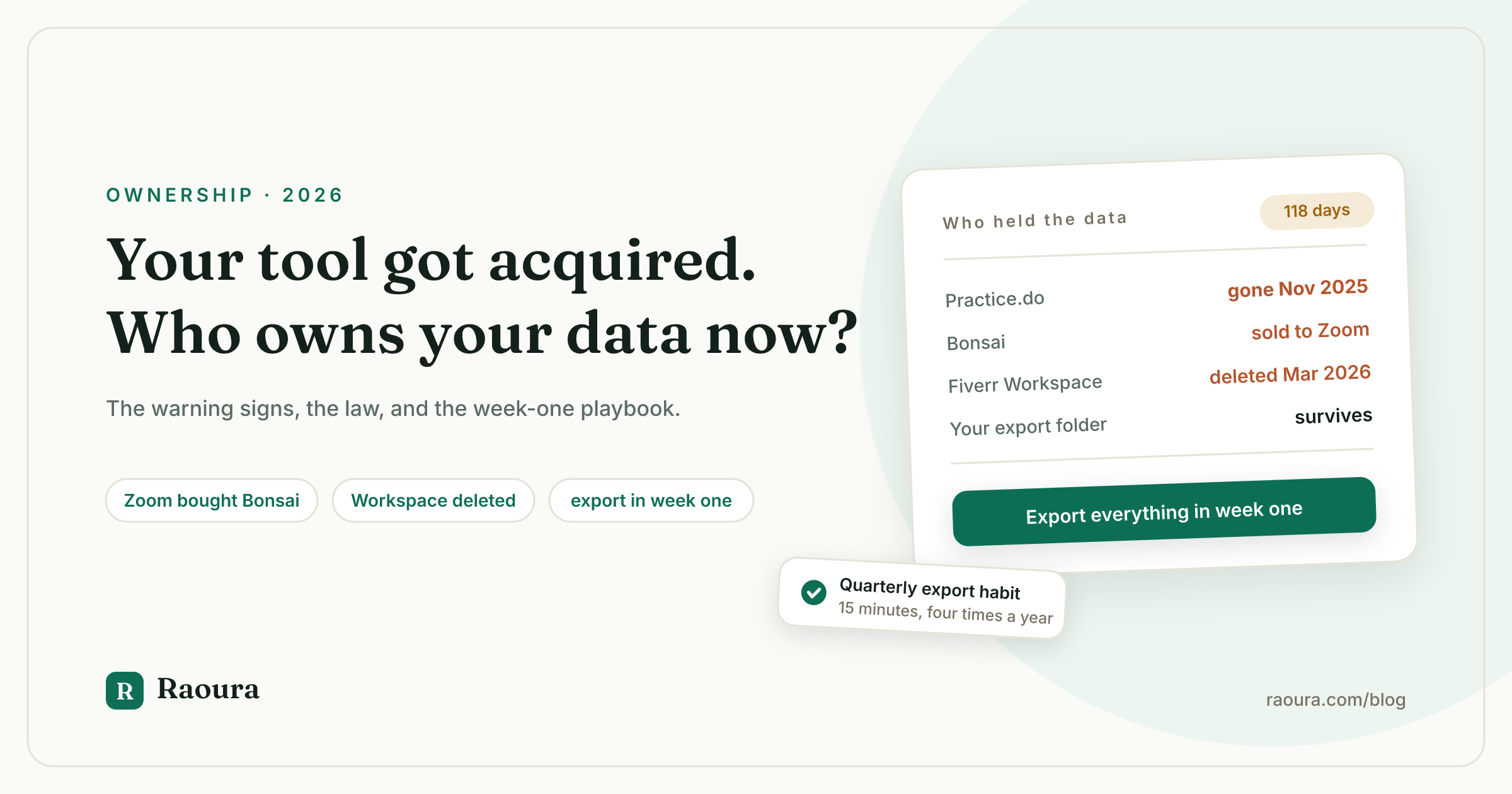
Your client tool holds your invoices, your signed contracts, your project history, and your clients' contact details. Then one morning there is a cheerful email: "We're thrilled to announce we've been acquired!" And every one of those records now belongs, in a very literal legal sense, to a company you never chose to do business with.
This is not a hypothetical for freelancers anymore. In a 118-day window between November 2025 and March 2026, three tools built for people like you were acquired, absorbed, or deleted outright. This article covers what actually happens to your data in each scenario, what the law says, the warning signs that showed up months before each announcement, and exactly what to do in the first week after one lands in your inbox.
One disclosure up front: this is the Raoura blog, and Raoura is a client management tool for solo freelancers, which means we are a competitor to some of the products discussed here. Every fact below is linked to a primary source so you can check our work.
Three tools, 118 days: what just happened#
Between November 3, 2025 and March 1, 2026, a span of 118 days, three freelance client platforms were acquired, absorbed, or shut down: Practice.do closed permanently, Zoom bought Bonsai, and Fiverr deleted Workspace along with all user data.
| Tool | What happened | Notice users got | Where the data ended up |
|---|---|---|---|
| Practice.do | Shut down permanently November 3, 2025 after a failed acquisition process, per [Paperbell's postmortem](https://paperbell.com/blog/practice-shut-down/) | A few weeks, no read-only period | Gone; the pre-shutdown export was a CSV of names and contact details only |
| Bonsai | [Acquired by Zoom](https://www.zoom.com/en/blog/zoom-acquires-bonsai/), announced November 5, 2025, closed December 2025 | Still running | Transferred to Zoom as part of the acquisition |
| Fiverr Workspace (ex AND.CO) | Shut down; all accounts and data deleted March 1, 2026, per [third-party coverage of the wind-down](https://www.plutio.com/blog/and-co-shutting-down-migration-guide) | Final billing January 31, 2026, then a 28-day export window | Permanently deleted |
Three different owners, three different endings. The shutdowns are the visible catastrophe, but the acquisition deserves just as much attention, because an acquisition is the moment your data changes hands while everything still looks normal.
Practice.do is the starkest version. The coaching platform had raised $10 million, and CEO Julien Smith announced in October 2025 that "after a failed acquisition process, the team has decided to put the company to rest," per Paperbell's account. Client portals and signed contracts went offline with the product.
The one thing users kept without asking: their payment history, which lived on in their own Stripe dashboards because Practice.do ran payments through each user's Stripe account.
Hold that thought. It becomes the most practical lesson in this article.
We covered the Workspace deletion in detail in Fiverr Workspace Is Gone and the Bonsai deal in Bonsai Alternatives Now That Bonsai Belongs to Zoom. This article is about the pattern.
Your data is an asset that transfers with the company#
In a US acquisition or bankruptcy, customer data is treated as a transferable business asset, and the FTC's position since the 2000 Toysmart case is that the buyer inherits the privacy promises that were in force when the data was collected.
There is no drama hiding in the legal mechanics, just a fact most people have never had spelled out: the database with your name, your clients' names, and your billing history is an asset on the company's books, like its trademarks and its office chairs.
When the company is sold, the asset is sold.
The clearest illustration is the FTC's intervention in the RadioShack bankruptcy. When RadioShack's assets went to auction in 2015, the personal information of, in the FTC's words, "tens of millions of consumers" was on the block with everything else. The FTC asked the bankruptcy court to require that any buyer "agree to be bound by the RadioShack privacy policies that were in place when the consumers' data was collected" and get affirmative consent before using the data in any materially different way. That built on the Toysmart settlement from 2000, where the FTC blocked a failed dot-com from selling customer data in violation of its own privacy policy.
So the baseline in the US is: yes, your data transfers, and the new owner is supposed to honor the old privacy policy or ask your permission to do something new with it. "Supposed to" is doing real work in that sentence. Enforcement happens after the fact, if at all, and the practical remedy for a freelancer is not a complaint to a regulator. It is having your own copy.
What about a right to take your data out? If you are in the EU or UK, Article 20 of the GDPR gives you a legal right to receive your personal data "in a structured, commonly used and machine-readable format." In the US there is no federal equivalent; California's CCPA gives California residents rights to access and delete personal information a business holds about them.
But notice the limitation in both: these laws cover personal data about you. Your invoice ledger, your project records, and your contract PDFs are business records, and no privacy statute obligates a dying SaaS company to hand them over in a usable format.
The export button is a product feature, not a legal right. If the feature is bad, your recourse is nothing.
The freelancer twist: it is your clients' data too, and your legal records#
The IRS expects you to keep records supporting your tax returns for 3 years minimum, 6 years if you underreported income by more than 25%, and 7 years for bad debt claims, per IRS record retention rules, which is longer than any freelance tool has ever promised to exist.
Generic "what happens to your data" articles treat you as a consumer whose email address got sold. A freelancer's exposure is categorically different, in three ways.
- Your tool holds records with legal lives of their own. Invoices back up the income on your tax returns for those 3-to-7-year IRS windows. Signed contracts are the document you produce if a client dispute ever gets serious, and a contract you can no longer produce is close to a contract that does not exist. When Practice.do went dark, signed agreements went with it.
- You are on both sides of the privacy equation. It is not just your data in there; you put your clients' names, emails, addresses, and payment histories into that tool. When the tool changes hands, your clients' information transfers to the new owner too, and none of them agreed to that. If you work with EU clients or you market yourself as careful with client information, "my software vendor got acquired" is a sentence you may one day have to say out loud to a client. You want to be able to follow it with "and here is what I did about it."
- The sums involved are not consumer sums. A deleted Netflix profile costs you a watch history. A deleted invoicing history costs you the paper trail behind tens of thousands of dollars of reported income. One user post on Fiverr's own community forum after the Workspace shutdown, quoted in the page's own summary: "My And.co account is gone, without warning. YEARS of accounting data is missing. I need help. Today."
The warning signs show up months before the announcement#
Bonsai's blog published its last regular article on March 13, 2025, almost 8 months before the November 5, 2025 acquisition announcement; a stalled blog, a shrinking free plan, and marketing that pivots away from you are the three most reliable tells that a tool's future is being negotiated.
Nobody sends a save-the-date for an acquisition. But in all three of the 2025-2026 cases, the signals were public long before the news:
- The content pulse stops. As of July 2026, the newest regular article on Bonsai's blog is dated March 13, 2025. The only newer post is the acquisition announcement itself. A content team going quiet is often the first budget cut of a company preparing to be sold.
- The marketing stops talking to you. Before the deal, Bonsai's site had shifted to selling "Solutions" for creative agencies, consultancies, and accounting practices, with per-seat pricing and a 3-user minimum on the top tier. When every new landing page targets a customer bigger than you, your segment is no longer the plan.
- The free plan shrinks and investment visibly stops. Fiverr Workspace's free tier ended up capped at one client, and G2 reviewers cited "lack of feature investment since acquisition" for years before the shutdown. Stagnation is a decision, not an accident.
- Listen for "for now." When Fiverr acquired AND.CO in 2018, TechCrunch reported it would "continue to operate as a separate brand for now." When Zoom bought Bonsai, the announcement said Bonsai "will remain a standalone platform, retaining the Bonsai brand," while Zoom looks forward to "incorporating Bonsai's capabilities directly into Zoom." The 2018 version of that sentence ended with a deletion date.
- Check the acquirer's track record. Zoom acquired the encrypted messaging tool Keybase in May 2020. Keybase's own announcement said "there are no specific plans for the Keybase app yet. Ultimately Keybase's future is in Zoom's hands." That post is still the final entry on Keybase's blog, six years later. Track records are not destiny, but they are evidence.
None of these signs mean you must leave the day you spot one. They mean the clock on your complacency should start ticking.
What to do in the first 7 days after an acquisition announcement#
A full export in week one costs you about 30 minutes and protects records the IRS may want for up to 7 years; here is the sequence, using Bonsai as the worked example.
- Export everything, today, not after you decide whether to stay. The export is free, and the option has a way of degrading later. Fiverr Workspace users got exactly 28 days of export access after billing ended. In Bonsai, per Bonsai's own help doc, go to your profile icon, then Company Settings, then Data, then "Download Data CSV," once for each dataset.
- Check what the export does NOT include. This is the step everyone skips. Bonsai's CSV export covers seven datasets: invoices, projects, tasks, expenses, companies, company addresses, and time tracked. Signed contracts and proposals are not on that list. They must be opened and downloaded one by one as PDFs. An export folder that is missing the signed contracts has backed up your busywork and skipped your legal protection.
- Download every signed contract and accepted proposal as a PDF. Tedious, yes. Do it while the product is healthy and fast rather than during a panicked shutdown window when every other user is hammering the same servers.
- Confirm where your payment records live. If the tool runs payments through your own Stripe or PayPal account, your full transaction history survives anything that happens to the tool, which is exactly what Practice.do users discovered when their Stripe dashboards outlived the product. If the tool processes payments itself, your payment history is inside the thing that was just sold, so export it with everything else. We wrote the full argument in Why Your Client Tool Should Never Touch Your Money.
- Archive the announcement and the current terms. Save the acquisition blog post, the privacy policy, and the terms of service as PDFs, with dates. Fiverr's shutdown notices are no longer findable on Fiverr's own site; the record of what was promised survives only in third-party coverage. If you ever need to show what the old policy said, your archived copy is the proof.
- Watch for the privacy policy update email. Under the FTC's RadioShack standard, a materially different use of your data needs your consent. The practical version: any email titled "updates to our terms" in the months after a deal is the one email from that company you should actually read.
- Set a decision date, not a vibe. Write down a date 60 or 90 days out and a short list of what would make you leave: a price change, a feature you rely on degrading, a forced migration to the acquirer's platform. Acquisitions punish drift. People who never quite decided to stay end up in year three of a product nobody is maintaining.
Staying is fine, if you make exports a habit#
A quarterly export of clients, invoices, and signed documents takes about 15 minutes and turns any future shutdown from a crisis into an inconvenience.
There are real reasons to stay after an acquisition: the product still works, migration has costs, and sometimes new owners genuinely invest. Staying is a defensible decision. Staying unbacked-up is not.
The habit that makes staying safe is a quarterly export: every three months, download the CSVs and any new signed documents into a folder you control, ideally one that syncs to two places. Fifteen minutes, four times a year. Every user who had that habit sailed through the Workspace deletion; every user who did not is rebuilding records from bank statements and old emails.
And before you trust any new tool, run the five-minute export test: create one fake client, one invoice, one contract, then find the export button and look at what actually comes out. If the answer involves emailing support, you have learned something important while it costs you nothing.
If you decide to leave#
Migrating a solo freelance practice to a new tool is a weekend project, not a quarter: the data that matters is a handful of CSVs and a folder of PDFs.
If the acquisition math does not work for you, leaving is smaller than it feels. Your active clients, open projects, and unpaid invoices are the only things that need careful handling; everything else is archive. We keep step-by-step migration guides for the tools this article covered: Migrate from Bonsai (Before or After the Zoom Changes) walks through every export and what to do with each file, and if you are still choosing a destination, Bonsai Alternatives and our direct Raoura vs Bonsai comparison lay out the options with verified pricing.
Where Raoura stands on all of this#
Disclosure: Raoura is our product, so read this section as the vendor talking.
Raoura is a small company too. We will not insult you by promising we could never be acquired; nobody who remembers "a separate brand for now" should accept that promise from anyone.
What we can do is design for a cheap exit:
- Your payments run through your own Stripe account, so your money and payment history are never inside our walls.
- Your data exports without a support ticket.
- The plan is one flat $17 a month, so there is no pricing ladder for a future owner to march you up.
Judge us by the same export test and the same warning signs this article gave you for everyone else. That is the deal we would want as customers, so it is the one we offer.

The cheap-exit design in practice: clients pay into your Stripe account, not ours, so an acquisition of Raoura could never hold your payment history hostage.
!Raoura's business report view with revenue and invoice records available to export at any time

The export test, applied to us: your records are one download away, no support ticket, no 30-day wind-down window required.
Frequently asked questions
Can the company that buys my tool use my data however it wants?
Not legally, in the US. Under the standard the FTC set in the Toysmart and RadioShack cases, the buyer inherits the privacy policy that was in force when your data was collected and needs your affirmative consent for materially different uses. In practice, enforcement is slow and rare, which is why your own export is better protection than the doctrine.
Is Bonsai shutting down?
There is no evidence of that. Zoom's announcement says Bonsai remains a standalone platform, and it is running normally as of July 2026. The same announcement says Zoom plans to incorporate Bonsai's capabilities "directly into Zoom" over time. Both things can be true. The rational response is not panic; it is a current export and a decision date.
Can I get my data back after a shutdown deletes it?
No. Once a provider deletes its databases, there is no recovery path, which Fiverr Workspace users learned on March 1, 2026. What you can do is rebuild the records that matter for taxes and bookkeeping from sources you still control: your payment processor, your bank statements, your email, and your clients. Our Fiverr Workspace guide has the full rebuild playbook.
Do I have a legal right to export my data?
If you are in the EU or UK, GDPR Article 20 gives you a portability right for personal data, in a machine-readable format. California's CCPA gives residents access rights. But business records like invoices and contract PDFs mostly fall outside these laws, so treat export as a product feature you test before trusting a tool, not a right you can invoke later.
How often should I back up my client tool?
Quarterly, at minimum, and immediately after any acquisition or shutdown news. Clients, invoices, expenses, and any newly signed contracts, into storage you control. If your tool cannot produce that in 15 minutes, that fact is itself the finding.
Facts and dates verified July 2026 against the linked sources: Zoom's and Bonsai's announcements, the FTC's press releases, IRS record retention guidance, Bonsai's help center, Keybase's blog, TechCrunch, and contemporaneous third-party coverage of the Fiverr Workspace wind-down. The Workspace timeline relies on third-party documentation because Fiverr's own notices are no longer online. If you spot something out of date, tell us and we will fix it.
Run your client work in one place
Send a proposal, get it signed, invoice, and get paid, with a branded portal your clients will actually use. One flat plan at $17/month, and we never take a cut of your payments.
Try Raoura free for 14 daysNo credit card required. Set up in minutes.
Keep reading
The Virtual Assistant Contract: 24 Clauses, Scored Against Every Template Ranking for This Search
We scored the four pages that publish actual virtual assistant contract text against 24 clauses a VA agreement needs. Twenty-four of 96 possible slots were filled. The best single template managed 7 out of 24. Twelve clauses appear in none of them, including every clause about the thing that makes VA work different from other freelance work: you are holding your client's passwords and running their inbox. One popular template also tells you a contract fixes your independent contractor status, then mandates client-set 9 to 5 weekday hours in the same document. Here is the clause-by-clause version, with the classification test the DOL is actually applying in 2026, the data protection terms nobody drafts, and the retainer mechanics that decide whether unused hours roll over.
Stripe vs PayPal for Freelancers: Every Fee Verified (2026)
Every page ranking for this comparison either prints in-person retail rates, contradicts itself, or skips the numbers freelancers actually pay. We read the current Stripe and PayPal pricing pages line by line, ran a $3,000 invoice through every rail, and found a $1,764 per year gap between the cheapest setup and the default one.
The Pause Clause: How to Stop Work When an Invoice Goes Overdue
Stopping work is the strongest move a freelancer has against a late-paying client, and the least understood. Here is the legal doctrine that lets you pause even without a clause, the exact clause to add so you never have to rely on doctrine again, the day-by-day timing, and the two emails that keep the pause professional. Verified against primary sources in July 2026.