Still Invoicing From PayPal? What It Costs You Each Year
November 2, 2026
PayPal invoicing is the default for a lot of freelancers because it was the first thing that worked. You typed in an email address, the client got a pay button, the money showed up. Nobody sat down and added up what it costs over a year.
The pages that rank for this question do not add it up either. One competitor's guide still quotes a 3.99% PayPal rate that does not exist on the current fee schedule. Another quotes 2.9% + $0.30, PayPal's rate from years ago. A third says PayPal has no automated reminders, which is wrong.
So this article does the math with PayPal's current US fee schedule (last updated October 1, 2026), and it ends somewhere you might not expect. You can cut most of your PayPal fees without leaving PayPal. The real reasons to leave are the costs that are not on the fee page.
The short answer#
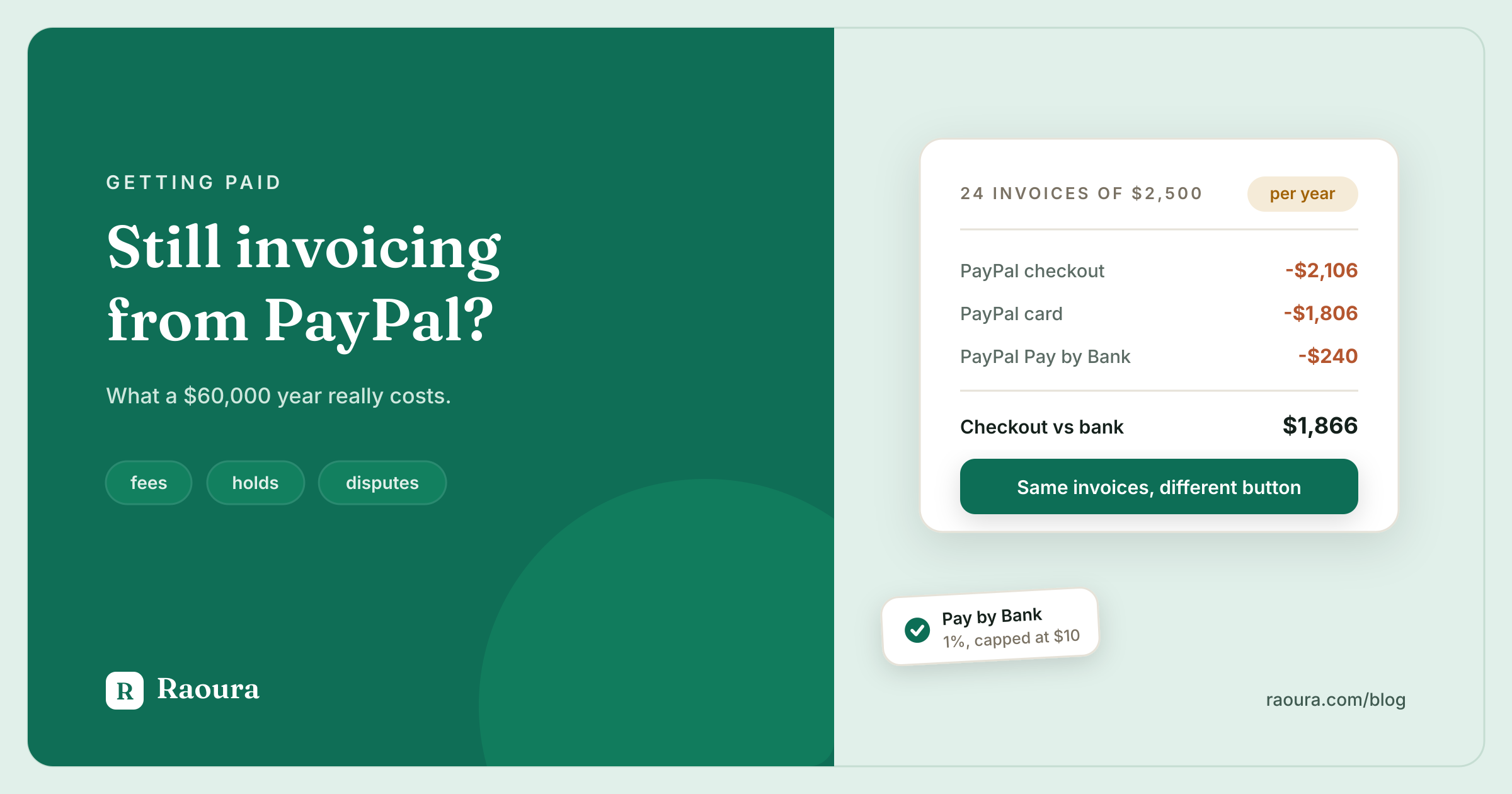
On $60,000 a year billed as 24 invoices of $2,500, PayPal invoicing costs you $2,106 if every client pays through PayPal checkout, $1,806 if they pay by card, and $240 if they pay with PayPal's Pay by Bank option.
Same tool, same invoices, a spread of $1,866 a year. What decides it is the payment method your client picks on the invoice page, and on most freelance invoices you are not the one choosing.
The fees are only half the bill. PayPal can hold a payment for up to 21 days, it keeps its fee when you refund a client, and its Seller Protection program does not cover the dispute service businesses get most: "the work was not what I agreed to."
What PayPal invoicing actually charges in 2026#
PayPal charges nothing to send an invoice and takes 2.99% to 4.99% plus $0.49 when it is paid, except bank payments, which cost 1% capped at $10.
PayPal's help center says invoicing "has no set up or monthly fees." The cost lands when the client pays, and the US merchant fee schedule lists a separate rate for each way they can pay an invoice.
| How your client pays the invoice | PayPal's invoicing rate | Fee on a $2,500 invoice |
|---|---|---|
| PayPal checkout, Venmo, or PayPal guest checkout | 3.49% + $0.49 | $87.74 |
| Credit or debit card, Apple Pay, other wallets | 2.99% + $0.49 | $75.24 |
| PayPal Pay Later | 4.99% + $0.49 | $125.24 |
| Pay by Bank (ACH) | 1%, capped at $10 | $10.00 |
| Any of the above from an international client | add 1.5% | add $37.50 |
A few other lines on the same schedule matter to freelancers:
- The paid invoicing tier. PayPal lists an "Invoicing Subscription" at $14.99 per month. You do not need it to send invoices, but if you signed up for it, add $179.88 a year to everything below.
- Dispute fees. $15 per dispute on the standard tier, $30 if your dispute rate puts you in the high-volume tier, and a $20 chargeback fee on card payments that did not run through a PayPal account or guest checkout.
- Currency conversion. A 3% spread on most conversions of money you receive, so a client paying in euros costs you more than the 1.5% international fee alone.
- Instant transfers. 1.5% of the amount if you want the money in your bank right away instead of waiting for a free standard transfer.
The Pay by Bank cap is the most useful number on that schedule. PayPal's 1% rate reaches the $10 ceiling at $1,000, so every bank-paid invoice above $1,000 costs a flat $10 no matter how large it is.
What it costs over a year#
At $60,000 a year, PayPal checkout fees cost almost 9 times as much as Pay by Bank fees: $2,105.76 against $240.
Here is the same work at three income levels, assuming invoices of $2,500. The two Stripe columns use Stripe's published rates for a comparison: 2.9% + $0.30 for domestic cards and 0.8% capped at $5 for ACH bank debits.
| Billed per year | PayPal checkout | PayPal card | PayPal Pay by Bank | Stripe card | Stripe ACH |
|---|---|---|---|---|---|
| $30,000 (12 invoices) | $1,052.88 | $902.88 | $120.00 | $873.60 | $60.00 |
| $60,000 (24 invoices) | $2,105.76 | $1,805.76 | $240.00 | $1,747.20 | $120.00 |
| $120,000 (48 invoices) | $4,211.52 | $3,611.52 | $480.00 | $3,494.40 | $240.00 |
Look across the $60,000 row and the honest conclusion is not "PayPal is expensive." PayPal checkout is expensive. If every client already pays you by card, moving the same clients to Stripe cards saves you $58.56 a year, which is not worth the hassle of switching on its own.
The money is in the bank rails. Getting clients from PayPal checkout to any bank payment saves you $1,865.76 to $1,985.76 a year at $60,000, depending on whose bank rail it is.
Invoice size changes the picture, too. Small invoices are where the $0.49 fixed fee bites, and big invoices are where the caps pay off.
| Invoice amount | PayPal checkout | PayPal card | PayPal Pay by Bank | Stripe card | Stripe ACH |
|---|---|---|---|---|---|
| $400 | $14.45 | $12.45 | $4.00 | $11.90 | $3.20 |
| $2,500 | $87.74 | $75.24 | $10.00 | $72.80 | $5.00 |
| $5,000 | $174.99 | $149.99 | $10.00 | $145.30 | $5.00 |
On a $5,000 invoice, a client who clicks the PayPal button instead of paying by bank costs you $164.99. That is the cost of one default.
How to cut your PayPal bill without leaving#
The single biggest saving is getting clients onto Pay by Bank, which turns a $2,500 invoice from $87.74 in fees into $10.
You do not control which button a client clicks, but you can make the cheap one the obvious one. Here is the order that works:
- Put it in the contract. Your payment terms can say that bank payment is the preferred method for invoices over a set amount. A signed term is easier to point back to than a polite request buried in an email.
- Say it on the invoice. Add one line to the invoice note: "Paying by bank keeps fees off this invoice; card and PayPal are also accepted." Short, not pushy, and the client sees it at the moment of payment.
- Ask once, at kickoff. Business clients often pay vendors by bank already. The question "do you pay vendors by ACH?" during onboarding settles it for the whole relationship. Our card vs ACH vs wire comparison covers the speed and risk trade-offs if a client pushes back.
- Cancel the subscription you are not using. If you are paying $14.99 a month for the invoicing tier and only use basic invoices, that is $179.88 a year for templates and branding.
- Never accept Friends and Family. It looks free, but PayPal's User Agreement prohibits personal payments for goods or services, and those payments carry no protection for either side.
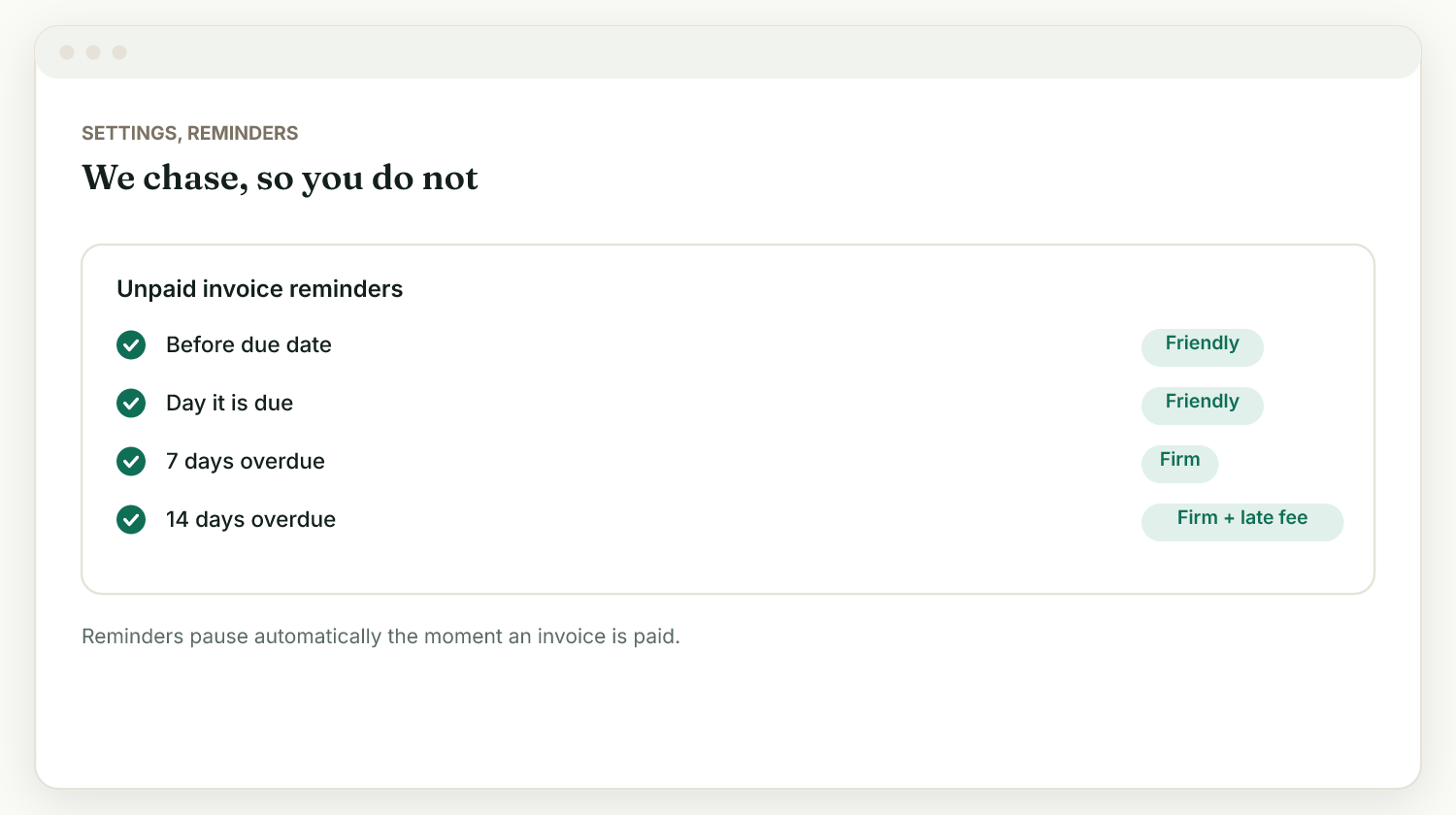
One thing PayPal gets right that some competitors misstate: PayPal invoicing does have automatic reminders. Its help center says you can schedule reminders for new invoices and for overdue ones, and you can accept partial payments with a minimum amount. If reminders are your only complaint, check your invoicing settings before you switch anything.
The costs that are not on the fee page#
PayPal's User Agreement says risk-based holds generally last up to 21 days, and disputed payments can be held until the matter is resolved, up to 180 days.
This is where freelancers on PayPal get hurt, and none of it shows up in a fee calculator.
Holds#
Under the User Agreement, PayPal can hold a payment based on risk, and those holds "generally remain in place for up to 21 days." It can also limit an account and hold the balance for up to 180 days, and place a reserve on a business account, giving the example of 10% held on a 90-day rolling basis.
For a solo business, a 21-day hold on a $2,500 invoice is three weeks of rent sitting in someone else's account. The agreement also says these decisions "may be based on confidential criteria," so you may never learn exactly what triggered one.
Refunds#
PayPal's fee schedule says there is no fee to make a refund, "but the fees you originally paid to receive the payment are not returned to you." Refund a $2,500 invoice a client paid through PayPal checkout and you are out $87.74 for a sale that did not happen.
Disputes on service work#
PayPal Seller Protection covers only two claim types, Unauthorized Transaction and Item Not Received, and it explicitly excludes "Significantly Not as Described" claims.
That exclusion matters more to freelancers than any rate on the fee page. When a client disputes a design, a website, or a month of consulting, the claim is almost never "I did not receive it." It is "this is not what I paid for," which is exactly the claim PayPal's Seller Protection policy says it does not cover.
So your real protection on PayPal is the same as anywhere else: a signed scope, written approval of deliverables, and an invoice that points back to both. PayPal invoicing does not connect to your proposal or contract, which means you are assembling that evidence by hand from email threads when a dispute lands. Our guide to handling a client who disputes an invoice covers what to gather.
Should you stay on PayPal?#
Stay on PayPal if your clients are individuals who already pay with it and you can steer the larger invoices to Pay by Bank; consider switching if you invoice businesses, bill over $1,000 per invoice, or have been hit by a hold.
PayPal's brand is a real advantage with consumer clients. A familiar button gets small invoices paid without a second email, and for a $400 job the fee difference between PayPal card and Stripe card is 55 cents.
Here is how the decision tends to split:
| Your situation | What we would do |
|---|---|
| Consumer clients, small invoices | Stay on PayPal, turn on reminders, push Pay by Bank for anything over $1,000 |
| Business clients, invoices over $1,000 | Move to a processor where bank payment is an equal option, such as Stripe ACH |
| You have had a hold or limitation | Do not keep all your income on one rail; add a second processor now, not after the next hold |
| Lots of revision-heavy or subjective work | Fix the paperwork first: signed scope and approvals, since no processor covers "not as described" |
| International clients | Run the numbers in our international invoicing guide before choosing, since PayPal adds 1.5% plus a conversion spread |
We compared both processors fee by fee in Stripe vs PayPal for freelancers. The short version: Stripe is cheaper on cards by a little and on bank payments by $5 per large invoice, and both still charge processing fees.
If you move off PayPal, move the paperwork too#
Switching processors saves you at most a few dollars per card payment; the bigger win is putting proposals, contracts, invoices, and reminders in one place so disputes and late payments have a paper trail.
The processor is the small part of getting paid. The part that costs you sleep is the invoice nobody chased and the dispute where you cannot find the email where the client approved the work.
(Disclosure: this is our product. Raoura is client management for solo freelancers at a flat $17 a month. Invoices run on your own Stripe account through Stripe Connect, so you pay Stripe's published rates, 2.9% + $0.30 for cards and 0.8% capped at $5 for ACH, with no markup and no commission. Stripe still charges those processing fees, and Raoura does not hold your money, offer escrow, or guarantee payment.)
What it does is the layer PayPal invoicing leaves to you. The proposal, the signed contract, and the invoice live on one client record, and reminders run on a schedule you set.
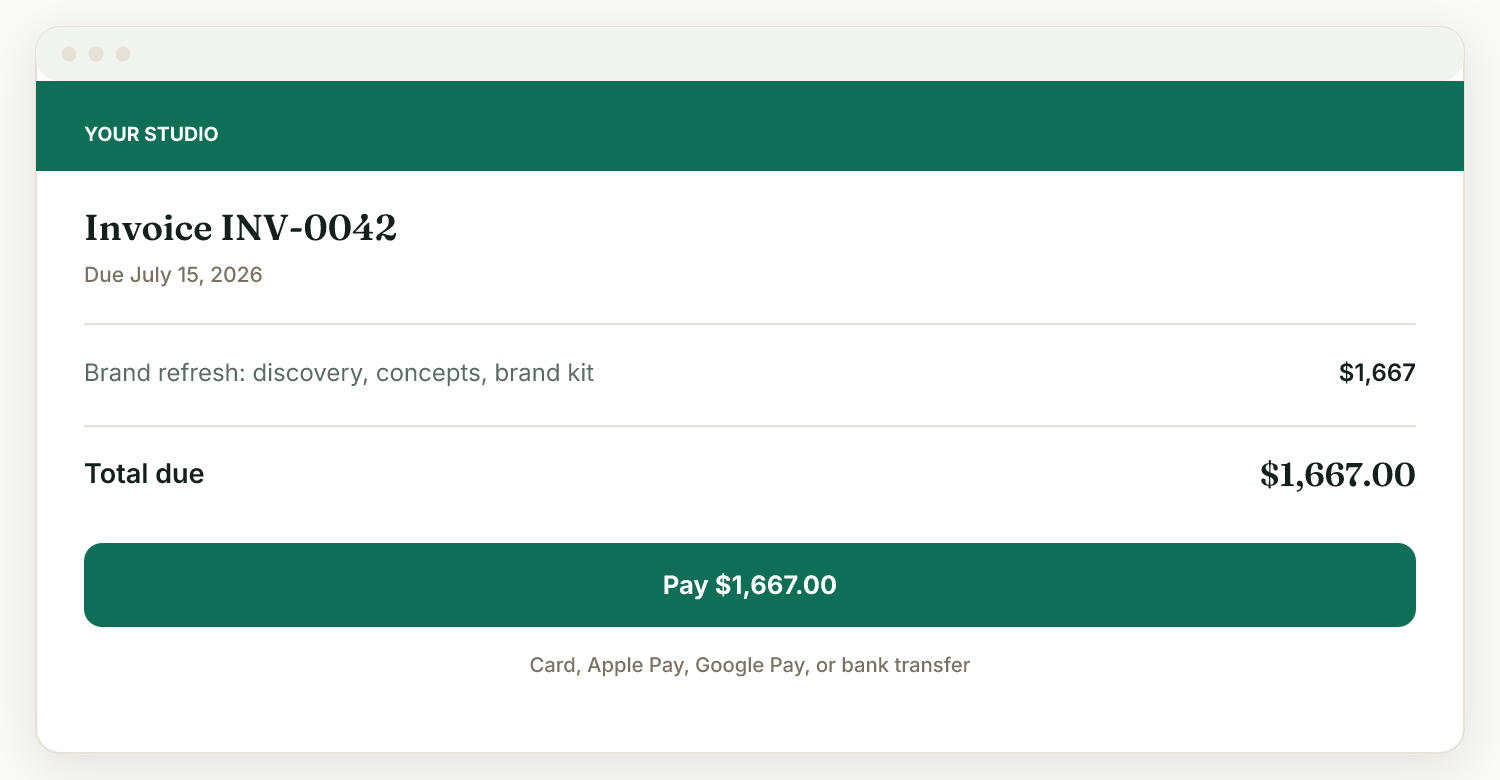
Your client gets a payment page that can offer card and bank payment side by side (whichever methods you enable in Stripe), so the cheap rail sits right next to the card option.
Be clear-eyed about the math, though. Raoura costs $204 a year. If all your clients pay by card and will never pay by bank, the fee savings over PayPal card alone will not cover that, and the reason to switch is the workflow, not the rates.
Verified October 2026 against PayPal's US merchant fee schedule (last updated October 1, 2026), PayPal's User Agreement (last updated September 14, 2026), PayPal's Seller Protection policy (last updated January 26, 2026), PayPal's invoicing help center, Stripe's pricing page, and the IRS newsroom. The annual and per-invoice totals are our own calculations from those published rates. PayPal changed its fee schedule more than once in 2026, so the linked pages win if they disagree with this article.
Frequently asked questions
Is PayPal invoicing free?
Sending invoices is free, and PayPal says invoicing has no setup or monthly fees. You pay when the invoice is paid: 3.49% + $0.49 for PayPal or Venmo, 2.99% + $0.49 for cards, 4.99% + $0.49 for Pay Later, or 1% capped at $10 for Pay by Bank. An optional invoicing subscription costs $14.99 a month.
How much does PayPal take from a $2,000 invoice?
$70.29 if the client pays through PayPal checkout, $60.29 by card, $100.29 with Pay Later, and $10 by Pay by Bank. Add 1.5% ($30) if the client is outside the US.
Who pays the PayPal invoice fee, me or the client?
You do. The fee comes out of the payment before it reaches your balance. Adding a surcharge to pass card fees to clients is restricted in some states, so read our guide to cash discounts and surcharges before you try it.
Does PayPal invoicing send automatic reminders?
Yes. PayPal's help center says you can set automatic reminders for new invoices and schedule reminders for overdue ones. Manual reminders are limited to two per invoice within 24 hours.
Does PayPal Seller Protection cover freelance services?
Only narrowly. Seller Protection covers Unauthorized Transaction and Item Not Received claims, with extra evidence requirements for intangible goods, and it excludes Significantly Not as Described claims. A client saying the work was not what they agreed to is not covered.
How long can PayPal hold my invoice payment?
PayPal's User Agreement says risk-based holds generally last up to 21 days. A disputed payment can be held until the dispute is resolved, up to 180 days, and account limitations can hold a balance for 180 days or, in some cases, longer.
Will PayPal send me a 1099-K?
Only above the reporting threshold, which the IRS says reverted to more than $20,000 and more than 200 transactions. Your freelance income is taxable either way, so keep your own invoice records as the source of truth.
Do I get my PayPal fee back if I refund a client?
No. PayPal's fee schedule says refunds cost nothing to send, but the fees you paid to receive the original payment are not returned.
Run your client work in one place
Send a proposal, get it signed, invoice, and get paid, with a branded portal your clients will actually use. One flat plan at $17/month, and we never take a cut of your payments.
Try Raoura free for 14 daysNo credit card required. Set up in minutes.
Keep reading
Raoura vs Hello Bonsai (2026): One Flat Plan vs Four Per-Seat Tiers, Now Under Zoom
Bonsai's useful plan costs $228 a year plus a 1% fee if you keep your own Stripe. Raoura is $204 flat, with retainers, time tracking and expenses on the one plan. Where each wins, with every price checked against the vendor pages.
Is Upwork Worth It in 2026? A Break-Even Test for Your Situation
Upwork is worth it when its fee costs less than finding the client yourself, and that is true far more often for a first project than for a repeat client. Here is the break-even math with 2026 numbers: the 0 to 15% fee, Connects, the shrinking client base, and when to wait out the 24-month rule instead of paying to leave.
The Virtual Assistant Contract: 24 Clauses, Scored Against Every Template Ranking for This Search
We scored the four pages that publish actual virtual assistant contract text against 24 clauses a VA agreement needs. Twenty-four of 96 possible slots were filled. The best single template managed 7 out of 24. Twelve clauses appear in none of them, including every clause about the thing that makes VA work different from other freelance work: you are holding your client's passwords and running their inbox. One popular template also tells you a contract fixes your independent contractor status, then mandates client-set 9 to 5 weekday hours in the same document. Here is the clause-by-clause version, with the classification test the DOL is actually applying in 2026, the data protection terms nobody drafts, and the retainer mechanics that decide whether unused hours roll over.