Late Fee and Deposit Clauses That Hold Up (Exact Wording)
August 30, 2026
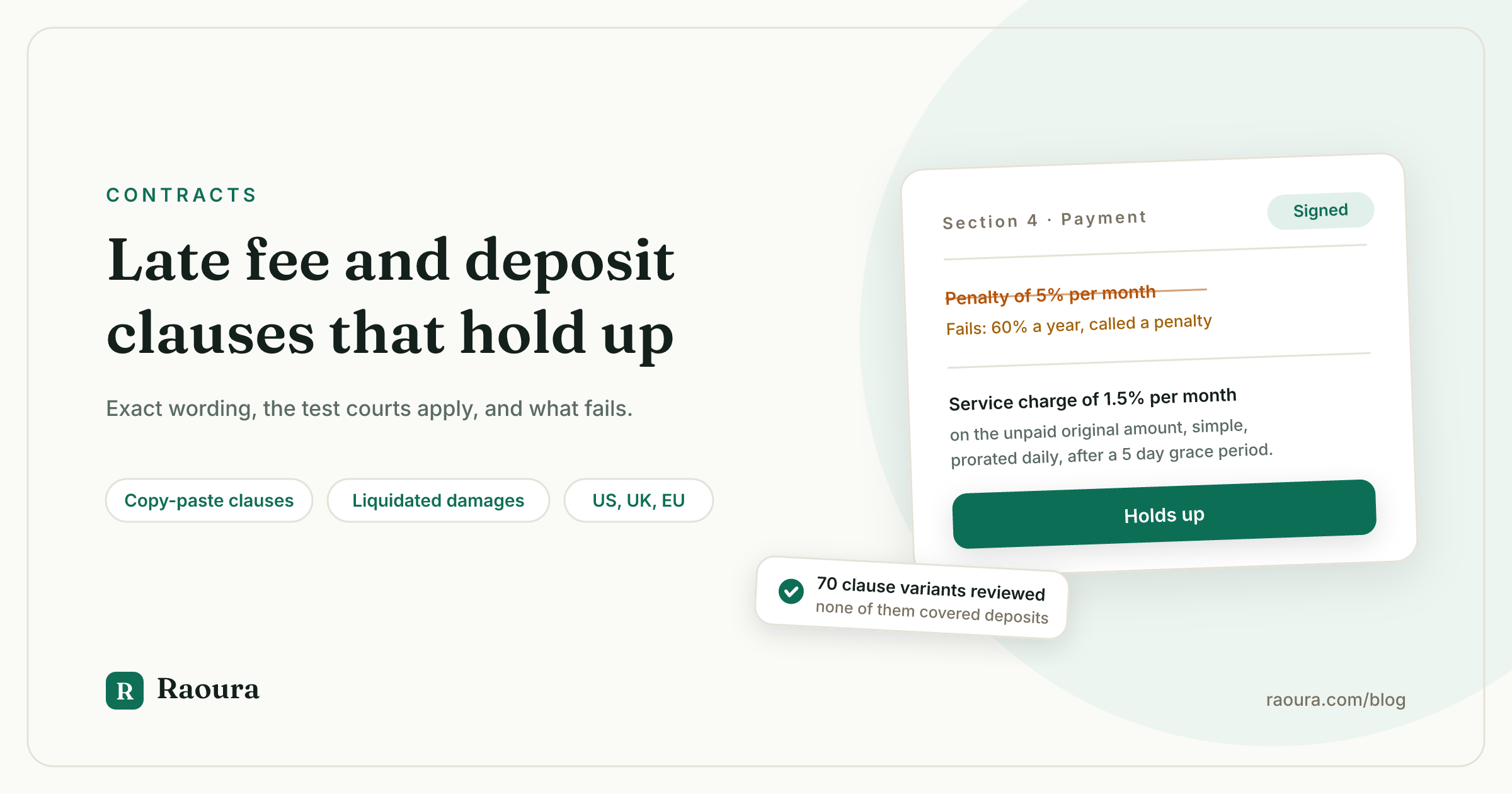
There is no shortage of late fee wording on the internet. There is a shortage of wording that survives contact with a client who decides not to pay it.
We read the five pages that rank for this search and counted roughly seventy clause variants between them. Not one of those variants covered deposits. Not one named the legal test a court actually applies. One of the biggest clause libraries labels its own samples "penalty clauses," which in US contract law is close to the fastest way to make a charge unenforceable.
So this is the clause library with the reasoning attached. For each clause you get the wording that fails, the wording that holds, and why the difference matters. Every legal reference below is a statute, a code section, or a government page, linked inline and checked in July 2026.
If you are still deciding on the numbers rather than the wording, start with how much a freelance late fee should be and how much deposit to charge. This article assumes you have picked your numbers and now need language that survives.
This is not legal advice, and a lawyer in your state is worth an hour of their rate before you rely on anything important.
The distinction that decides whether your clause survives#
A flat late fee and a running monthly percentage are judged under two completely different bodies of law, and no page ranking for this search says so.
A flat charge (say $50 once an invoice passes its due date) is a liquidated damages term. Courts ask whether it is a reasonable pre-estimate of what the delay actually costs you.
A running percentage on an overdue balance (1.5% per month until paid) looks much more like interest on a forbearance. That pulls it toward your state's usury statute, which has an actual number in it.
The same clause can therefore fail two different ways, and the fix for one is not the fix for the other.
| What you charge | Legal test that applies | How it fails | The guardrail |
|---|---|---|---|
| Flat fee once overdue | Liquidated damages (Restatement of Contracts Section 356) | Too large relative to the invoice, so a court calls it a penalty and voids it | Keep it proportionate to the invoice and to your real cost of chasing |
| Monthly percentage on the balance | Usury statutes on interest and forbearance | Rate exceeds the state ceiling | Stay at or under 1.5% per month (18% per year) |
| Flat fee, then percentage | Both, separately | Either half can fail on its own | Each half has to clear its own test |
| Deposit retained on cancellation | Liquidated damages, again | A bare "non-refundable" label with no tie to your loss | Tie retention to a schedule, not to a word |
The controlling sentence for the liquidated damages half comes from Restatement (Second) of Contracts Section 356, as quoted by Cornell's Legal Information Institute: damages may be liquidated in the agreement "but only at an amount that is reasonable in the light of the anticipated or actual loss caused by the breach and the difficulties of proof of loss." A term fixing unreasonably large liquidated damages "is unenforceable on grounds of public policy as a penalty."
UCC Section 2-718(1) says nearly the same thing with a third factor added. Article 2 governs goods, so it does not bind your design contract directly, but courts reach for it as persuasive authority all the time.
The practical translation is two sentences long. Your charge has to look like a forecast of your loss. The moment it looks like a punishment, you lose it.
The late fee clause, wrong and right#
A late fee clause holds up when it was agreed before the work started, is proportionate to the invoice, and states a rate you can defend as commercial rather than punitive.
Here is the version that fails.
Late payments will incur a penalty of 5% of the invoice total per month, compounded monthly, plus a $100 administrative penalty. All penalties are non-refundable under any circumstances.
Four separate problems. It calls itself a penalty twice, which invites the exact analysis you want to avoid. It compounds. It stacks a flat charge that would dwarf a small invoice. And 5% per month is 60% per year, a rate you cannot point at any benchmark to justify.
Here is the version that holds.
Late payment. Invoices are due within [14] days of the invoice date. If an invoice remains unpaid [5] days after its due date, a service charge of [1.5]% per month accrues on the unpaid original invoice amount, calculated as simple interest and prorated daily, until the balance is paid in full. This charge compensates the Contractor for the cost and delay of collection and is not a penalty. Where this rate exceeds the maximum permitted by applicable law, the rate shall be reduced to that maximum.
Six things are doing work in that paragraph:
- A due date. A fee with no stated due date has nothing to accrue from, which is why your payment terms and your late fee clause have to be written together.
- A grace period. Five days is the convention. It makes the clause read as a policy rather than a trap, and it costs you about $5 on a $2,000 invoice.
- "On the unpaid original invoice amount." This is what stops compounding. Simple interest is easier to defend, easier to explain, and the dollar difference at freelance invoice sizes is trivial.
- The word "compensates," and an explicit "is not a penalty." Courts are not fooled by labels, but labels frame the reading, and the ranking clause libraries hand you the wrong one.
- Prorated daily. Without it you are arguing about whether day 31 triggers a whole second month.
- The savings clause at the end. If your rate turns out to exceed a local ceiling, this sentence caps it instead of voiding it.
If your invoices are small, swap the percentage for a flat charge, because 1.5% of $400 is six dollars and deters nobody.
Late payment (flat). If an invoice remains unpaid [5] days after its due date, a one-time late charge of $[25] is added to the balance. This charge reflects the Contractor's administrative cost of collection and is not a penalty.
Do not run both a flat charge and a percentage unless the invoice is large enough that both look reasonable side by side. On a $12,000 project, $25 plus 1.5% per month is unremarkable. On a $400 invoice, the same pair looks like a shakedown.
The numbers you can actually put in the blank#
Three states have statute text worth quoting, and the commonly cited blog tables get all three wrong. These were read this month.
| State | The real number | Statute |
|---|---|---|
| Texas | 10% per year is the general ceiling on contractual interest. The 6% figure repeated in blog tables is the rate you may charge when there was **no** interest agreement, running from the 30th day after the amount is due | [Tex. Fin. Code Section 302.001, 302.002](https://statutes.capitol.texas.gov/Docs/FI/htm/FI.302.htm) |
| Florida | 18% per year (1.5% per month) is the ceiling, and the exception is transaction size above $500,000, not paperwork. Separately, a merchant may charge a one-time delinquency charge of up to 5% of a defaulted installment, and the statute says that charge is **not** interest | [Fla. Stat. Section 687.03](https://www.leg.state.fl.us/Statutes/index.cfm?App_mode=Display_Statute&URL=0600-0699%2F0687%2FSections%2F0687.03.html) |
| New York | The general rate is set under Banking Law Section 14-a. The two facts nobody mentions: usury caps drop away entirely for forbearances of $250,000 or more, and corporations are barred from raising the usury defense at all | [N.Y. Gen. Oblig. Law Section 5-501](https://www.nysenate.gov/legislation/laws/GOB/5-501), [Section 5-521](https://www.nysenate.gov/legislation/laws/GOB/A5T5) |
Two honest caveats. Every statute above regulates interest on a "loan or forbearance," and whether a late charge on an overdue services invoice counts as that is jurisdiction-specific. And the Florida and Texas carve-outs for capped delinquency charges are legislatures deliberately saying a modest flat charge is not interest, which is exactly the distinction the top of this article is built on.
For a benchmark rather than a ceiling, look at what the US federal government pays itself when it pays a vendor late. The Treasury's Prompt Payment interest rate for July through December 2026 is 4.75% per year.
That is the number to keep in mind when you decide how far to push. At 18% per year you are roughly four times the federal rate, which is defensible as a genuine commercial charge on a small unsecured balance. At 60% per year you are twelve times it, with nothing to point at.
The deposit clause, wrong and right#
A deposit survives on one of two theories, and "non-refundable" is not one of them.
Either the deposit is payment for value you already delivered (holding the dates, onboarding, discovery, capacity you turned other work away to reserve), in which case it is simply earned revenue and no damages question arises. Or it is money you keep because the client breached, in which case it is liquidated damages and has to clear the same reasonableness test as your late fee.
A flat "non-refundable in all circumstances" label makes no argument for either theory. It just asserts a forfeiture.
Here is how weak a bare forfeiture is. Under UCC Section 2-718(2), when there is no valid liquidated damages term, a buyer in breach still gets back everything they paid above the lesser of 20% of the contract value or $500. On a $6,000 contract, that default lets the seller keep $500, not the $1,500 deposit.
Article 2 covers goods, not your services contract, so this does not bind you. It tells you which way courts lean when a contract says "we keep it" and nothing more.
The version that fails:
A 50% deposit is required. The deposit is non-refundable under all circumstances.
The version that holds:
Deposit. A deposit of [25]% of the total project fee is due before work begins. The deposit reserves the Contractor's availability for the scheduled project window and covers project setup, research, and planning, which begin on receipt.
If the Client cancels the project, the Contractor will retain the following portion of the deposit as compensation for the reserved availability and work already performed:
- more than [30] days before the scheduled start date: [25]% of the deposit
- [15] to [30] days before the scheduled start date: [50]% of the deposit
- fewer than [15] days before the scheduled start date, or at any time after work has begun: [100]% of the deposit
The parties agree these amounts are a reasonable estimate of the Contractor's losses from cancellation, which would be difficult to calculate precisely, and are not a penalty.
The tiered schedule is the entire trick. It converts a forfeiture into a forecast.
Late cancellation costs you more than early cancellation, because by then you have turned down other work and cannot refill the slot. A schedule that rises as the start date approaches maps the money you keep onto the loss you actually suffer, which is precisely what the Section 356 test asks for. A flat "non-refundable" does not even attempt the argument.
Worked on a $6,000 project with a 25% deposit, that deposit is $1,500. Cancellation more than 30 days out costs the client $375 and refunds $1,125. Inside 15 days, or once you have started, you keep the full $1,500.
Two details worth stealing. Say what the deposit buys (reserved availability, setup work that starts on receipt), because that is the first theory and it does not depend on breach at all. And include the closing sentence about reasonable estimate and difficulty of calculation, because it is the language of the test itself.
If the client pushes back on the deposit itself rather than the wording, that is a separate conversation and we have the scripts for it.
One jurisdiction note that cuts your way if you work in California. Cal. Civ. Code Section 1671(b) makes a liquidated damages provision in a non-consumer contract valid unless the party attacking it proves it was unreasonable when the contract was made. The burden sits with the client, not with you.
Where these clauses have to live#
A clause in a signed contract that never appears on the invoice does about half its job.
Enforceability turns on the client having agreed before the obligation arose, which is what the contract achieves. Getting paid turns on the client seeing the consequence at the moment they are deciding whether to pay, which is what the invoice achieves. You need both surfaces.
- In the signed contract, as its own numbered section, with the deposit clause next to it. If you are building the agreement from scratch, both clauses slot into the structure in what should be in a freelance contract, and there is a full annotated contract template you can lift them into.
- On every invoice, one line under the total: "Due [date]. Balances unpaid 5 days after the due date accrue 1.5% per month, per Section [4] of our agreement."
- In the reminder that goes out when the invoice ages, restating the clause rather than introducing it.
That third one is where most freelancers quietly give up, because sending the fourth reminder about a $900 invoice feels worse than eating the delay. Automating it removes the decision.
Disclosure: Raoura is our product. It is client and project management for solo freelancers at one flat $17 per month, and the reason it belongs in this article is that these three surfaces are the same system: the contract you send for signature, the invoice generated from it, and the reminders that go out on their own afterward.

Contract templates ship with the clause sections already numbered, so the late fee and deposit terms have a section number your invoices can point back to.

The reminder ladder runs without you, which is the only reliable way a late fee clause gets enforced by a one-person business.
The clause wording above works the same in any tool, or in a Google Doc. What matters is that all three surfaces say the same thing.
Clients outside the US: your clause may be costing you money#
In the UK, a freelancer who writes "1.5% per month" into a contract has just traded away a statutory entitlement worth 11.75% per year as of July 2026.
UK business-to-business late payment carries statutory interest automatically: 8 percentage points over the Bank of England base rate. The Bank Rate was held at 3.75% at the June 2026 meeting, so statutory interest is 3.75 plus 8, or 11.75%.
On top of that you can claim fixed compensation per invoice under Section 5A of the Act, plus any reasonable recovery costs above the fixed sum.
And here is the trap, straight from GOV.UK: "You cannot claim statutory interest if there's a different rate of interest in a contract."
| Jurisdiction | Statutory interest | Fixed compensation per invoice | Default payment term |
|---|---|---|---|
| UK | 8 points over BoE base rate, so 11.75% per year in July 2026 | £40 under £1,000, £70 from £1,000 to £10,000, £100 at £10,000 and above | 30 days from invoice or delivery, absent agreement |
| EU | At least 8 points over the reference rate, fixed each 1 January and 1 July | €40 minimum, plus reasonable costs above it | 30 days absent agreement; contractual B2B terms capped at 60 days unless expressly agreed and not grossly unfair |
The EU figures come from Directive 2011/7/EU, Articles 2, 3, 4 and 6. A term that excludes late payment interest is treated as grossly unfair under Article 7.
Note the status question, because secondary sources get it wrong. A 2023 proposal would have replaced the Directive with a Regulation and raised recovery compensation to between €50 and €150. Parliament adopted its position in April 2024, but the file is listed as blocked in Council on the European Parliament's own legislative tracker as of May 2026. It is stalled, not withdrawn, and the 2011 Directive is still the operative law.
So the clause for UK and EU clients looks different on purpose:
Late payment (UK and EU clients). Invoices are due within [30] days. Overdue balances accrue statutory interest and fixed compensation at the rates provided by applicable law, and the Client shall also pay the Contractor's reasonable costs of recovery.
That wording claims the statutory entitlement instead of replacing it with a lower number of your own.
What no clause can do for you#
In four US jurisdictions, the law already gives you a bigger stick than any late fee clause: double damages plus attorney's fees.
None of these statutes sets an interest rate, which is why they never show up in late fee articles. What they do is stronger.
- New York State. Under GBL Section 1414, a freelancer who prevails on a timely payment claim gets double damages, plus reasonable attorney's fees and costs. Missing written contract carries $250 statutory damages. Complaints go to the Attorney General. The limitations period is six years for payment claims.
- New York City. The Freelance Isn't Free Act has been live since 2017 and is actively enforced. DCWP announced a $528,817 settlement in February 2026 over systematic late payment to freelancers.
- Illinois. Under 820 ILCS 193/30, double the underpayment plus costs and reasonable attorney's fees, with a two-year window.
- California. SB 988 gives damages up to twice the unpaid amount, $1,000 for refusing a requested written contract, plus fees and costs. Payment is due within 30 days of completion if the contract is silent. The statute cannot be waived by contract.
The attorney's fees provision is the part that matters most. It is what makes a demand letter self-enforcing, because a client who does the math realises that fighting a $4,000 invoice can cost them $8,000 plus your lawyer.
Your clause and these statutes are complementary. The clause covers you everywhere. The statutes cover you better in four places, and they do not depend on your wording at all. For the full jurisdiction-by-jurisdiction picture, see freelance payment laws by state.
One thing we could not verify, and will not pretend to#
Three of the five pages ranking for this term assert that late fees change client payment behaviour. We went looking for the study behind that claim and could not find one.
There is no reliable public data on what rate freelancers actually charge, and none establishing that a late fee measurably speeds up payment. The vendor claims we checked trace back to marketing pages, not research.
The honest case for a late fee clause is narrower and still good enough: it is the only consequence you control entirely, it costs nothing to include, and it converts an awkward conversation into a term the client already agreed to.
Do not expect it to be income. On a $2,000 invoice paid two weeks late, 1.5% per month prorated daily earns you about $14.
Frequently asked questions
Can I add a late fee to an invoice that is already overdue?
No. The charge has to be agreed before the obligation arises. Texas is a partial exception, where Section 302.002 gives you 6% per year from the 30th day after the amount is due even with no agreement, but everywhere else a retroactive fee is unenforceable.
Is "non-refundable" enough to protect a deposit?
On its own, no. It asserts a forfeiture without making an argument for it. Say what the deposit buys, tie retention to a cancellation schedule, and add the sentence about reasonable estimate and difficulty of calculation.
What is the highest late fee I can safely charge?
1.5% per month (18% per year) is the norm and sits inside every ceiling we could verify. 2% per month is defensible in most places. Above that you are relying on a client never contesting it.
Should the late fee compound?
No. Charge simple interest on the original invoice amount. Compounding is harder to defend and the extra dollars are negligible at freelance invoice sizes.
Do I need a different clause for UK clients?
Yes, and it should claim the statutory rate rather than set your own. Writing your own rate into a UK contract displaces the statutory 8 points over base rate, which in July 2026 means giving up 11.75% per year plus the fixed compensation.
Can I charge a late fee and a collection cost?
You can include both, but they should not overlap. A late fee compensates for the delay. A collection cost clause shifts the expense of chasing, and in New York, Illinois and California the statutes may already give you attorney's fees, which is better than any clause you write.
What if the client disputes the invoice?
Build in a dispute window: the client must raise any objection within a set number of days, and interest pauses on the disputed portion only while it is being resolved. A fee that keeps running on a genuinely contested amount is the kind of fact that makes a judge look harder at the whole clause.
Does the clause need to be on the invoice too?
Legally, no, if it is in the signed contract. Practically, yes. The contract is what makes the fee enforceable, and the invoice line is what makes the client act on it.
---
Every rate, statute, and legal reference in this article was verified in July 2026 against primary sources: the Texas Finance Code, the Florida Statutes, the New York General Obligations Law and General Business Law, California Civil Code Section 1671 and SB 988, 820 ILCS 193, UCC Sections 2-718(1) and 2-718(2), Restatement (Second) of Contracts Section 356 as quoted by Cornell LII, the Late Payment of Commercial Debts (Interest) Act 1998 with S.I. 2002/1675, EU Directive 2011/7/EU, the Bank of England June 2026 rate decision, and the US Treasury Prompt Payment rate for the second half of 2026.
Run your client work in one place
Send a proposal, get it signed, invoice, and get paid, with a branded portal your clients will actually use. One flat plan at $17/month, and we never take a cut of your payments.
Try Raoura free for 14 daysNo credit card required. Set up in minutes.
Keep reading
The Virtual Assistant Contract: 24 Clauses, Scored Against Every Template Ranking for This Search
We scored the four pages that publish actual virtual assistant contract text against 24 clauses a VA agreement needs. Twenty-four of 96 possible slots were filled. The best single template managed 7 out of 24. Twelve clauses appear in none of them, including every clause about the thing that makes VA work different from other freelance work: you are holding your client's passwords and running their inbox. One popular template also tells you a contract fixes your independent contractor status, then mandates client-set 9 to 5 weekday hours in the same document. Here is the clause-by-clause version, with the classification test the DOL is actually applying in 2026, the data protection terms nobody drafts, and the retainer mechanics that decide whether unused hours roll over.
Stripe vs PayPal for Freelancers: Every Fee Verified (2026)
Every page ranking for this comparison either prints in-person retail rates, contradicts itself, or skips the numbers freelancers actually pay. We read the current Stripe and PayPal pricing pages line by line, ran a $3,000 invoice through every rail, and found a $1,764 per year gap between the cheapest setup and the default one.
The Pause Clause: How to Stop Work When an Invoice Goes Overdue
Stopping work is the strongest move a freelancer has against a late-paying client, and the least understood. Here is the legal doctrine that lets you pause even without a clause, the exact clause to add so you never have to rely on doctrine again, the day-by-day timing, and the two emails that keep the pause professional. Verified against primary sources in July 2026.