Bonsai vs HoneyBook (2026): pricing, fees, and the two things no ranking page will tell you
August 30, 2026
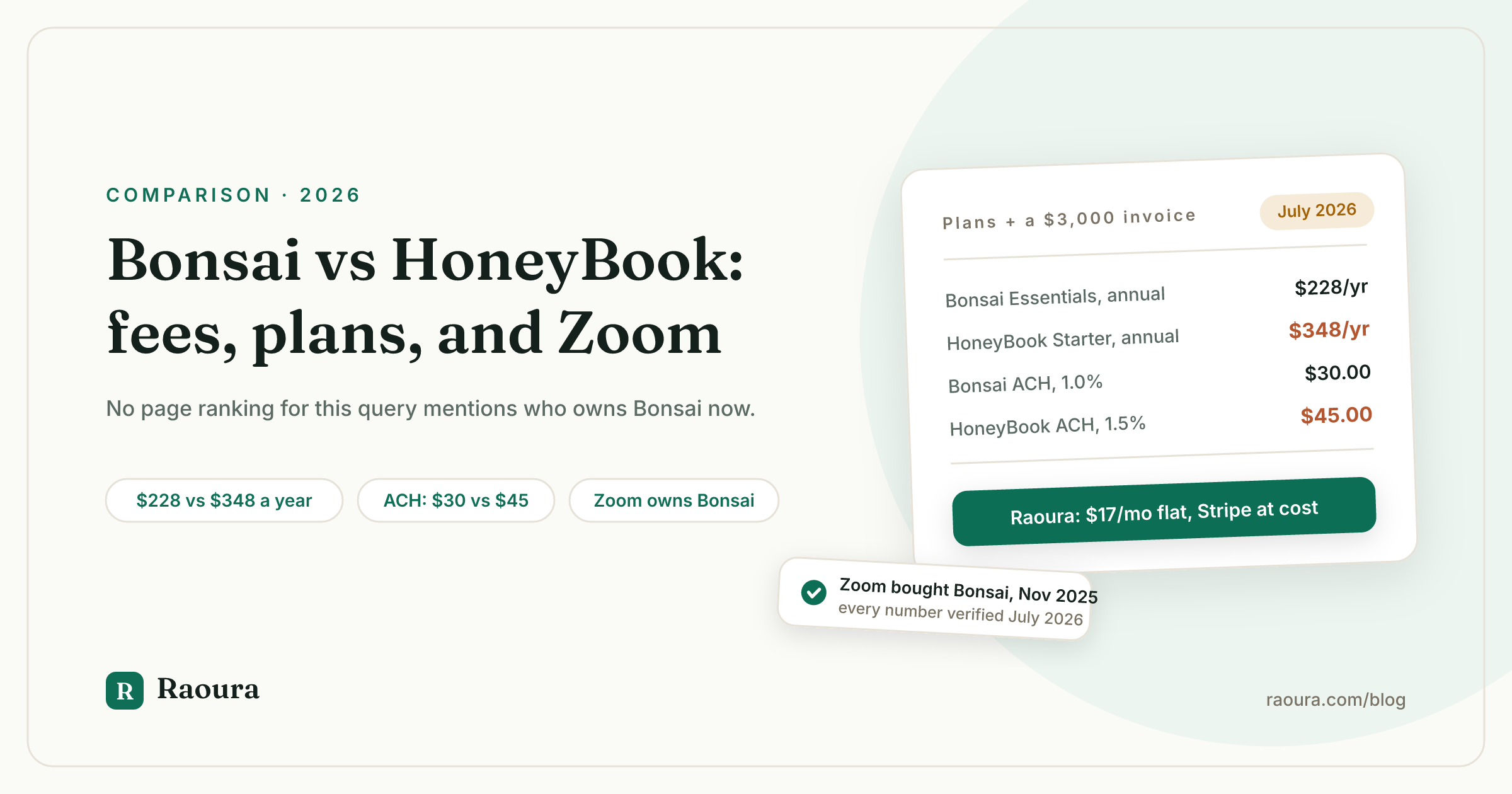
TL;DR: Bonsai costs $15 to $59 per user per month on monthly billing ($9 to $49 on annual), but its cheapest plan cannot send an invoice: invoicing, proposals, and contracts start on the $25 per month Essentials plan ($228 per year on annual billing). HoneyBook costs $36 to $129 per month ($348 to $1,308 per year on annual billing) and includes invoicing, contracts, a client portal, and AI on every plan. Both companies process your client payments themselves and profit from the fees: Bonsai charges 1.0% on bank transfers plus a 1% platform fee if you route around it with your own Stripe, and HoneyBook charges an uncapped 1.5% on bank transfers with no own-processor option at all. Two facts you will not find on any page currently ranking for this query: Zoom acquired Bonsai in November 2025, and HoneyBook raised prices up to 89% in February 2025 before expanding to the UK and Australia in May 2026. Disclosure: Raoura, our $17 per month flat-price tool, appears at the end of this comparison.
Search "Bonsai vs HoneyBook" and here is what actually ranks as of July 2026: HoneyBook's own comparison of Bonsai, which quotes Bonsai prices that do not match Bonsai's pricing page. A Plutio page stamped "all data verified in January 2026" that still lists HoneyBook's pre-February-2025 prices, off by up to 89%. A Zendo post from 2022 that describes plan lineups neither company has sold in years. And the freshest of them, from Taskip, which gets both pricing tables right and then calls HoneyBook "$39 per month" in its own intro.
Not one of those pages mentions that Zoom bought Bonsai. It was announced on November 5, 2025 and closed a month later, and it is arguably the single most important fact in this comparison, because you are not just picking features, you are picking which company holds your contracts, invoices, and payment history for the next several years.
So this article does the boring thing: every number below was checked against the vendors' own pricing and help pages in July 2026, with links. Where we could not verify something first-hand, we say so and leave it out of the tables.
Bonsai vs HoneyBook at a glance#
As of July 2026, the cheapest plan that can send an invoice costs $228 per year on Bonsai (Essentials, annual billing) and $348 per year on HoneyBook (Starter, annual billing).
| Bonsai | HoneyBook | |
|---|---|---|
| **Plans (annual billing, per month)** | Basic $9, Essentials $19, Premium $29, Elite $49, all per user | Starter $29, Essentials $49, Premium $109 |
| **Plans (monthly billing)** | Basic $15, Essentials $25, Premium $39, Elite $59, all per user | Starter $36, Essentials $59, Premium $129 |
| **Pricing model** | Per user; Elite has a 3-user minimum | Per plan; Essentials includes 2 members, Premium unlimited |
| **Invoicing on cheapest plan** | No; starts on Essentials | Yes |
| **Free trial** | 7 days, card required, no free plan | 30 days, no credit card, plus a 60-day money-back guarantee |
| **Payment processing** | Bonsai Payments (US, UK, Canada, Australia); own Stripe or PayPal allowed but with a 1% platform fee added | HoneyBook processes everything itself; you cannot connect your own processor |
| **Card fees** | 2.9% + 30c; Amex 3.25% + 30c | FAQ says from 2.7% + 10c; the plan table on the same page says from 2.9% + 25c |
| **ACH (bank transfer) fees** | 1.0%, $1 minimum, no cap | 1.5%, no cap |
| **Instant payout** | Additional 1.5% | 1% fee, pending eligibility |
| **AI features** | No AI plan features listed; promotes Bonsai MCP (connect Claude, ChatGPT, Gemini to your Bonsai data) | HoneyBook AI on every plan |
| **Client portal** | Essentials and up | Every plan |
| **Country availability** | Sold internationally; Bonsai Payments in US, UK, Canada, Australia | US, Canada, UK, Australia |
| **Last major price event** | None found this run | February 2025, up to +89% |
| **2025 to 2026 company news** | Acquired by Zoom (announced November 5, 2025, closed December 2025); blog frozen since March 2025 apart from the acquisition post | Launched in the UK and Australia (May 28, 2026) |
Sources: Bonsai pricing, Bonsai payment fees help article, Zoom acquisition announcement, HoneyBook pricing, HoneyBook plan change announcement, all fetched July 2026.
Pricing: per-seat tiers vs flat plans, and the invoicing catch#
Bonsai's headline $9 per month price cannot send an invoice; the plan a freelancer actually needs is Essentials at $228 per year, which is 35% less than HoneyBook's $348 per year Starter.
Here are the current plans, verified on both pricing pages this month:
| Plan | Monthly billing | Annual billing | Cost per year (annual) |
|---|---|---|---|
| Bonsai Basic | $15/mo per user | $9/mo per user | $108 |
| Bonsai Essentials | $25/mo per user | $19/mo per user | $228 |
| Bonsai Premium | $39/mo per user | $29/mo per user | $348 |
| Bonsai Elite | $59/mo per user | $49/mo per user | $588 (3-user minimum, so $1,764 in practice) |
| HoneyBook Starter | $36/mo | $29/mo | $348 |
| HoneyBook Essentials | $59/mo | $49/mo | $588 |
| HoneyBook Premium | $129/mo | $109/mo | $1,308 |
Three things the side-by-side hides.
- The invoicing catch. Bonsai Basic includes time tracking, tasks, unlimited clients and projects, and a CRM, but invoices and payments, proposals, contracts, forms, scheduling, and the client portal all start on Essentials, per Bonsai's pricing page. If you freelance, you invoice, so treat $228 per year as Bonsai's real entry price, not $108. HoneyBook Starter, by contrast, includes invoicing, proposals, contracts, a branded client portal, and HoneyBook AI at $348 per year.
- The pricing models diverge as you grow. Bonsai charges per user on every plan and its Elite tier has a 3-user minimum. HoneyBook charges per plan: Essentials includes 2 team members and Premium includes unlimited members. Solo today, that difference is academic; it stops being academic the first time you add a contractor seat.
- Price history. HoneyBook's current prices are the result of its February 4, 2025 increase, the company's first ever for existing members, which raised Starter by 89% (from $19 to $36 monthly), Essentials by 51%, and Premium by 63%, per HoneyBook's own announcement. We track that event and your options in our HoneyBook price increase guide. We found no comparable Bonsai increase this run, but Bonsai's pricing is now Zoom's decision to make, which is where the company news section below comes in.
A coincidence worth noticing: Bonsai Premium and HoneyBook Starter both cost exactly $348 per year on annual billing. One buys you Bonsai's integrations tier; the other buys you HoneyBook's entry plan.
Payment fees: both companies profit when you get paid#
On a $3,000 invoice paid by bank transfer, Bonsai's fee is $30, HoneyBook's is $45, and the same payment through your own Stripe account would cost $5, because Stripe caps ACH fees at $5 while both platforms charge uncapped percentages.
Neither ranking page does this math, and it is where the real money moves for anyone invoicing four figures.
Bonsai processes payments through Bonsai Payments in the US, UK, Canada, and Australia. Its fee schedule lists cards at 2.9% + 30c (Amex 3.25% + 30c), ACH at 1.0% with a $1 minimum, instant payouts at an additional 1.5%, and a 2.5% fee on international payments. Bonsai does let you connect your own Stripe or PayPal account, but where Bonsai Payments is available it adds "an additional 1% platform fee" for doing so. Read that twice: routing around Bonsai's processor through your own Stripe costs more than using Bonsai's processor, because the 1% platform fee stacks on top of Stripe's own charges.
HoneyBook does not offer the choice at all. Its help center states plainly that "you can't use PayPal, Venmo, Stripe, or other payment processors with HoneyBook." Cards run from 2.7% + 10c per the pricing page FAQ, or from 2.9% + 25c per the plan table on the same page (both figures are HoneyBook's own, published side by side). Bank transfers cost 1.5%, uncapped.
For scale, Stripe's standard US rates, which you pay when a tool passes payments through your own account at cost, are 2.9% + 30c on cards and 0.8% on ACH capped at $5.
Here is what that means at freelancer invoice sizes, paid by ACH:
| Invoice amount | Bonsai ACH fee (1.0%, $1 min) | HoneyBook ACH fee (1.5%, no cap) | Your own Stripe (0.8%, $5 cap) |
|---|---|---|---|
| $500 | $5.00 | $7.50 | $4.00 |
| $1,000 | $10.00 | $15.00 | $5.00 |
| $3,000 | $30.00 | $45.00 | $5.00 |
| $10,000 | $100.00 | $150.00 | $5.00 |
A freelancer collecting $60,000 per year over 20 bank-transfer payments hands Bonsai about $600 per year and HoneyBook about $900 per year in ACH fees. The same payments through a tool that passes your own Stripe account through at cost run about $100 per year. On cards the three are close to a wash, within a few tenths of a point. Why we think a client tool should never sit between you and your money is a longer argument we make in Why your client tool should never touch your money.
Features: what each plan actually gates#
Bonsai gates invoicing itself behind its second tier, while HoneyBook includes invoicing on every plan but gates its scheduler, automations, and QuickBooks sync behind the $59 per month Essentials plan.
Where Bonsai is ahead#
Breadth per dollar once you are on Essentials. At $228 per year you get invoicing and payments, proposals and contracts, Bonsai's full template library, forms, scheduling, a client portal, and expense and income tracking. Time tracking and task management are included from Basic up, which HoneyBook only matches with manual entry.
Premium adds a deals pipeline, Gantt views, client tasks and messaging, profit reports, branding removal, and the integrations most solos eventually want: QuickBooks, Zapier, Calendly, and Google. Storage scales from 10 GB on Basic to 500 GB on Premium. And Bonsai Payments' 1.0% ACH rate, while not at-cost, undercuts HoneyBook's 1.5% on every transfer.
Where HoneyBook is ahead#
Completeness at the entry price and polish everywhere. Starter includes unlimited clients and projects, invoices, proposals, contracts, a branded client portal, two lead forms, and HoneyBook AI, so a new freelancer is fully operational at $348 per year with nothing essential missing. The trial terms are the most generous in the category: 30 days with no credit card, plus a 60-day money-back guarantee, against Bonsai's 7 days with a card required.
HoneyBook AI (chat, drafted replies, an automations builder) ships on every plan; Bonsai's pricing page lists no comparable AI features, though it promotes Bonsai MCP, which lets you connect Claude, ChatGPT, or Gemini to your Bonsai data, a genuinely novel angle for the AI-curious. HoneyBook also now serves four countries after its May 2026 UK and Australia launch.
What both gate#
The middle tiers are where each company parks the features freelancers assume are standard. HoneyBook's scheduler, automations, SMS reminders, QuickBooks sync, and "remove Powered by HoneyBook" all sit on Essentials at $588 per year. Bonsai's integrations and branding removal sit on Premium at $348 per year. Budget for the tier you will actually need, not the one in the headline.
What neither vendor will tell you: Zoom and the 89%#
Since November 2025 Bonsai has been a Zoom company pivoting its marketing toward agencies, and since February 2025 HoneyBook's entry price has been 89% higher than the price most older comparison articles still quote.
Company trajectory matters as much as this month's feature grid, because switching costs are real: contracts, invoice history, and client records do not move themselves.
On the Bonsai side: Zoom announced the acquisition on November 5, 2025, and the transaction closed in December 2025. Zoom says Bonsai "will remain a standalone platform, retaining the Bonsai brand," and in the same post says it looks forward to "incorporating Bonsai's capabilities directly into Zoom" over time. Read the signals around the announcement too: Bonsai's pricing page now leads with "over 5,000 agencies and consultancies rely on Bonsai," its solutions menu is organized by agency verticals, dedicated onboarding starts at 10 seats, and its blog has published exactly one post since March 2025, the acquisition announcement. None of that means Bonsai will get worse for solos. It does mean the company's center of gravity is moving somewhere you are not. If that concerns you, we keep a current list of Bonsai alternatives written specifically around the acquisition question.
On the HoneyBook side: the February 2025 increase remains the defining event. First increase ever for existing members, entry plan up 89%, and the one-year 20% discount that softened it has now lapsed for most members who received it. Since then the signals point to expansion: AI on every plan, a 30-day trial, and the May 28, 2026 launch in the United Kingdom and Australia, HoneyBook's first markets beyond North America. Growth is good news for product investment, but a company that raised prices 89% once has shown you what it is willing to do, and its payment-fee revenue means it can never let you bring your own processor. If you are already a HoneyBook user weighing the exits, our weekend migration guide covers what exports cleanly.
Neither company can write this section about itself, and, as of July 2026, no page ranking for this comparison has written it either.
The three-year math#
Over three years, a bank-transfer-heavy solo freelancer pays about $2,484 all-in on Bonsai Essentials versus about $3,744 on HoneyBook Starter, with payment fees, not subscriptions, driving most of both totals.
Here is a worked example for a solo freelancer collecting $60,000 per year across 20 ACH payments of about $3,000 each, on current annual pricing:
| Cost over 3 years | Bonsai Essentials | HoneyBook Starter |
|---|---|---|
| Subscription | $684 | $1,044 |
| ACH processing fees | $1,800 | $2,700 |
| **Total** | **$2,484** | **$3,744** |
Subscription math: Bonsai Essentials $228 per year and HoneyBook Starter $348 per year, times three. Fee math: 1.0% of $60,000 is $600 per year for Bonsai; 1.5% of $60,000 is $900 per year for HoneyBook. Note that on both platforms the three-year processing fees cost more than the three-year subscription. A card-heavy business will see a much smaller gap between the two, since card rates are within a few tenths of a point of each other.
For context, and with the plain disclosure that Raoura is our product: the same three years on Raoura's single $17 per month plan is $612 in subscriptions plus about $300 in at-cost Stripe ACH fees through your own Stripe account, roughly $912 all-in. We publish that math the same way we publish the incumbents'.

What the at-cost math looks like in practice: your client pays a Raoura invoice straight into your own Stripe account, with no platform percentage added on top.
So which one should you pick?#
Choose Bonsai if you want the most features per dollar and can accept the Zoom unknowns; choose HoneyBook if you want a complete, polished entry plan and will pay its fees; choose something simpler if you would use less than half of either.
Choose Bonsai if#
You want time tracking, tasks, and a CRM alongside invoicing, you invoice by bank transfer often (1.0% beats 1.5% every time), you are comfortable that a newly acquired product stays good for solos while its marketing chases agencies, and you are willing to start paying after a 7-day trial. Go in at Essentials, not Basic, since Basic cannot invoice. Our head-to-head against it is here: Raoura vs Bonsai.
Choose HoneyBook if#
You are in the US, Canada, UK, or Australia, you want everything essential working on the cheapest plan from day one, your clients mostly pay by card, and you value the strongest trial terms in the category (30 days, no card, 60-day guarantee). Budget for the renewal price and the 1.5% bank-transfer fee, and know that your own Stripe account is never an option. Our head-to-head is here: Raoura vs HoneyBook.
Consider neither if#
Your actual needs are proposals, contracts, invoices, milestones, and a client portal, and the rest of both feature grids would go unused. Bonsai is per-seat software steering toward agencies inside a video conferencing company; HoneyBook is a payments business with a project manager attached.
That gap is why we built Raoura: one $17 per month flat plan, the five things above, your own Stripe account with fees passed through at cost, and setup measured in an afternoon. Disclosure: Raoura is our product, so weigh this paragraph accordingly. If you are surveying the whole field first, start with HoneyBook alternatives for solo freelancers or Bonsai alternatives now that Bonsai belongs to Zoom.
!Raoura's dashboard, showing a solo freelancer's clients, projects, and invoices on one screen

One flat plan means one dashboard: proposals, contracts, invoices, milestones, and the client portal live behind a single screen, which is why setup fits in an afternoon.
For what real users say once the honeymoon ends, read our roundup of HoneyBook and Bonsai complaints pulled from public reviews.
Frequently asked questions
Is Bonsai cheaper than HoneyBook?
For a solo freelancer who needs invoicing, yes: Bonsai Essentials costs $228 per year on annual billing versus $348 per year for HoneyBook Starter, about 35% less. Bonsai's advertised $9 per month Basic plan does not include invoicing, proposals, or contracts, so it is not the right price to compare. Bonsai also charges per user, so the gap narrows or reverses if you ever add seats.
Did Zoom really buy Bonsai?
Yes. Zoom announced the acquisition on November 5, 2025 and the transaction closed in December 2025. Zoom says Bonsai remains a standalone platform under the Bonsai brand, and that it plans to incorporate Bonsai's capabilities into Zoom over time. Bonsai's site footer now reads "Bonsai, a Zoom company."
What are Bonsai's payment processing fees?
Through Bonsai Payments: 2.9% + 30c on most cards, 3.25% + 30c on Amex, 1.0% on ACH bank transfers with a $1 minimum, plus 1.5% extra for instant payouts and 2.5% on international payments. If you connect your own Stripe or PayPal where Bonsai Payments is available, Bonsai adds a 1% platform fee on top of the processor's own charges.
What are HoneyBook's payment fees?
HoneyBook's pricing page FAQ says card fees start at 2.7% + 10c, while the plan table on the same page says they start at 2.9% + 25c. Bank transfers cost 1.5% with no cap, so a $10,000 ACH payment costs $150. You cannot connect your own Stripe, PayPal, or any other processor to HoneyBook.
Does Bonsai have a free plan?
No. As of July 2026 Bonsai offers a 7-day trial that requires a credit card, then you pick one of four paid plans. Older comparison articles describing a free Bonsai plan or a 14-day trial are out of date. HoneyBook's trial is 30 days with no card required, plus a 60-day money-back guarantee.
Can I use Bonsai or HoneyBook outside the US?
HoneyBook supports businesses in the US, Canada, the UK, and Australia, after launching in the latter two in May 2026. Bonsai is sold internationally and Bonsai Payments operates in the US, UK, Canada, and Australia, with a 2.5% fee on international payments.
Is there a simpler alternative to both?
If you only need proposals, contracts, invoicing, milestones, and a client portal, simpler flat-price tools cost less and set up faster. Raoura is $17 per month flat with no markup on payments through your own Stripe account. Disclosure: Raoura is our product.
All prices, fees, and claims verified July 2026 against the linked primary sources.
Run your client work in one place
Send a proposal, get it signed, invoice, and get paid, with a branded portal your clients will actually use. One flat plan at $17/month, and we never take a cut of your payments.
Try Raoura free for 14 daysNo credit card required. Set up in minutes.
Keep reading
The Virtual Assistant Contract: 24 Clauses, Scored Against Every Template Ranking for This Search
We scored the four pages that publish actual virtual assistant contract text against 24 clauses a VA agreement needs. Twenty-four of 96 possible slots were filled. The best single template managed 7 out of 24. Twelve clauses appear in none of them, including every clause about the thing that makes VA work different from other freelance work: you are holding your client's passwords and running their inbox. One popular template also tells you a contract fixes your independent contractor status, then mandates client-set 9 to 5 weekday hours in the same document. Here is the clause-by-clause version, with the classification test the DOL is actually applying in 2026, the data protection terms nobody drafts, and the retainer mechanics that decide whether unused hours roll over.
Stripe vs PayPal for Freelancers: Every Fee Verified (2026)
Every page ranking for this comparison either prints in-person retail rates, contradicts itself, or skips the numbers freelancers actually pay. We read the current Stripe and PayPal pricing pages line by line, ran a $3,000 invoice through every rail, and found a $1,764 per year gap between the cheapest setup and the default one.
The Pause Clause: How to Stop Work When an Invoice Goes Overdue
Stopping work is the strongest move a freelancer has against a late-paying client, and the least understood. Here is the legal doctrine that lets you pause even without a clause, the exact clause to add so you never have to rely on doctrine again, the day-by-day timing, and the two emails that keep the pause professional. Verified against primary sources in July 2026.