We read 151 HoneyBook and Bonsai reviews: the 7 complaints that keep repeating
August 30, 2026
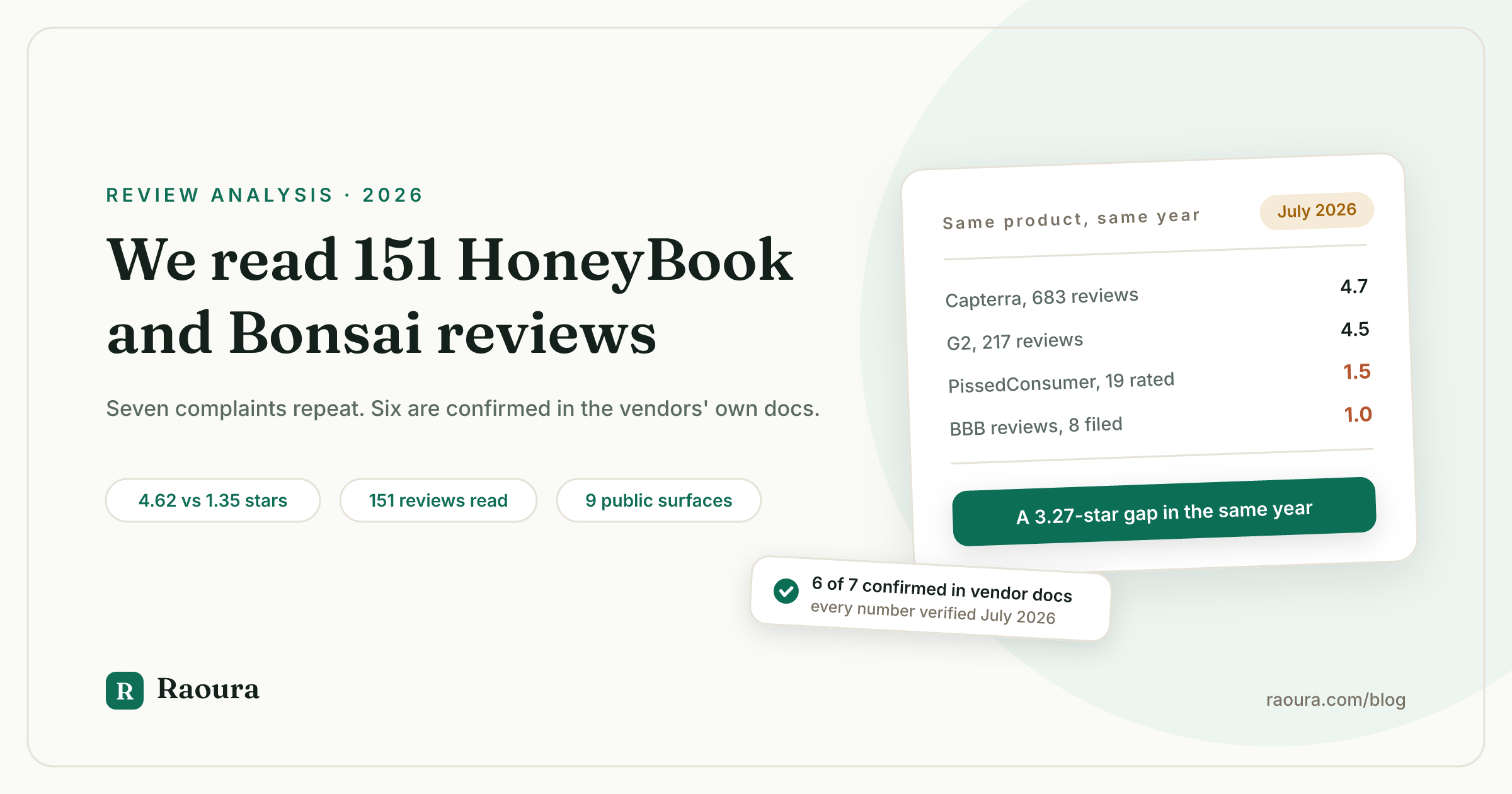
TL;DR: We read 151 individual HoneyBook and Bonsai reviews and complaints across nine public surfaces in July 2026. Seven criticisms repeat often enough to be structural rather than anecdotal: price increases outrunning the product, payout timing, funds held during disputes and verification, support that starts as a bot, a fee for using your own payment processor, feature gates on the cheapest plan, and manual-only data export. Six of the seven are confirmed in the vendors' own published documentation, which means they are policy, not accidents. The single most useful finding is not a complaint at all: HoneyBook averages 4.62 stars on the sites where it asks for reviews and 1.35 stars on the sites where users show up on their own, a gap of 3.27 stars for the same product in the same year. Disclosure: Raoura is our product, a $17 per month flat-price alternative, and it appears once near the end.
Search "HoneyBook complaints" in July 2026 and you get a wall of aggregators: the Better Business Bureau, PissedConsumer, G2, Capterra, Software Advice. The two editorial pages that break through are both published by direct competitors, and both of them soften the complaints in exactly the places where the primary sources are harshest.
One of those pages claims HoneyBook's "real-person support remains a top-rated feature in every recent review." The BBB file for the same company contains a March 2026 review from a user who says she could only reach an AI chatbot while her funds were frozen.
Somebody is wrong, and it is not the person whose money was stuck.
So we did the boring version instead. We opened the review pages themselves, read the text, counted, and then went to HoneyBook's and Bonsai's own help centers to see which complaints their documentation confirms.
What we actually read (and what we could not)#
We read 151 individual review and complaint texts across nine public surfaces, 101 about HoneyBook and 50 about Bonsai, in July 2026.
We are stating the count precisely because most "we analyzed the reviews" articles do not. Here is the exact breakdown.
| Surface | Product | Rating shown | Total reviews on file | Texts we read |
|---|---|---|---|---|
| [G2](https://www.g2.com/products/honeybook/reviews) | HoneyBook | 4.5 / 5 | 217 | 27 |
| [Capterra](https://www.capterra.com/p/162588/HoneyBook/reviews/) | HoneyBook | 4.7 / 5 | 680 | 25 |
| [GetApp](https://www.getapp.com/finance-accounting-software/a/honeybook/) | HoneyBook | 4.7 / 5 | 683 | 0 (distribution only) |
| [TrustRadius](https://www.trustradius.com/products/honeybook/reviews) | HoneyBook | 7.7 / 10 | 38 | 5 |
| [Apple App Store](https://apps.apple.com/us/app/honeybook-small-business-crm/id1104772757) | HoneyBook | 4.8 / 5 | 16,000 ratings | 6 |
| [Google Play](https://play.google.com/store/apps/details?id=com.honeybook.alfred) | HoneyBook | 4.5 / 5 | 2,270 | 3 |
| [BBB reviews](https://www.bbb.org/us/ca/san-francisco/profile/records-management/honeybook-inc-1116-878229/customer-reviews) | HoneyBook | 1.0 / 5 | 8 | 8 |
| [BBB complaints](https://www.bbb.org/us/ca/san-francisco/profile/records-management/honeybook-inc-1116-878229/complaints) | HoneyBook | n/a | 17 in 3 years | 10 |
| [PissedConsumer](https://honeybook.pissedconsumer.com/review.html) | HoneyBook | 1.5 / 5 | 19 rated | 15 |
| [HoneyBook Community](https://community.honeybook.com/) | HoneyBook | n/a | 1,611 topics | 2 |
| [G2](https://www.g2.com/products/bonsai/reviews) | Bonsai | 4.3 / 5 | 101 | 15 |
| [Capterra](https://www.capterra.com/p/238825/Bonsai/reviews/) | Bonsai | 4.6 / 5 | 95 | 25 |
| [Software Advice](https://www.softwareadvice.com/architecture/bonsai-profile/) | Bonsai | 4.6 / 5 | 95 | 10 |
| **Total** | **151** |
Two things we could not get, and we would rather say so than fake it.
Trustpilot returned an empty page on every attempt, for both products. You will see other articles quote a Trustpilot score for HoneyBook or Bonsai. We could not verify one this run, so there is no Trustpilot number anywhere in this article.
Reddit returned nothing through the search tooling we used. Every Reddit claim you read in competitor comparison posts is worth checking yourself, because we could not.
One thing nobody tells you about "three sources agree"#
Capterra, GetApp, and Software Advice are all owned by Gartner Digital Markets and draw from the same review pool, so an article citing all three is citing one source three times.
Look at the Bonsai rows above. Capterra says 4.6 from 95 reviews. GetApp says 4.6 from 95 reviews. Software Advice says 4.6 from 95 reviews.
That is not corroboration. That is the same 95 people, rendered on three domains.
For HoneyBook the counts are 680 and 683, days apart, which is the same corpus mid-refresh. The genuinely independent pools we found are G2, the Gartner pool, the two app stores, and the complaint sites. Four, not nine.
The ratings paradox: 4.62 stars and 1.35 stars for the same product#
HoneyBook averages 4.62 stars on the surfaces where it solicits reviews and 1.35 stars on the surfaces where users arrive unprompted, a gap of 3.27 stars.
We calculated that ourselves from the counts in the table above, and it is the most useful number in this article.
Weighted by review count, the solicited surfaces (G2, the Gartner pool, TrustRadius) come to 4.62. The unsolicited complaint surfaces (BBB customer reviews and PissedConsumer's rated reviews) come to 1.35.
| Venue type | Surfaces | Reviews | Weighted average |
|---|---|---|---|
| Solicited (vendor invites users to review) | G2 (217 at 4.5), Gartner pool (683 at 4.7), TrustRadius (38 at 3.85) | 938 | 4.62 / 5 |
| Unsolicited (user goes looking for somewhere to complain) | BBB reviews (8 at 1.0), PissedConsumer (19 rated at 1.5) | 27 | 1.35 / 5 |
| **Difference** | **3.27 stars** |
TrustRadius publishes a 7.7 out of 10, which we converted to 3.85 out of 5 for the weighting.
Neither number is a lie. They are measuring different populations.
Solicited reviews reach people who are still customers, still logged in, and still working. Nobody prompts you to leave a review during the week your payout is frozen. Complaint sites collect the opposite selection: almost exclusively people with money stuck somewhere.
The honest read is that both are true at once. Most HoneyBook users are fine, and the users who are not fine are having a specific, expensive kind of problem that the star average will never surface.
Here is HoneyBook's published star distribution, the one number that gives you both halves at once.
| Stars | Reviews | Share of 683 |
|---|---|---|
| 5 | 565 | 82.7% |
| 4 | 76 | 11.1% |
| 3 | 24 | 3.5% |
| 2 | 8 | 1.2% |
| 1 | 10 | 1.5% |
Source: GetApp, last updated June 2026.
Bonsai's distribution, from the same Gartner pool, runs 73 five-star, 15 four-star, 2 three-star, 2 two-star, and 3 one-star out of 95. That is 5.3% at one or two stars against HoneyBook's 2.6%.
Now, the seven complaints.
Complaint 1: The price went up faster than the product did#
HoneyBook raised its entry plan 89.5% in a single change in February 2025, from $19 to $36 per month, and G2 tags nine separate reviews with "drastic price increases without additional value."
This is the single most repeated complaint across both products, and it is the easiest one to verify, because the vendors publish the prices.
| Plan | Monthly | Annual (per month) | Cost per year on annual |
|---|---|---|---|
| HoneyBook Starter | $36 | $29 | $348 |
| HoneyBook Essentials | $59 | $49 | $588 |
| HoneyBook Premium | $129 | $109 | $1,308 |
| Bonsai Basic (no invoicing) | $15 per user | $9 per user | $108 |
| Bonsai Essentials | $25 per user | $19 per user | $228 |
| Bonsai Premium | $39 per user | $29 per user | $348 |
| Bonsai Elite (3-user minimum) | $59 per user | $49 per user | $1,764 at the minimum |
Sources: HoneyBook pricing and Bonsai pricing, both fetched July 2026.
HoneyBook's pre-February-2025 monthly tiers were $19, $39, and $79. Against today's $36, $59, and $129, that is an increase of 89.5%, 51.3%, and 63.3%.
What reviewers say about it:
- "When I started my subscription with Honeybook, I paid a little over $250 a year. Now two years later, they are charging over $500 a year" (Brian S., G2, September 2025, rated 2.0)
- "The yearly cost for me doubled last year, which takes funds from my non-profit that could be used elsewhere." (Delmar H., G2, May 2026, rated 3.5)
- "Pricing has increased but the product has not improved enough for the price increase" (verified user in photography, G2, May 2026, rated 3.5)
- "They've raised prices by >150% in only a few years and not improved the platform enough to warrant that." (Brandon B., Software Advice, February 2024, on Bonsai)
One caution on our own evidence. The "$250 a year to over $500 a year" wording appears almost verbatim on both G2 and Capterra under two different reviewer names. That is either one person posting twice or a syndication artifact, so we counted it once.
A timing detail nobody ranking for this query mentions: existing HoneyBook members got a one-year grandfather discount at the February 2025 change. That year is over. 2026 is the first full year most long-time users are paying the unsubsidized price, which is why the complaint is louder now than it was in 2025.
We track every change to that number in our HoneyBook price increase guide, and the full Bonsai tier math sits in our Bonsai pricing teardown.
Complaint 2: The money takes longer to arrive than anyone expects#
Capterra tags "slow and restrictive payment processing" as negative in 44% of the 64 HoneyBook reviews that mention it, and HoneyBook's own help center confirms ACH payments take 7 to 8 days to reach your bank.
This is the complaint where the vendor documentation is most damning, because it agrees with the reviewers.
Here is what HoneyBook publishes on its payment statuses and processing times page, updated June 2026.
| Payment type | Published time to your bank |
|---|---|
| Card | 2 to 3 business days |
| ACH bank transfer | 7 to 8 days |
| Canadian pre-authorized debit | 2 to 5 business days |
| Any payment collected through a lead form | 5 to 7 business days |
Payments taken after 4:00 pm Pacific push another day. A card payment on Thursday evening lands the following Tuesday. And once a payment starts processing, HoneyBook states plainly that it "can't be stopped or expedited."
What reviewers say:
- "the payment deposits are the slowest on the market - days! If you use Square, you get the deposit the next day" (Angela B., Capterra, April 2024)
- "I keep getting overdrafts in my account because Honeybooks is not depositing my Clients money into my account!" (PissedConsumer, April 2024)
- "each day the scheduled deposit date is pushed back. It is now saying the payment will deposit next week." (BBB complaint, June 2024)
- "ACH payments take way too long to process through. I can't wait that long for my money." (Cory R., G2, February 2024, on Bonsai)
Note what the sliding-date complaints have in common with the documentation. HoneyBook's page lists ACH re-queuing, bank holidays, and "bank verification or hold, especially for larger amounts or first-time transfers" as reasons a date moves. The reviewers are not imagining the slide. They are describing documented behavior that nobody warned them about at signup.
Complaint 3: Funds get held, and the hold is written policy#
HoneyBook's help center states that disputes "usually take about 90 days at most to reach a decision" and that its $10 dispute fee is not refunded even if you win, which matches the BBB complaint record almost word for word.
This is the most serious theme in the corpus, and it barely exists on the review aggregators. It lives on the BBB.
The mechanic that BBB filings describe: a client disputes a charge, HoneyBook debits the freelancer's connected bank account to cover it before the dispute is resolved, charges a non-refundable dispute fee, and disables payouts while the client's bank investigates.
- "Honeybook is holding my funds because my EIN does not match my business name... I could only speak to an AI chatbot." (Christina M., BBB review, March 2026, 1 star)
- "I had all funds frozen and payments locked... So i went 4 days without being able to operate my business." (BBB complaint, September 2025)
- "honeybook goes into YOUR BANK account and removes all money from any booked contract, without warning and holds it for up to 90 days" (BBB complaint, October 2024)
HoneyBook's own response on file is worth quoting, because it is accurate: "across the payments industry, it's standard practice to hold funds while the client's bank investigates" (BBB response, November 2025).
That is true. Disputes work that way everywhere, including on Stripe directly. The difference is who is standing between you and the decision, and whether you can call them.
Bonsai has a documented history here too, though the evidence is older and we want to be precise about that. Nearly every held-funds complaint we found for Bonsai dates to 2023 or early 2024:
- "they blocked over $20k from client payments going to my bank account for ~2 weeks." (Paris P., G2, September 2023)
- "they charged me an additional $300 in transaction fees for my first two transactions and would not let me access the fund for over two weeks" (verified reviewer, Capterra, March 2024)
- "Your account was subject to a manual review process. I regret to inform you that we will not be able to provide you with our Bonsai Payments offering going forward." (Bonsai support email quoted by Sharina M., G2, October 2023)
Bonsai reviews from 2025 and 2026 are mostly four and five stars and complain about pricing and integrations, not frozen money. The fair framing is a documented history of payment holds concentrated in 2023 and 2024 that has not clearly recurred, not a current crisis.
If you are on the receiving end of a dispute right now, our client disputes your invoice walkthrough covers the response sequence.
Complaint 4: Support starts as a bot, and sometimes stays one#
Customer support scores 4.7 on Capterra but is the single most repeated grievance on the complaint sites, and it is also Bonsai's lowest published sub-score at 4.3.
This is the theme where solicited and unsolicited reviews contradict each other most sharply, which is exactly what the ratings paradox predicts.
- "customer service isn't very helpful. I've asked for a demo multiple times... and was told no." (Rhianna C., G2, May 2026, rated 2.5)
- "their concierge is absolutely slow. two days now and they still haven't gotten back to me." (Google Play, May 2026)
- "I have spent THREE WEEKS trying to talk to an actual live person through Honeybook!!" (Monica P., BBB, April 2025)
- "I've been waiting for support to get back to me for 9 days now and still nothing." (G2, rated 0.0, on Bonsai)
- "No Customer service number to speak with a human. Poor turn around response, believe it to be AI Generated." (Sharina M., Capterra, October 2023, on Bonsai)
GetApp's own summary of the HoneyBook corpus concedes the pattern in careful language: "A minority of users report slow response times, difficulty reaching support by phone, and limited urgency in resolving certain issues."
Read those quotes again and notice the pattern in when support fails. It is not during onboarding. It is during a payment problem, which is precisely when a bot cannot help you and a human decision is the only thing that unblocks your money.
Counter-evidence deserves the same space: multiple recent five-star reviews on both products specifically praise support, including one Bonsai user who reports a resolution in under 30 minutes (Jonathan H., Capterra, October 2024). Support quality here is variable, not uniformly bad.
Complaint 5: On Bonsai, you pay a fee to use your own Stripe#
Bonsai adds a 1% platform fee to your payout when you route payments through your own Stripe or PayPal account instead of Bonsai Payments, which is confirmed on Bonsai's own fees help page.
Of the seven complaints, this is the one with the cleanest documentation and the least ambiguity. It is not a bug or a support failure. It is a published price.
From Bonsai's payment methods and fees article:
| Fee | Rate |
|---|---|
| Cards via Bonsai Payments | 2.9% + $0.30 |
| American Express via Bonsai Payments | 3.25% + $0.30 |
| ACH bank transfer | 1.0%, $1 minimum |
| Instant payout | additional 1.5% |
| International payments (currency conversion) | 2.5% |
| **Using your own Stripe or PayPal instead** | **additional 1% platform fee** |
Two details make this sharper than it first looks.
Bonsai Payments is on by default for US users, and you have to go into Financial Management, then Invoices, then Edit Payment Methods, then a three-dot menu, to deactivate it before Stripe can be enabled. That is four levels deep to opt out of a default.
And when you do connect Stripe, Bonsai's documentation says it "will create a sub-account in Stripe that is hosted by Bonsai." You are not getting an independent merchant relationship out of it.
Put a number on the 1%. On $50,000 of client payments a year, choosing your own processor costs you $500 annually in platform fee, on top of whatever Stripe charges you. That is more than two years of a $17 per month subscription, paid for the privilege of not using the built-in option.
HoneyBook's version of this is simpler and stricter: there is no own-processor option at all. Its bank transfer fee is 1.5% with no cap.
Run that against a $5,000 invoice. HoneyBook's uncapped 1.5% takes $75. Stripe's own ACH pricing is 0.8% capped at $5, so the same invoice costs $5. That is a $70 difference on one payment, created entirely by the cap.
We wrote a whole piece on why this category exists at all: why your client tool should never touch your money.
Complaint 6: The cheapest plan cannot do the job you bought it for#
Bonsai's advertised $9 per month Basic plan cannot send an invoice; invoicing and payments start at Essentials, which is $228 a year.
Feature gating shows up in reviews as a sense of bait, and the pricing pages confirm the gates.
On Bonsai, verified on the live pricing page this month:
- Invoicing and payments start at Essentials ($19 per user per month annual, $25 monthly). The $9 headline plan cannot bill anyone.
- The client portal is a Premium-tier feature ($29 per user per month annual). Several third-party articles place it on Essentials. The live page says Premium.
- Removing Bonsai branding is also Premium.
- Elite carries a 3-user minimum, so its real floor is $147 per month on annual billing, or $1,764 a year, for a plan sold as $49.
That last one sits on the same page as a footer line reading "Beyond the 7-day trial, there are no monthly fees and no minimums." Both statements are live right now. They cannot both be true.
The branding gate produces a specific, predictable review:
- "I ended up downgrading my Bonsai to a lower tier to make it more affordable again, which meant I had to give up custom branding." (Vesna M., Capterra, November 2024)
- "Bonsai Tax, which stripped some existing and included functionality from the original offering and turned it into an add on feature for an extra $100/year" (Brandon B., Software Advice, February 2024)
HoneyBook gates differently: automations and the scheduler sit on the $59 tier, and multi-company support on the $129 tier. Its pricing page is also internally inconsistent on fees, quoting "card fees start at 2.7% + 10 cents" in the fee section while the plan cards on the same page display "2.9% + 25 cents."
Complaint 7: Getting your data out is manual#
G2 tags six HoneyBook reviews with "poor data export options," and HoneyBook's cancellation help page confirms that after you cancel you keep read access but cannot create or send anything.
Export is the complaint that costs you the most and shows up in reviews the least, because you only discover it on the way out.
The most vivid one we found is titled "Great to get into, but never try to leave," rated 0.0:
- "they have NO way for me to export my data en masse. Instead, I am to download each of my files MANUALLY." (Austin P., consultant, G2, September 2025)
- "Ive processed about $210,000 in payments and none of the information on the payments were given before they closed my account" (Rhian W., BBB, March 2024)
HoneyBook's own cancellation article, updated March 2026, states it plainly: "When your membership is cancelled, you'll still have access to all existing projects and information, but you will no longer be able to create new files, projects, or send messages."
Read that carefully. Your archive is a museum, not a filing cabinet you can carry.
Two related facts from the same page that explain a chunk of the "charged after I cancelled" complaints on PissedConsumer. The 60-day money-back guarantee is real, but refunds "are not processed automatically." You have to chat in and ask, inside the window.
If you are heading for the exit on either tool, we documented the steps in migrate from HoneyBook in a weekend and migrate from Bonsai.
The pattern underneath all seven#
Line the seven up and six of them share a root cause: the tool is also the payment processor.
Payout timing, dispute holds, verification freezes, the fee for using your own Stripe, and the support failures that only happen during money problems are all downstream of one architectural decision. When your client software also holds the money, its risk department gets a veto over your cash flow, and you get a support ticket instead of a bank.
The seventh, export, is the same idea applied to data.
Which is the whole reason we built Raoura the way we did. Disclosure: Raoura is our product.
Raoura is client and project management for solo freelancers at $17 per month, one flat plan, no tiers and no per-seat pricing. Payments run through your own Stripe account via Stripe Connect, so client money goes from the client to you. It never sits in a Raoura balance, because there is no Raoura balance. We take no percentage of your payments and we add no platform fee for using your own processor, which means Stripe's published rates are the rates you pay, including the ACH cap.

Client payments settle through your own Stripe account, so Raoura never holds a balance and never sets a payout schedule.
There are no feature gates to compare, because there is one plan. Proposals, contracts, invoices, milestones, and the white-label client portal are all included at $17.
!Raoura dashboard showing projects, invoices, and proposals on a single flat plan

One plan at $17 per month: proposals, contracts, invoices, milestones, and the client portal, with nothing held back for a higher tier.
At $204 a year, that is $144 less than HoneyBook's cheapest annual plan and $228 less than its cheapest monthly one. If you want that comparison done properly rather than in a paragraph, we wrote Raoura vs HoneyBook and Raoura vs Bonsai, and a neutral field of options in HoneyBook alternatives for solo freelancers.
How to read software reviews before you buy#
Five habits that would have saved most of the reviewers quoted above, based on what actually went wrong for them.
- Check who owns the review site. Capterra, GetApp, and Software Advice are one company. Count the independent pools, not the domains.
- Read the one and two-star reviews first, sorted by date. The star average tells you about the median user. You need to know what the bad week looks like, and whether it is still happening this year.
- Search the vendor's own help center for the complaint. This is the step nobody takes and it is the highest-yield one. Six of the seven complaints in this article are confirmed in published documentation. If a policy is written down, it is not a bug that support will fix for you.
- Look up the company on the BBB, not just the review sites. Seventeen complaints in three years is a small number, but the texts describe the failure mode in detail that no star rating can.
- Find the export instructions before you sign up. If you cannot locate a bulk export in the help center in five minutes, assume there is not one.
That third habit is worth its own line. Reviews tell you what happened to someone. Documentation tells you what will happen to you.
Frequently asked questions
Is HoneyBook a scam?
No. HoneyBook is an established company with 683 reviews averaging 4.7 on Capterra and roughly 82.7% of them at five stars. The serious complaints are concentrated in payments: holds during disputes, verification freezes, and payout timing. Those are real, documented in HoneyBook's own help center, and affect a minority of users, usually at the worst possible moment.
Why does HoneyBook have a 1-star BBB rating and a 4.7 on Capterra?
Because they sample different people. Capterra and G2 collect reviews from users the vendor invites, who are by definition still active customers. The BBB collects filings from people who went looking for somewhere to escalate. We calculated a 3.27-star gap between HoneyBook's solicited surfaces (4.62 weighted average across 938 reviews) and its unsolicited ones (1.35 across 27). Both numbers are accurate about their own population.
What is the most common HoneyBook complaint?
Price. G2 tags nine reviews specifically with "drastic price increases without additional value," and it is the theme that appears independently on G2, Capterra, and Google Play. HoneyBook's entry plan went from $19 to $36 per month in February 2025, an increase of 89.5%.
How long does HoneyBook take to pay out?
HoneyBook publishes 2 to 3 business days for card payments, 7 to 8 days for ACH bank transfers, 2 to 5 business days for Canadian pre-authorized debit, and 5 to 7 business days for anything collected through a lead form. Payments taken after 4:00 pm Pacific add another day, and once processing starts it cannot be expedited.
Does Bonsai charge extra for using my own Stripe?
Yes. Bonsai's fees help page states that in locations where Bonsai Payments is available, using another processor such as Stripe or PayPal "will result in an additional 1% platform fee being added to the payout amount." Bonsai Payments is also enabled by default for US accounts and must be manually deactivated first.
Did the Zoom acquisition change Bonsai for users?
Not visibly, as of July 2026. Zoom announced the acquisition on November 5, 2025 and the deal closed in December 2025, with Bonsai staying a standalone platform under its own brand. We found no user review on any surface that mentions Zoom, positive or negative. We cover what acquisitions usually mean for your data in what happens when your freelance tool gets acquired.
Can I export my data out of HoneyBook?
Not in bulk, according to reviewers. The most detailed account, a September 2025 G2 review, describes downloading files one at a time. After cancellation HoneyBook confirms you retain read access to existing projects but lose the ability to create or send anything.
Are these complaints current or old?
Mixed, and it matters. HoneyBook's pricing, support, and payout complaints run through May 2026 and are current. Bonsai's most severe complaints (held funds, account termination) cluster in 2023 and early 2024, with 2025 and 2026 reviews trending four and five stars on different issues. We flagged that rather than blending the timelines.
---
Every rating, review count, price, and fee in this article was checked against the linked source in July 2026. Verified July 2026. Ratings and review counts move; if you are reading this months later, open the links and check.
Run your client work in one place
Send a proposal, get it signed, invoice, and get paid, with a branded portal your clients will actually use. One flat plan at $17/month, and we never take a cut of your payments.
Try Raoura free for 14 daysNo credit card required. Set up in minutes.
Keep reading
Is Upwork Worth It in 2026? A Break-Even Test for Your Situation
Upwork is worth it when its fee costs less than finding the client yourself, and that is true far more often for a first project than for a repeat client. Here is the break-even math with 2026 numbers: the 0 to 15% fee, Connects, the shrinking client base, and when to wait out the 24-month rule instead of paying to leave.
The Virtual Assistant Contract: 24 Clauses, Scored Against Every Template Ranking for This Search
We scored the four pages that publish actual virtual assistant contract text against 24 clauses a VA agreement needs. Twenty-four of 96 possible slots were filled. The best single template managed 7 out of 24. Twelve clauses appear in none of them, including every clause about the thing that makes VA work different from other freelance work: you are holding your client's passwords and running their inbox. One popular template also tells you a contract fixes your independent contractor status, then mandates client-set 9 to 5 weekday hours in the same document. Here is the clause-by-clause version, with the classification test the DOL is actually applying in 2026, the data protection terms nobody drafts, and the retainer mechanics that decide whether unused hours roll over.
Stripe vs PayPal for Freelancers: Every Fee Verified (2026)
Every page ranking for this comparison either prints in-person retail rates, contradicts itself, or skips the numbers freelancers actually pay. We read the current Stripe and PayPal pricing pages line by line, ran a $3,000 invoice through every rail, and found a $1,764 per year gap between the cheapest setup and the default one.