CRM for Freelance Writers: A Pipeline That Fits How Writing Actually Works
August 30, 2026
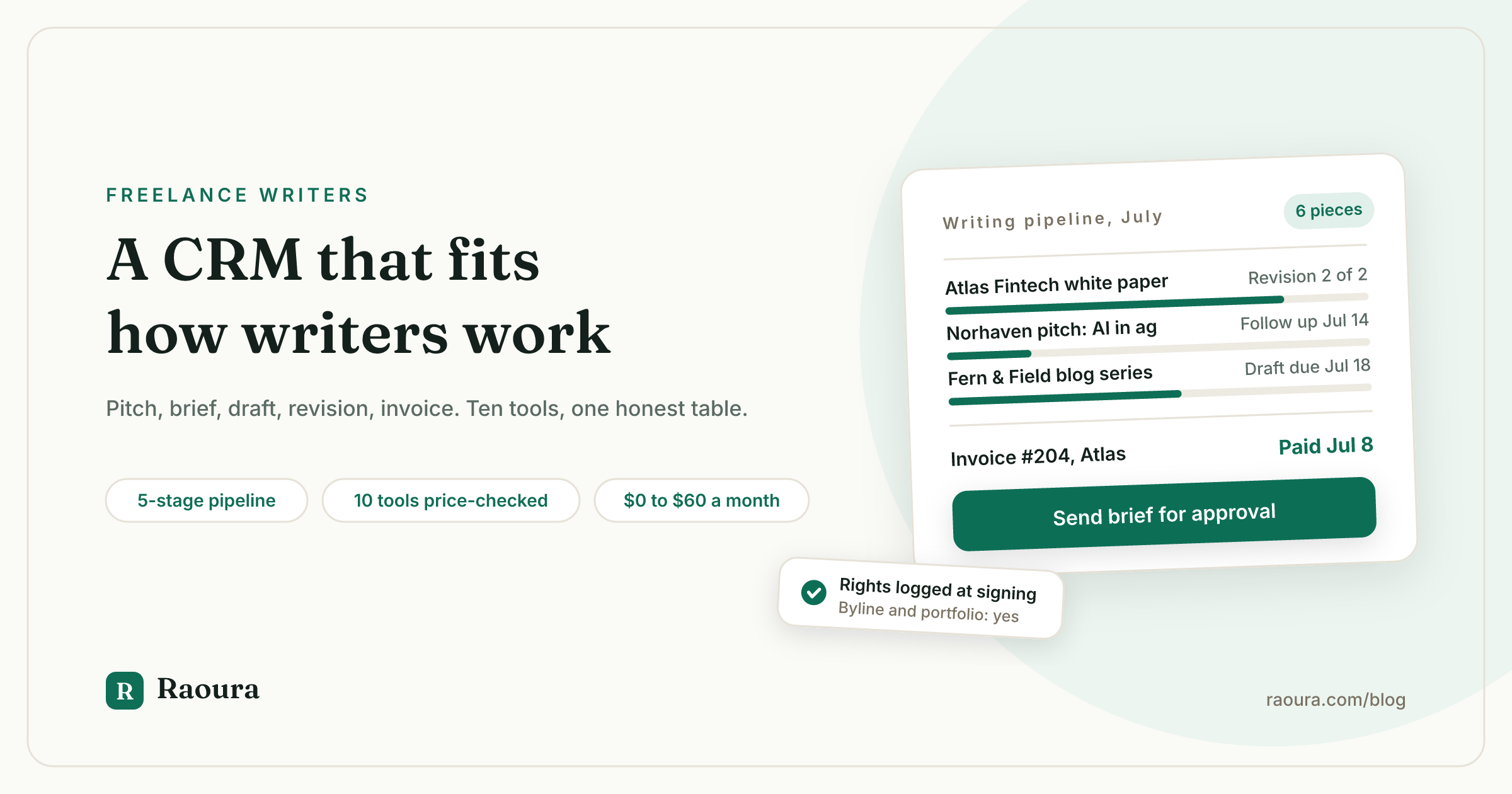
Search for a CRM as a freelance writer and you will find lists written for someone else. Before writing this guide we fetched the top-ranking pages for this exact search in July 2026. Every one is an affiliate list, and the recommendations are per-seat sales CRMs built for teams that run discovery calls and demos: power dialers, sales forecasting, deal rotation.
Not one ranking page mentions pitching editors, content briefs, revision rounds, retainers, or bylines. One of the top results is a personal blog post last touched in June 2023.
The prices are worse than the framing. We checked the three biggest lists line by line against the vendors' own pricing pages and found six prices or plans that no longer exist:
- A Close "Solo" plan that is not on Close's pricing page.
- A $16 HoneyBook tier that was retired before the February 2025 price increase.
- A free Streak CRM plan Streak has discontinued.
- A $15 Streak Solo plan that is now $49.
- HubSpot Starter quoted at $45 when it is $15 per user.
- A Bonsai plan structure from two pricing models ago.
So this guide does two things those pages do not. It maps client management to how writing work actually flows, and it gives you a tool table where every price was pulled from the vendor's own pricing page this month.
What a writer's pipeline actually looks like#
A freelance writer's pipeline has five stages, pitch, brief, draft, revision, and invoice, and a sales CRM models only the first one.
Sales CRMs are built around a funnel that ends at "closed won." For a writer, the close is where most of the work begins. What you need to see at a glance is different at every stage:
- Pitch. Which outlets and clients you have pitched, which angle, which editor, and when you last followed up. This is the only stage that resembles a sales pipeline.
- Brief. What was actually agreed: topic, angle, word count, deadline, rate, rights, revision rounds. If it is not written down, you will pay for it at stage four.
- Draft. What is due when, across every client at once. Deadline collisions are the writer's version of overbooking.
- Revision. Which round you are on, what was requested, and where the agreed limit is. This is where scope creep lives.
- Invoice. What has been sent, what is overdue, and what rights transfer on payment.
A tool earns its subscription only if it makes those five things visible. Most of the software recommended for this search makes stage one visible and charges you per seat for the privilege.
Do freelance writers need a CRM at all?#
Usually not in the sales sense: 46.3% of freelance writers run zero to three clients at a time, and referrals and word of mouth bring in 67% of freelance work, not cold funnels.
The All Things Freelance Writing survey of 346 writers found 46.3% hold zero to three clients, 38.4% hold four to six, and 15.3% hold seven or more. A pipeline that size fits on one screen without deal-stage software. And since word of mouth is the top source of freelance work at 67% per Fiverr's 2024 Freelance Economic Impact Report, the highest-value "CRM activity" for a writer is staying findable to past clients, not managing a funnel of strangers.
Worth noting from the same survey: writers holding seven or more clients were overrepresented in the $15,000-a-month bracket. Volume correlates with income, which is exactly why the juggling has to live somewhere more reliable than your inbox.
What writers do need is the record half of a CRM: who agreed to what, which draft is due, which round of edits you are on, what is unpaid, and what rights you signed away. That is a lighter and cheaper category than sales software, and it is the argument we make at length in what freelancers actually need instead of a CRM.
The tool table: ten options, prices verified July 2026#
Realistic solo cost runs from $0 (Notion, HubSpot Free) to $60 a month (17hats billed monthly), and five of the ten tools below use per-seat sales pricing a solo writer does not need.
Every price below was read from the vendor's own pricing page in July 2026, not from another listicle. Prices are for annual billing unless noted.
| Tool | Solo price (annual billing) | Pricing model | The writer catch |
|---|---|---|---|
| Notion | Free (Plus $10/member/mo) | Free, then per member | You build and maintain the whole system yourself |
| HubSpot Free CRM | $0, up to 2 users | Freemium, per-user paid tiers | New free accounts cap at 1,000 contacts; the old million-contact free tier is gone |
| Streak | Pro $49/user/mo | Per user | The free CRM plan and $15 Solo plan cited in ranking articles no longer exist |
| Pipedrive | Lite $14/seat/mo | Per seat | No email sync until the $39 Growth tier, which defeats pitch tracking |
| Moxie | Pro $20/mo ($25 monthly) | Flat | Closest on price; pipeline is still generic, not writing-shaped |
| HoneyBook | Starter $29/mo | Flat tiers | Card processing fees on top: plan pages show 2.9% + 25 cents, its own FAQ says from 2.7% + 10 cents |
| Bonsai | Essentials $19/user/mo ($25 monthly) | Per user | Now a Zoom company pivoting to 10-to-50 person agencies |
| 17hats | $600/year ($60 monthly) | Flat, all inclusive | $600 a year is a lot of words at freelance rates |
| Dubsado | Starter $335/year (about $28/mo) | Flat | Starter has no workflows or scheduling; the setup curve is famous |
| Raoura | $17/mo flat | Flat | Disclosure: Raoura is our product |
Three patterns worth naming.
- The per-seat tools (Streak, Pipedrive, Bonsai, and HubSpot's paid tiers) price for teams, so their roadmaps serve teams. The solo writer is nobody's core customer there.
- The suites that process your payments take a cut of every invoice on top of the subscription, which is why we think your client tool should never touch your money.
- The two free options are genuinely free but make you the system administrator. In Notion you are building databases, views, and reminders from scratch and maintaining them forever.
If your shortlist includes the big suites, we have deeper teardowns of 17hats alternatives, the HoneyBook price increase, and what the Zoom acquisition means for Bonsai users.
Tracking pitches: the one stage sales CRMs almost fit#
Log four fields for every pitch, outlet or client, editor name, angle, and next follow-up date, and schedule at least one follow-up, because most pitches die from silence rather than rejection.
You do not need software for this; a spreadsheet with those four columns beats an unconfigured CRM. What matters is the discipline attached to it:
- One angle, one outlet at a time for editorial pitches, with a stated exclusivity window (7 to 14 days is common) so you can re-pitch elsewhere without burning a bridge.
- A follow-up date on every row. One polite nudge after a week to ten days is standard. You will find confident response-rate percentages on writing blogs; we could not trace a single one to a real study, so treat them as folklore. The honest version: silence is the default, and follow-ups are free.
- Editor moves are leads. When an editor who bought from you changes outlets, that is the warmest pitch you will ever send. Track people, not just publications.
- Won pitches graduate to briefs. The pitch tracker is not the system of record for active work; the brief is.
For the commercial side (content marketing clients rather than publications), the same fields work, but the "pitch" is usually a proposal, and proposal structure measurably changes close rates.
Briefs and revisions: where writing projects actually go wrong#
PMI's Pulse of the Profession found 52% of projects experience scope creep, and for writers it almost always arrives as a third revision round nobody priced.
That 52% figure is PMI's own, measured across all project types; freelancer surveys routinely report higher. The writer-specific version is predictable enough to pre-empt:
- No brief, no draft. A written brief (topic, angle, audience, word count, examples, deadline, rate, rights) is the cheapest dispute insurance that exists. If the client will not write one, write it yourself and have them confirm it in one reply.
- Cap revision rounds in writing. Two rounds is the common norm. What counts as a "round" (one consolidated set of edits, not a rolling thread) belongs in the same sentence.
- Route extra rounds to paper, not resentment. "Happy to do a third round, here is the change order" is a system, not a confrontation. Change orders do the arguing for you.
- Keep every version. When a client asks to "go back to how the intro was," you want that to be a two-minute job, and when they use draft two after paying for nothing, you want the paper trail.
The money end: writers get paid late, and mostly at the end#
69% of freelance writers are paid only after the work is fully complete, and writers' invoices arrive late 26% of the time.
Those two numbers explain each other. The All Things Freelance Writing survey found 69% of writers collect 100% of the fee after completion, which hands the client all of the leverage. Bonsai's invoice dataset, built on three years of data from over 100,000 freelancers, puts writers' late-payment rate at 26%, slightly better than the 29% average across professions but still one invoice in four.
The fixes are structural, not motivational:
- Take a deposit. For new clients, a deposit of 25% to 50% is the norm, and it filters out the clients who were never going to pay.
- Milestone-bill anything long. White papers, books, and site rewrites should never be one invoice at the end; milestone billing means you are never owed more than one phase.
- Shorten your terms. "Due on receipt" or Net 7 beats Net 30 for solo writers, and the payment terms evidence backs it.
- Put it in a contract. A 2014 ILR Review study of Freelancers Union survey data found contract use is associated with 13.7% higher income. Start from our annotated contract template and add the rights language below.
- Automate the chasing. Payment reminders on a schedule collect faster than ad-hoc guilt.
On rates themselves: the Editorial Freelancers Association's 2026 rate chart, surveyed from over 1,100 members, puts median work-for-hire blog and article writing at 25 to 45 cents per word. If a $600-a-year suite is pitched at you, that is a full article of pure overhead every year: 1,300 to 2,400 words at those median rates, before the tool has done anything.
Rights, bylines, and the portfolio problem#
Every deliverable should carry three recorded facts: who owns the copyright, whether your name appears on it, and whether you may show it in your portfolio.
This is the part of client management that is unique to writers and absent from every CRM listicle. Ghostwritten work usually transfers all three away. Bylined editorial work may leave you copyright while licensing first publication. Content marketing contracts are frequently silent, which defaults ownership in ways that surprise people on both sides; the details are in our freelance IP rights guide.
Whatever tool you pick, record those three facts per project at signing, not at portfolio-building time two years later when the contract PDF is in an email account you no longer check. Your portfolio is your pipeline (remember the 67% referral figure), so a deliverable you cannot legally show is worth less than its invoice said.
Where Raoura fits#
Disclosure: Raoura is our product, so weigh this section accordingly.
We built Raoura for exactly the shape of business this article describes: one writer, a handful of concurrent clients, and a pipeline that runs pitch to brief to draft to revision to invoice. It is $17 a month flat, and that price includes proposals, contracts with e-signature, milestone invoicing, and a white-label client portal where briefs, drafts, and approvals live in one place per client. Payments run through your own Stripe account, so we never touch your money and never take a cut of an invoice.
If the free-spreadsheet route from this article works for you, use it: the system matters more than the software. When maintaining the spreadsheet becomes its own unbilled admin job, that is the moment a flat-priced tool earns its keep.
!Milestone billing on a Raoura project, splitting a long writing project into staged payments

Milestone invoicing built into the project means a white paper or site rewrite never becomes one lump invoice at the end, which is the 69 percent problem from the money section.
!A client's project view in the Raoura portal, one place per client for briefs, drafts, and approvals

One link per client where briefs, drafts, and approvals live: the record half of a CRM, which is the half writers actually need.
Before the first brief lands, lock down kill fees, rights and revision rounds with a freelance writing contract built for writers.
Frequently asked questions
What is the best free CRM for freelance writers?
Notion or HubSpot's free tier. Notion is the more shapeable of the two: a Clients database and a Projects database with status, deadline, rate, rights, and revision-round fields covers the whole pipeline, at the cost of building and maintaining it yourself. HubSpot Free is a real CRM, but new accounts cap at 1,000 contacts and 2 users, and its concepts (deals, pipelines, lifecycle stages) are sales furniture you will be working around.
Is Streak still free for CRM use?
No. Streak's free plan now covers email power tools only (tracking, snippets, mail merge). CRM features start at the Pro plan, $49 per user per month billed annually. Several pages ranking for this search still recommend the discontinued free and $15 Solo plans.
Do copywriters need a CRM or a client portal?
Different jobs. A CRM-type record keeps you organized internally. A client portal is client-facing: one link per client where briefs, drafts, invoices, and approvals live, which is what kills the "any update?" email. Solo writers usually feel portal pain before pipeline pain; our guide to what a client portal is covers when it is worth having.
How many clients does a freelance writer have at once?
Per the All Things Freelance Writing survey of 346 writers: 46.3% hold zero to three clients, 38.4% hold four to six, and 15.3% hold seven or more, with the seven-plus group overrepresented at the highest income bracket.
What should a writer track that a normal CRM does not?
Rights and byline status per deliverable, revision rounds against a contracted cap, brief details (angle, word count, examples), pitch exclusivity windows, and editor relationships across outlet changes. No sales CRM ships fields for any of these.
Is a paid tool worth it at part-time volume?
Below three or four concurrent clients, a spreadsheet plus a contract template plus scheduled invoice reminders covers the jobs. Past that point, the math is admin time: if a $17 to $29 monthly tool saves you two billable hours of chasing and re-finding things, it pays for itself at even modest freelance rates.
---
Every price and statistic in this article was checked against a primary source in July 2026: each vendor's public pricing page (Notion, HubSpot, Streak, Pipedrive, Moxie, HoneyBook, Bonsai, 17hats, Dubsado, Stripe), the EFA 2026 rate chart, the All Things Freelance Writing 2023 survey, Bonsai's invoice dataset, PMI's Pulse of the Profession, the ILR Review contract-income study, and Fiverr's 2024 Freelance Economic Impact Report. Verified July 2026.
Run your client work in one place
Send a proposal, get it signed, invoice, and get paid, with a branded portal your clients will actually use. One flat plan at $17/month, and we never take a cut of your payments.
Try Raoura free for 14 daysNo credit card required. Set up in minutes.
Keep reading
The Virtual Assistant Contract: 24 Clauses, Scored Against Every Template Ranking for This Search
We scored the four pages that publish actual virtual assistant contract text against 24 clauses a VA agreement needs. Twenty-four of 96 possible slots were filled. The best single template managed 7 out of 24. Twelve clauses appear in none of them, including every clause about the thing that makes VA work different from other freelance work: you are holding your client's passwords and running their inbox. One popular template also tells you a contract fixes your independent contractor status, then mandates client-set 9 to 5 weekday hours in the same document. Here is the clause-by-clause version, with the classification test the DOL is actually applying in 2026, the data protection terms nobody drafts, and the retainer mechanics that decide whether unused hours roll over.
Stripe vs PayPal for Freelancers: Every Fee Verified (2026)
Every page ranking for this comparison either prints in-person retail rates, contradicts itself, or skips the numbers freelancers actually pay. We read the current Stripe and PayPal pricing pages line by line, ran a $3,000 invoice through every rail, and found a $1,764 per year gap between the cheapest setup and the default one.
The Pause Clause: How to Stop Work When an Invoice Goes Overdue
Stopping work is the strongest move a freelancer has against a late-paying client, and the least understood. Here is the legal doctrine that lets you pause even without a clause, the exact clause to add so you never have to rely on doctrine again, the day-by-day timing, and the two emails that keep the pause professional. Verified against primary sources in July 2026.