How Much Runway Before Going Full-Time Freelance
August 30, 2026
You have clients on the side, a resignation letter half-written in your head, and one question with a dollar sign on it: how much money do you need in the bank before you go full-time freelance?
The pages that rank for this question in July 2026 are not much help. The standard answer is "3 to 6 months of expenses," which is the SEC's general emergency fund guidance repurposed for a decision it was never designed for. An emergency fund is sized for losing income you already have. Runway is sized for building income you do not have yet, while your expenses go up. Those are different problems with different math, and this article does the second one properly: the adjusted burn calculation, a full month-by-month ramp model you can check with a calculator, and honest runway targets by starting point.
The short answer: 6 to 12 months of your adjusted burn, not 3 to 6 of your current budget#
Most solo freelancers starting with a partial client base need 6 to 9 months of adjusted monthly burn saved; starting from zero pipeline, 9 to 12 months; in our worked model, a freelancer with a $5,050 adjusted burn needs about $31,600.
Three words in that sentence carry all the weight: adjusted, ramp, and pad.
Adjusted means your burn rate after quitting, not before. The moment you leave, you pick up costs your employer used to carry, health insurance being the largest, and you become responsible for self-employment tax of 15.3 percent on your net earnings.
Ramp means your income does not jump from zero to full on a start date. It climbs, and your savings drain fastest early while the gap between burn and income is widest.
Pad means late invoices, surprise expenses, and slow months still exist after you break even. In the Federal Reserve's 2025 household survey, 59 percent of US adults hit at least one major unexpected expense in the prior 12 months, and 37 percent could not cover a $400 emergency with cash or its equivalent. Runway that lands you at exactly zero on break-even day is not a plan.
The rest of this article builds each piece, then puts them together.
Step 1: Calculate your adjusted burn (it is higher than your budget app says)#
Expect your monthly burn to rise by $600 to $1,000 the day you quit, driven mostly by health insurance: an average single COBRA premium runs about $793 a month, and the average 2026 marketplace deductible hit a record $3,786.
Start with your true personal spending. Not your aspirational budget: what actually leaves your accounts in a normal month. For scale, the BLS Consumer Expenditure Survey puts average US household spending at $78,535 a year, roughly $6,545 a month, with housing taking a third of it. Your number is your own; pull 6 months of statements and average them.
Then add the freelancer-only lines:
Health insurance is the big one, and 2026 is the worst year in a decade to guess at it. The enhanced ACA subsidies expired at the end of 2025, and KFF's 2026 marketplace analysis found the average premium payment among subsidized enrollees jumped 58 percent, from $113 to $178 a month, while the average deductible rose 37 percent to $3,786. And that $178 is the average for people who still qualify for credits; a freelancer with a healthy income can pay several times that.
The other route is COBRA, which by federal rule costs the full premium your employer was paying plus 2 percent: against the average 2025 employer premium of $9,325 for single coverage, that is about $793 a month, and about $2,294 a month for family coverage against the $26,993 family average.
Get a real quote from healthcare.gov before you set your number; our freelance health insurance guide walks through the 2026 landscape and the deduction math.
Business costs are smaller but real: software, a professional email, insurance if your field needs it, an accountant at tax time. Budget $100 to $200 a month and adjust once you know.
Taxes deserve one clarification, because they confuse runway math in both directions. You do not pay tax on savings you spend, so your runway itself is not taxed. But every freelance dollar you earn during the ramp arrives gross: no withholding, and quarterly estimated payments are required once you expect to owe $1,000 or more for the year.
The clean way to model it: count only 70 to 75 percent of projected freelance income as available to cover your burn, and treat the rest as spoken for. The right percentage for your income level is in our tax set-aside guide, and the payment mechanics are in the quarterly taxes guide.
A worked adjusted burn, which we will carry through the article: $4,300 of true personal spending, plus $600 for a realistic unsubsidized health plan, plus $150 of business costs. Adjusted burn: $5,050 a month.
Step 2: Model the ramp, not the cliff#
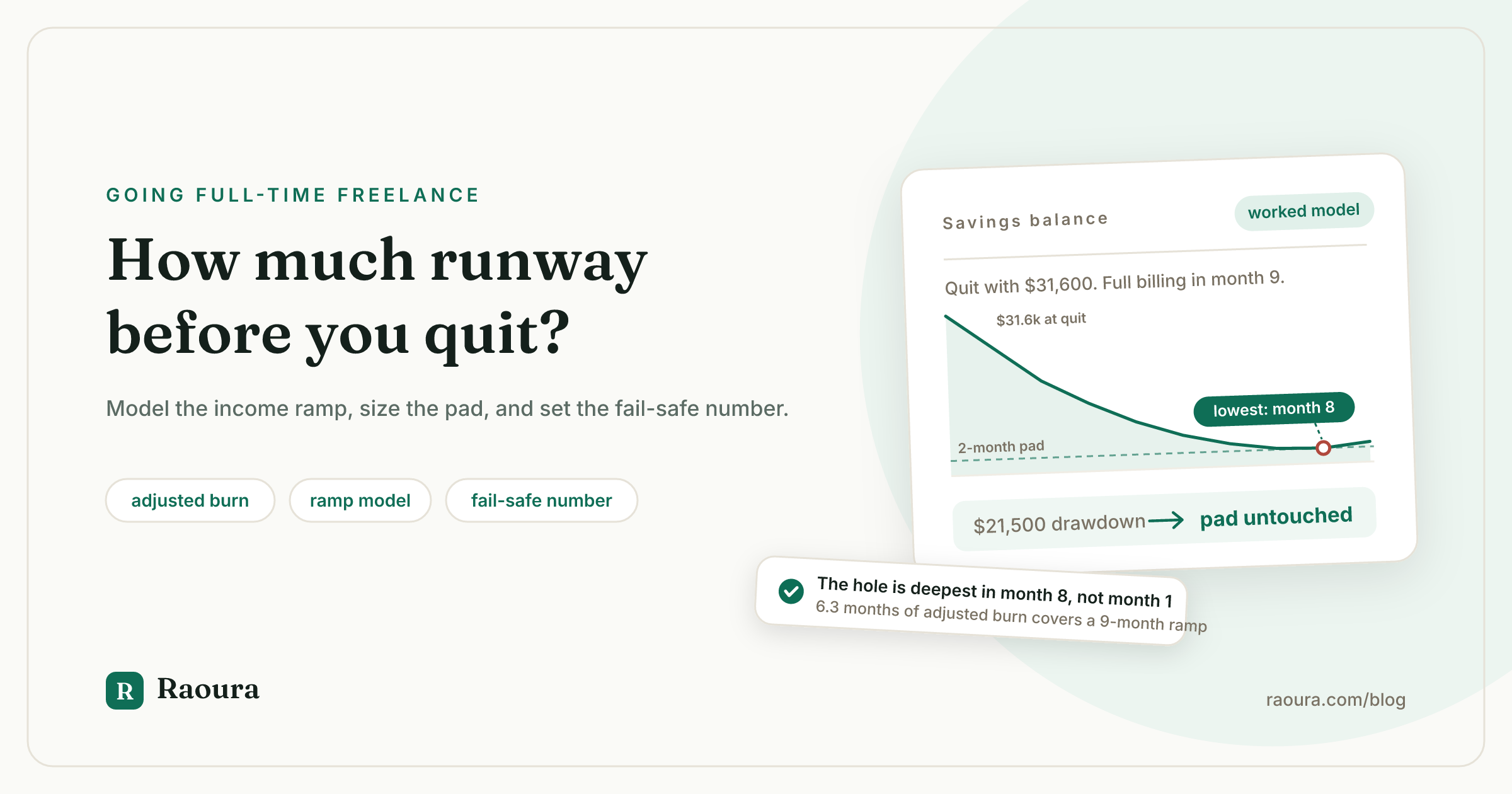
In our model, a freelancer with a $5,050 adjusted burn who grows collections from $0 to $8,000 a month by month nine draws down $21,500 of savings before breaking even, and the drawdown bottoms out in month eight.
Here is the mistake baked into "N months of expenses": it models your income as a cliff followed by a rescue, like a layoff followed by a new job. Freelance income is a slope. You will earn something in month three. You will probably not earn enough. The question is not how many months until income exists; it is how much total gap accumulates between your burn line and your income line before they cross.
The table below is our worked ramp. Assumptions: adjusted burn is $5,050 a month; the collections column is cash that actually arrived that month, not what you invoiced, which builds roughly a month of invoice lag into the model; 30 percent of every collected dollar goes straight to a tax account, so only 70 percent counts against burn; the target is $8,000 a month of collections, which nets about $5,600 against the $5,050 burn.
| Month | Collected | Net after 30% tax set-aside | Monthly gap | Cumulative drawdown |
|---|---|---|---|---|
| 1 | $0 | $0 | $5,050 | $5,050 |
| 2 | $0 | $0 | $5,050 | $10,100 |
| 3 | $2,000 | $1,400 | $3,650 | $13,750 |
| 4 | $3,000 | $2,100 | $2,950 | $16,700 |
| 5 | $4,000 | $2,800 | $2,250 | $18,950 |
| 6 | $5,000 | $3,500 | $1,550 | $20,500 |
| 7 | $6,000 | $4,200 | $850 | $21,350 |
| 8 | $7,000 | $4,900 | $150 | $21,500 |
| 9 | $8,000 | $5,600 | +$550 | $20,950 |
Every row recomputes from the assumptions, and three things in it are worth staring at.
First, the total. The drawdown peaks at $21,500, which is 4.3 months of burn spent across eight months. The old rule of thumb is not wrong by a mile on the total; it is wrong about what the total buys you. Three months of this burn is $15,150, which runs dry partway through month four of a nine-month ramp. That is the worst possible moment to go back to job hunting: too late to claim you never left, too early to have a portfolio of full-time freelance work.
Second, the shape. The deepest point of the hole arrives in month eight. This is why freelancers who quit with "a few months saved" and early momentum still hit a wall: the account balance keeps falling long after the income starts. If you do not model the ramp, month six feels like failure when it is actually the plan working.
Third, the sensitivity. Every month your ramp slips costs you roughly a full month of burn at the front of the table, where the gap is widest. Slip the whole ramp by two months and the peak drawdown grows by about $10,000. Your ramp assumptions matter more than your latte budget ever will.
So the runway formula this article exists to give you: runway = peak cumulative drawdown from your own ramp model + a pad of 2 months of adjusted burn. In the worked example: $21,500 + $10,100 = $31,600. Round it to $32,000. That is 6.3 months of adjusted burn for a freelancer who reaches full billing in nine months, and it is sized by a model you can rerun with your own numbers in a spreadsheet in ten minutes.
Step 3: Pass the pipeline test before the savings test#
Savings buy time, but only a pipeline ends the drawdown: the strongest quit signal is side income already covering 30 to 50 percent of your adjusted burn, because it proves your ramp assumptions with real invoices.
A pile of cash and no pipeline is not runway; it is a countdown. Before the resignation letter, you want evidence that the collections column in your table is real:
Recurring beats total. One $6,000 project proves someone paid you once. A $1,500 monthly retainer proves the model. Weight retainers and repeat clients far above one-off wins when you decide whether your ramp is credible.
Referrals are the engine, and they are slow to start. In Peak Freelance's industry survey, freelancers named referrals and word of mouth the top source of their highest-paying work at 42 percent, ahead of social media and job boards; it is a small survey, but it matches what most working freelancers will tell you. Referral networks compound with time in the field, which is precisely what runway is buying. Our guide to getting clients without a marketplace is the playbook for that period.
The income on the other side is real. In the Upwork Research Institute's 2025 study, 28 percent of US skilled knowledge workers now freelance, and those who earn exclusively from freelancing report a median income of $85,000, above the $80,000 median of their full-time-employee counterparts. Full-time freelancing is not a pay cut by default. It is a cash flow problem for exactly as long as your ramp lasts, which is what the runway is for.
One honest caveat: there is no reliable published data on how long it takes the average freelancer to replace a salary. Anyone quoting you a universal "most freelancers match their income in X months" number is making it up. Build your ramp from your own evidence: your side income trend, your niche's project sizes, your network. That is the only ramp model that means anything.
Pad for late invoices, because your break-even month has an asterisk#
Late payment is the norm, not the exception: 56 percent of US small businesses are owed money from unpaid invoices, averaging $17,500 per business, and 47 percent have invoices more than 30 days overdue.
The ramp table assumes the money you earn in a month arrives that month. Reality pays slower. In the QuickBooks 2025 Late Payments Report, 56 percent of US small businesses surveyed were owed money from unpaid invoices, averaging $17,500 per business, and 47 percent had invoices more than 30 days overdue.
For an employee, payday is a law of nature. For a freelancer, it is a negotiation you have to win every month, and in month five of your runway a single $4,000 invoice arriving six weeks late is the difference between calm and panic.
This is the part of the runway problem you can actually engineer away, and it is worth doing before you quit, not after.
- Set payment terms of due on receipt or net 7 instead of net 30.
- Take a deposit before work starts so every project is part-paid on day one.
- Break larger projects into milestones so you are never owed more than one phase.
- Send invoices the day work ships and chase them on a fixed schedule.
Freelancers who do these four things need visibly less pad than freelancers who invoice at project end with net 30 terms and hope.
This is also where our product fits, so, disclosure: Raoura is our product. It is a $17 a month client and project tool for solo freelancers that handles deposits, milestone invoicing, and automatic payment reminders, with payments landing in your own Stripe account so nobody takes a cut of your invoice. Every dollar that arrives on time is runway you did not have to save.

Milestone billing keeps the collections column of your ramp table close to what you invoiced, instead of one big payment at project end.

A one-click payment page shortens the invoice lag your ramp model has to absorb.
Runway targets by starting point#
If side clients already cover half your burn, 4 to 6 months of adjusted burn is defensible; from a standing start with no network, plan 12 months or do not quit yet.
The worked model above is one scenario. Your target moves with your starting position:
| Your starting point | Typical months to break even | Runway target (months of adjusted burn) |
|---|---|---|
| Side income already covers 50%+ of adjusted burn | 3 to 5 | 4 to 6 |
| Active clients, some repeat work, no recurring revenue | 6 to 9 | 6 to 9 |
| No clients yet, strong professional network | 9 to 12 | 9 to 12 |
| No clients, thin network, or sole earner with dependents | 12+ | 12+, and build the pipeline first |
Two adjustments trump everything in this table.
If you are the only income in a household with dependents, take the top of every range and add the 12-month figure the cautious camp recommends for parents.
And read the room on the job market you would fall back to: as of May 2026, the US quits rate sits at 1.9 percent, with 3.1 million people quitting a month, subdued numbers that say workers are hesitant to walk away from jobs. A soft rehiring market does not mean do not go; it means your fallback takes longer, so your runway carries more of the risk.
Set a fail-safe number, not just a launch number#
Decide before you quit what balance triggers the retreat: when savings fall to 2 months of adjusted burn without a break-even month on the board, you start the job search while you still have 8 or more weeks of financial oxygen.
Runway planning usually obsesses over the start line and ignores the abort line. Set both on the same day, while you are still calm and employed.
A good fail-safe has two parts: a balance floor, commonly 2 months of adjusted burn, and a trend test, such as two consecutive quarters where collections fall short of your ramp plan by 30 percent or more.
Hit either one and you execute the pre-agreed plan: job search opens, spending drops to the survival budget, and you keep freelancing while you interview, because a part-time client base is an asset in a job search, not a confession.
Write it down and tell one person who will hold you to it. The freelancers who lose worst are not the ones who go back to jobs; they are the ones who burn the last three months of savings refusing to decide.
And once you are through the ramp and earning, the discipline flips from stretching savings to smoothing income: move to the pay-yourself-a-salary system so the lumpy months your clients create never reach your rent.
Frequently asked questions
Is 3 to 6 months of expenses enough to go full-time freelance?
Usually not, for two reasons: the rule sizes against your current expenses rather than your higher post-quit burn, and it models a cliff rather than a ramp. Three months of our worked model's burn runs out in month four of a nine-month ramp. Six months of true adjusted burn can work, but only if your side income is already covering a meaningful share of your costs.
How much should I save if I already have steady side clients?
Model it: your peak cumulative drawdown plus a 2-month pad. If side clients already cover half of your $5,050 adjusted burn, your monthly gap starts near $2,500 and shrinks, so peak drawdown might land near $10,000 and 4 to 6 months of burn is a defensible target. Real invoices from real clients are what make the shorter number safe.
Do I pay taxes out of my runway?
Spending saved money is not a taxable event; you already paid tax on it. But freelance income earned during the ramp is untaxed when it arrives, so set aside 25 to 30 percent of every payment from day one, and expect quarterly estimated payments once you will owe $1,000 or more for the year. Model freelance income at 70 to 75 cents on the dollar and the tax account takes care of itself.
What happens to my health insurance when I quit?
You get two clocks: 60 days to elect COBRA at 102 percent of your employer's full premium, about $793 a month for the average single plan, and a 60-day special enrollment window for a marketplace plan. In 2026, with enhanced subsidies expired, compare real quotes rather than assuming the marketplace is cheaper; the average marketplace deductible is now $3,786. Never let coverage lapse to save a month of premium; one ER visit erases years of runway.
Does a spouse's income change the math?
It changes the pad, not the model. A second income that covers the household basics means your runway only has to cover your share of the burn plus business costs, and your fail-safe floor can be lower. It does not excuse skipping the ramp model, because a drawn-out ramp still strains a single income covering two people.
What is the fastest way to shrink the runway I need?
Start the ramp before you quit. Every month of overlap moves a row of the drawdown table onto your employer's payroll. After that, it is cash flow engineering: deposits on every project, milestone billing, due-on-receipt terms, and automatic reminders, which together pull collections earlier and cut the pad you need. The runway you do not need is cheaper than the runway you save.
---
Figures verified July 2026: household survey data against federalreserve.gov (SHED 2025, published May 2026); health costs against kff.org (2026 marketplace analysis and 2025 Employer Health Benefits Survey) and dol.gov (COBRA rules); tax mechanics against irs.gov; spending benchmarks against bls.gov (Consumer Expenditure Survey 2024, JOLTS May 2026); late payment data against quickbooks.intuit.com (2025 Late Payments Report); income data against upwork.com (Research Institute, 2025). The ramp model and runway formula are our own, and every table row recomputes from the stated assumptions. This is general information, not financial advice.
Run your client work in one place
Send a proposal, get it signed, invoice, and get paid, with a branded portal your clients will actually use. One flat plan at $17/month, and we never take a cut of your payments.
Try Raoura free for 14 daysNo credit card required. Set up in minutes.
Keep reading
Is Upwork Worth It in 2026? A Break-Even Test for Your Situation
Upwork is worth it when its fee costs less than finding the client yourself, and that is true far more often for a first project than for a repeat client. Here is the break-even math with 2026 numbers: the 0 to 15% fee, Connects, the shrinking client base, and when to wait out the 24-month rule instead of paying to leave.
The Virtual Assistant Contract: 24 Clauses, Scored Against Every Template Ranking for This Search
We scored the four pages that publish actual virtual assistant contract text against 24 clauses a VA agreement needs. Twenty-four of 96 possible slots were filled. The best single template managed 7 out of 24. Twelve clauses appear in none of them, including every clause about the thing that makes VA work different from other freelance work: you are holding your client's passwords and running their inbox. One popular template also tells you a contract fixes your independent contractor status, then mandates client-set 9 to 5 weekday hours in the same document. Here is the clause-by-clause version, with the classification test the DOL is actually applying in 2026, the data protection terms nobody drafts, and the retainer mechanics that decide whether unused hours roll over.
Stripe vs PayPal for Freelancers: Every Fee Verified (2026)
Every page ranking for this comparison either prints in-person retail rates, contradicts itself, or skips the numbers freelancers actually pay. We read the current Stripe and PayPal pricing pages line by line, ran a $3,000 invoice through every rail, and found a $1,764 per year gap between the cheapest setup and the default one.