The Feast-or-Famine Fix (Operational, Not Motivational)
August 30, 2026
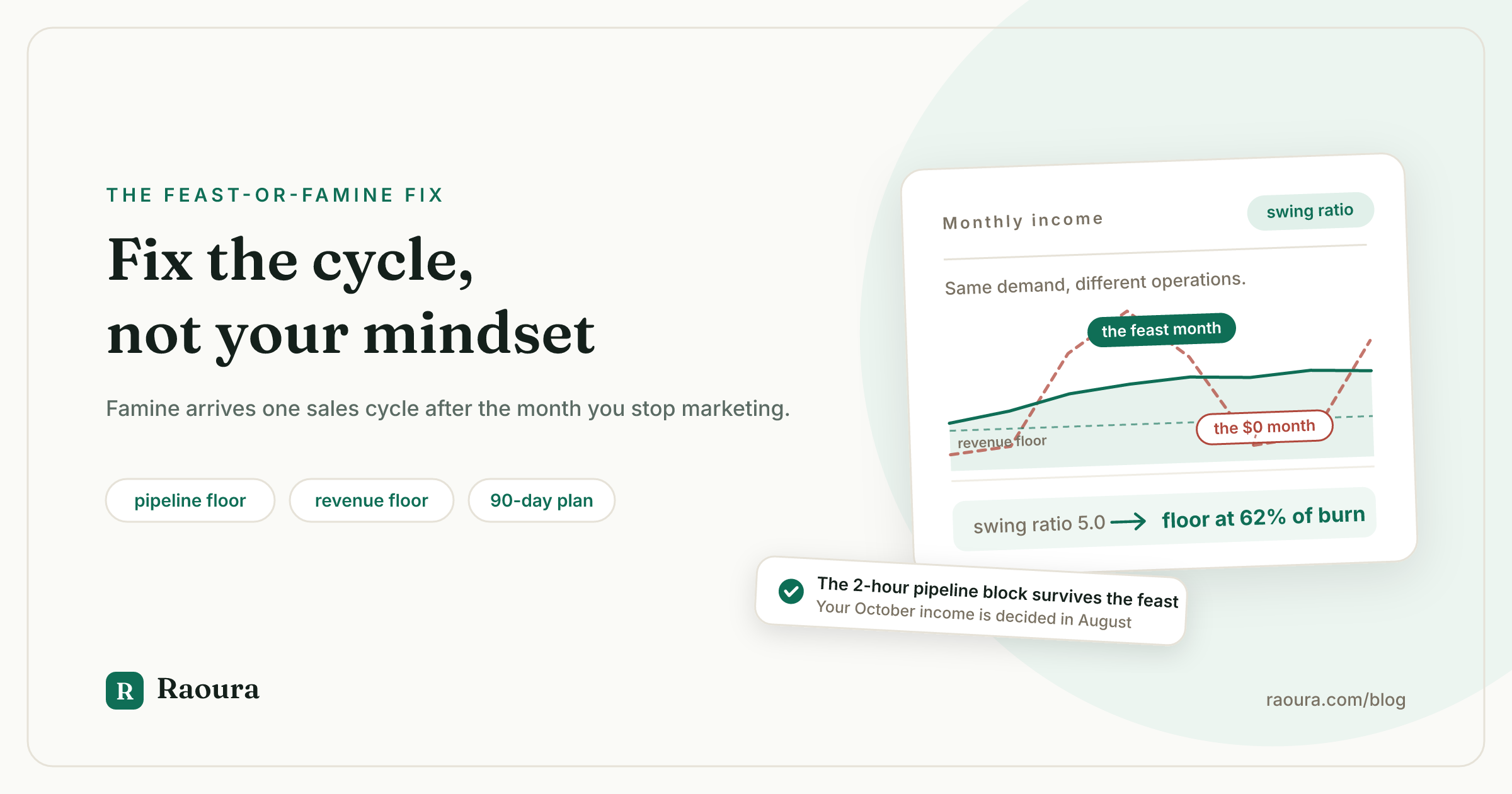
Three months ago you turned work away. This month you are refreshing your inbox and wondering if you should update your resume. Nothing about your skills changed in between. So what happened?
If you search this question, you will find essays about resilience, reminders to network, and advice to "always be marketing" delivered as a personality trait. All of it treats feast or famine as an emotional condition. It is not. It is a scheduling problem with a known mechanism, and mechanisms can be fixed. In freelancermap's 2025 freelancer study, 39 percent of freelancers named fluctuating income as a top challenge and 58 percent named project acquisition, and the two are the same problem wearing different hats: work arrives in clumps because the effort that produces work happens in clumps.
This article is the operational fix: where the cycle actually comes from, how to measure yours, and the four levers that flatten it, with a 90-day plan at the end. No mindset advice anywhere.
Why feast or famine happens: it is a lag, not a luck problem#
Famine arrives roughly one sales cycle after the month you stopped marketing, so with a typical 6 to 8 week pitch-to-signature cycle, an empty month was caused by whatever you did not do about 2 months earlier.
Here is the mechanism. Landing freelance work takes lead time: you reach out, conversations happen, proposals go out, contracts get signed, projects start. For most solo freelancers that pitch-to-signature cycle runs somewhere between a few weeks and a few months.
Now add the constraint that you are one person: when you are delivering work, marketing is the first thing you drop. The result is a feedback loop with a built-in delay.
You market when you are idle, the work lands one sales cycle later, you go heads-down to deliver it, the pipeline empties while you are busy, and one sales cycle after that, the famine hits.
The table below traces the loop with concrete assumptions so you can watch it happen. Assume an 8-week sales cycle (outreach in month 1 becomes signed work in month 3), 8 hours of outreach produces one $5,000 project, each project pays half at signing and half the following month, and, like most freelancers, you stop all marketing while you are delivering.
| Month | What you are doing | Outreach hours | Cash collected |
|---|---|---|---|
| 1 | No work, marketing hard | 16 | $0 |
| 2 | Still quiet, still marketing | 16 | $0 |
| 3 | Two projects land (from month 1 outreach) | 0 | $5,000 |
| 4 | Two more land (from month 2), fully booked | 0 | $10,000 |
| 5 | Delivering the tails, pipeline empty | 0 | $5,000 |
| 6 | Famine: nothing was signed in months 3 to 5 | 16 | $0 |
Every row follows from the assumptions. Month 4 feels like success, and month 4 is exactly when month 6 was lost. Notice what the trace is not: it is not bad luck, a bad niche, or a soft market. The freelancer in that table did 32 hours of effective outreach and earned $20,000 in half a year while riding a rollercoaster from $0 to $10,000 and back, and the entire swing came from when the outreach happened, not how much.
That reframing matters because it changes what you fix. If famine were a demand problem, the answer would be more marketing. Because it is a timing problem, the answer is marketing that never stops, plus structures that stop cash from clumping even when projects do. Those are the four levers below.
First, measure your cycle: the swing ratio#
Divide your best month of the last 12 by your worst: under 2 is smooth, 2 to 4 is lumpy, and above 4 means you have a feast-or-famine cycle worth treating as an operational emergency.
You cannot manage what you have not measured, and most freelancers have never actually looked at their own volatility. Pull your last 12 months of collected income (money that arrived, not invoices sent) from your bank statements or invoicing tool. Then compute one number we call the swing ratio: your best month divided by your worst month. A freelancer whose best month was $10,000 and worst was $2,000 has a swing ratio of 5.
For context on how normal some volatility is: the JPMorgan Chase Institute's income volatility research, built on bank account data, found 84 percent of individuals saw month-to-month income changes greater than 5 percent, and that monthly volatility exceeded year-to-year volatility for every income group. Middle-income individuals typically saw swings around 15 percent up and 12 percent down in a given month, and that is the general population, most of whom have paychecks.
Freelance income sits far out on that distribution. Some swing is the cost of being paid by projects instead of payroll.
A ratio above 4 is not.
While you have the 12 months open, mark two more numbers: your famine floor, the worst month itself, and your monthly burn, what your life plus business actually costs. The whole game in the rest of this article is raising the floor until it covers the burn.
Lever 1: A pipeline floor you never drop below#
Reserve a fixed 2 hours a week for pipeline work that survives your busiest delivery month, because the marketing you do while fully booked is the only thing standing between month 4 and month 6 of the trace above.
The single highest-leverage change is converting marketing from a famine response into a standing appointment. Not 16 hours in a panic: 2 hours, every week, including, especially, the weeks you are slammed. In the trace table, the famine exists entirely because outreach hours read zero in months 3 through 5. A freelancer who had kept even a quarter of their outreach running through the feast would have had work signing in months 5 and 6.
What goes in the 2 hours matters less than that they happen, but rank by yield:
- Referrals first. Fiverr's Freelance Economic Impact Report found 67 percent of freelance work comes through word of mouth, referrals, and reputation, which makes the referral ask the cheapest pipeline work that exists. Build the ask into your project close: when a client approves the final deliverable, that same week, ask who else they know with the same problem.
- Warm reactivation second. Past clients and dormant leads, one or two short check-in notes a week.
- Cold or content channels third, whatever fits your field, but only after the first two are running. Our guide to getting clients without Upwork covers those channels in depth.
The floor also needs to survive contact with a feast. Two rules make it stick:
- Book it as a recurring calendar block and treat it like a client meeting, because a slot that floats is a slot that dies.
- Track leads somewhere more structured than your inbox, so 2 hours goes into conversations instead of archaeology.
A quotable version of the whole lever: the best month to send outreach is the month you least feel like you need to.
Lever 2: Build a revenue floor with retainers and repeat work#
Aim to cover 50 to 60 percent of your monthly burn with recurring or committed revenue, because a famine month can never fall below the part of your income that renews by default.
Project income clumps by nature. Recurring income cannot, which makes it the structural fix for the bottom half of your swing. If your burn is $4,000 a month and a $1,500 retainer plus a repeat client worth about $1,000 most months are in place, your famine floor is $2,500, or about 62 percent of burn, before you sell anything new that month. The famine months stop being $0 months, and the pipeline floor from lever 1 only has to bridge a $1,500 gap instead of a $4,000 one.
You almost certainly have retainer candidates already. The best one is the client who keeps coming back with one-off requests: maintenance after a build, monthly content after a launch, ongoing design support after a rebrand. The pitch moment is the end of a successful project, and the shape is a fixed monthly fee for a defined recurring scope, prepaid. Scope it in deliverables or capped hours, put rollover and cancellation terms in writing, and use a real agreement: our freelance retainer agreement template has the clauses and the reasoning behind each.
Two cautions so this lever does not backfire:
- Do not discount heavily for the privilege of stability. A modest discount for a 3-month commitment is defensible; 30 percent off is just a pay cut with extra steps.
- Watch concentration. A single retainer that becomes 70 percent of your income has not fixed feast or famine, it has renamed it, and its cancellation clause is now your famine schedule.
Lever 3: Flatten the cash inside each project#
Deposits, milestones, and due-on-receipt terms can turn one lump payment into 3 or more spread payments, and they attack the 29 percent of freelance invoices that arrive late on top of arriving lumpy.
Even with a steady pipeline, cash clumps if every project pays once, at the end, whenever the client gets around to it. Bonsai's analysis of invoicing data from over 100,000 freelancers found 29 percent of invoices are paid at least a day late. Late is the enemy of smooth: a payment that slips 3 weeks does not just cost you interest, it moves income out of a thin month into a fat one and steepens the very cycle you are trying to flatten.
Three structures fix the shape of project cash, and they stack:
- A deposit before work starts. For most solo work that means 25 to 50 percent up front, scaled by client history and project size; the decision table is in our deposit guide. A deposit moves income earlier and filters out the clients who were never going to pay well.
- Milestones on anything that runs longer than a few weeks. Splitting a $12,000 project into 4 payments of $3,000 converts one quarterly income spike into something resembling a salary, and it caps how much unpaid work you are ever carrying; the split math by project size is in the milestone billing guide.
- Short terms, enforced politely. Due on receipt or net 7 beats net 30 for solo freelancers in nearly every case, and the evidence on terms is in our payment terms guide. Pair the terms with an automatic reminder cadence so enforcement does not depend on your memory or your nerve; the reminder templates and the full pay-on-time system cover the exact sends.
The broader numbers on how late payment hits freelancers are collected in our late payment statistics page.
Lever 4: A buffer that absorbs what the other levers cannot#
Build toward 3 months of expenses in a separate buffer account and pay yourself a fixed salary from it, because in the Federal Reserve's 2025 household survey 37 percent of US adults could not cover even a $400 emergency with cash.
The first three levers narrow the swing; none of them eliminates it. The residual is a banking problem, and the fix is mechanical: income lands in a business account, a fixed salary moves to your personal account on the 1st, and the buffer in between absorbs the difference in both directions. Feast months fill the buffer instead of your lifestyle, famine months drain it instead of your rent. The full system, including how to set the salary number and a worked year with a $0 month in it, is in our irregular income budgeting guide, so this section stays short.
Two numbers justify the effort. In the Federal Reserve's 2025 Survey of Household Economics and Decisionmaking, 37 percent of US adults could not cover a $400 emergency expense with cash or its equivalent. And the JPMorgan Chase Institute estimated a typical middle-income household needed about $4,800 in liquid assets to weather ordinary income and spending swings, roughly 14 percent of annual after-tax income, while the median such household held only $3,000. The general population, mostly salaried, is underinsured against volatility smaller than yours. Start the buffer with your next deposit, even if it starts at $500.
The feast-month protocol: what to do when you are slammed#
A feast month has 3 standing obligations: the 2-hour weekly pipeline block still happens, the buffer transfer still happens, and if you are turning work away, your rates go up rather than your hours.
Everything above fails in the same place: the month you are too busy to care. So write down what a feast month owes the system, and keep the list short enough to honor.
- The pipeline block survives, because of the lag.
- The buffer transfer survives, because a feast that gets spent is just a famine with better memories.
- Demand you cannot serve becomes price information, not overtime. If you are booked out and still fielding inquiries, you are underpriced, and the fix is a rate increase for new work, not a 60-hour week. The rate raising guide has the data and timing, and the rate increase scripts have the exact emails.
A waitlist beats a burnout, and it beats a discount panic 2 months later even more.
If you are still deciding whether full-time freelancing is viable at all, the same modeling discipline applies to that decision, and our runway guide walks through it month by month.
The 90-day fix, in order#
The full fix installs in 90 days: measure in week 1, run the pipeline floor from week 2, restructure billing by day 60, and land one recurring revenue line by day 90.
| Days | Move | Done when |
|---|---|---|
| 1 to 7 | Pull 12 months of collected income; compute your swing ratio, famine floor, and monthly burn | Three numbers written down |
| 8 to 30 | Start the pipeline floor: recurring 2-hour weekly block, referral ask added to your project close step | 4 consecutive weekly blocks completed |
| 31 to 60 | Restructure billing: deposit on every new project, milestones on anything over about a month, due on receipt or net 7, automatic reminders on | No new project starts without money up front |
| 61 to 90 | Pitch a retainer to your best repeat client; open the buffer account and automate the salary transfer | One recurring line item and a fixed payday |
The order is deliberate. Measurement makes the problem concrete, the pipeline floor has the longest lag so it starts earliest, billing changes only apply to new projects so they need lead time, and the retainer pitch works best aimed at a client your newly steady attention has just served well.
Where a tool fits#
The four levers are policies, not software, and they work from a spreadsheet and a calendar if that is what you have. But most of the fix is repetition: leads tracked every week, deposits and milestone invoices raised on every project, reminders sent on every due date, and repetition is what tools are for. Raoura handles the mechanics in one place for $17 a month flat: a pipeline view for the weekly block, proposals and contracts with deposit and milestone schedules built in, automatic payment reminders, and payments that go straight to your own Stripe account with no added commission. Disclosure: Raoura is our product. The levers work without it; it just removes the willpower from the loop.
!A Raoura project with a milestone payment schedule that spreads project cash across stages

Lever 3, mechanized: deposits and milestone schedules are set when the project is, so every new engagement starts with its cash already flattened.
!Raoura's settings screen for automatic reminders on overdue invoices

Automatic reminders enforce your payment terms on every due date, so enforcement never depends on your memory or your nerve.
Frequently asked questions
What does feast or famine mean in freelancing?
It is the alternating cycle of too much work followed by none. Operationally, it is caused by a lag: freelancers market only when idle, work lands one sales cycle later, marketing stops during delivery, and the pipeline runs dry one sales cycle after that. The income swing is a symptom; the stop-start marketing is the disease.
How do I stop the feast-or-famine cycle?
Four levers, in order of leverage: a fixed weekly block of pipeline work that continues through busy months, recurring revenue (retainers and repeat clients) targeted at 50 to 60 percent of your monthly burn, payment structures that spread cash inside each project (deposits, milestones, short terms), and a buffer account you pay yourself a fixed salary from. Motivation is not on the list; scheduling is.
How much should a freelancer keep as a buffer?
Work toward 3 months of personal expenses, then stop and put the surplus to work elsewhere. For scale, JPMorgan Chase Institute research put the liquid assets a typical middle-income household needed to absorb ordinary volatility at about $4,800, and freelance volatility is wider than the general population's. Any buffer beats none: 37 percent of US adults could not cover a $400 emergency with cash in the Federal Reserve's 2025 survey.
Are retainers the answer to inconsistent freelance income?
They are the strongest single answer for the bottom of the cycle, because recurring revenue sets a floor a famine month cannot fall through. But a retainer that dominates your income recreates the problem as concentration risk, and retainers still require the pipeline floor, because they end. Treat retainers as one lever of four, not the fix.
How many hours a week should I spend marketing when I am busy?
Two hours a week is the floor that survives real workloads, and it matters most during your busiest months because of the sales-cycle lag: the work you land in October comes from what you send in August. Spend it in yield order: referral asks first, warm reactivation of past clients second, cold channels last.
Is feast or famine normal for freelancers?
Fluctuation is normal; the extreme cycle is not mandatory. In freelancermap's 2025 study, 39 percent of freelancers named fluctuating income a top challenge, and JPMorgan Chase Institute data shows even salaried households see month-to-month swings above 5 percent 84 percent of the time. A swing ratio (best month divided by worst) under 2 is about as smooth as project work gets; above 4 is a structural problem the four levers can fix.
---
Figures verified July 2026: freelancer challenge data against freelancermap.com (2025 freelancer study); household finance data against federalreserve.gov (SHED 2025, published May 2026) and jpmorganchase.com (Institute income volatility research); late payment data against hellobonsai.com (invoicing dataset, updated January 2026); referral share against fiverr.com (Freelance Economic Impact Report). The 6-month trace model, the swing ratio metric, and the 50 to 60 percent revenue floor target are our own. This is general information, not financial advice.
Run your client work in one place
Send a proposal, get it signed, invoice, and get paid, with a branded portal your clients will actually use. One flat plan at $17/month, and we never take a cut of your payments.
Try Raoura free for 14 daysNo credit card required. Set up in minutes.
Keep reading
Is Upwork Worth It in 2026? A Break-Even Test for Your Situation
Upwork is worth it when its fee costs less than finding the client yourself, and that is true far more often for a first project than for a repeat client. Here is the break-even math with 2026 numbers: the 0 to 15% fee, Connects, the shrinking client base, and when to wait out the 24-month rule instead of paying to leave.
The Virtual Assistant Contract: 24 Clauses, Scored Against Every Template Ranking for This Search
We scored the four pages that publish actual virtual assistant contract text against 24 clauses a VA agreement needs. Twenty-four of 96 possible slots were filled. The best single template managed 7 out of 24. Twelve clauses appear in none of them, including every clause about the thing that makes VA work different from other freelance work: you are holding your client's passwords and running their inbox. One popular template also tells you a contract fixes your independent contractor status, then mandates client-set 9 to 5 weekday hours in the same document. Here is the clause-by-clause version, with the classification test the DOL is actually applying in 2026, the data protection terms nobody drafts, and the retainer mechanics that decide whether unused hours roll over.
Stripe vs PayPal for Freelancers: Every Fee Verified (2026)
Every page ranking for this comparison either prints in-person retail rates, contradicts itself, or skips the numbers freelancers actually pay. We read the current Stripe and PayPal pricing pages line by line, ran a $3,000 invoice through every rail, and found a $1,764 per year gap between the cheapest setup and the default one.