The Freelance Client Intake Form: All 34 Questions, Ungated
August 30, 2026
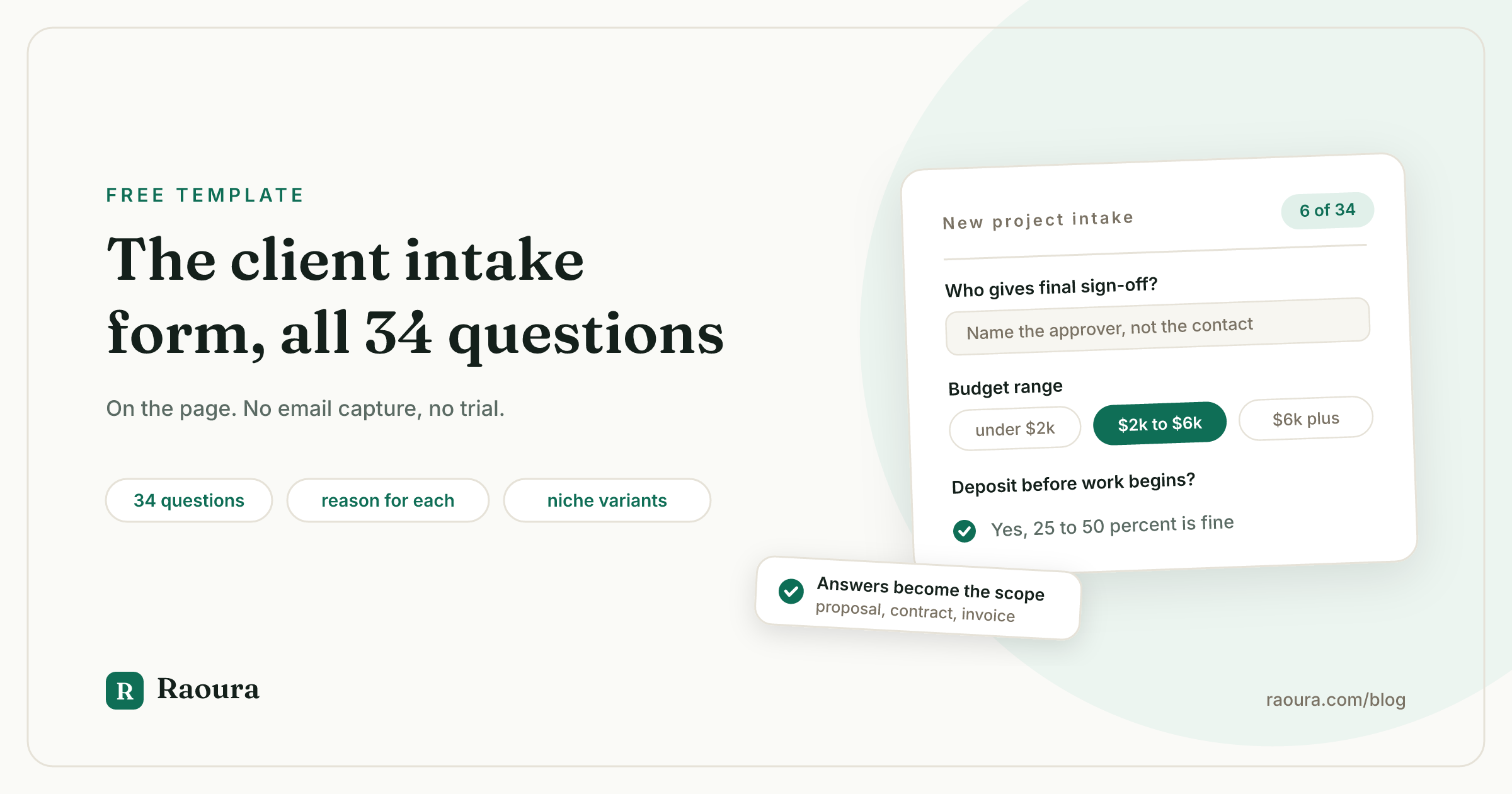
An intake form is the cheapest piece of business machinery you will ever build. One document, written once, that stops you from pricing a project blind, discovers the person who will actually approve the work before you meet them in round four, and quietly filters out the clients who were never going to pay you.
So it is strange how badly the internet serves this query.
Before writing this we fetched the seven pages ranking for "client intake form freelance" and its close variants in July 2026 and counted the fully written, client-facing questions on each. The counts were 20, 17, 15, 13, 10, 3 and 0. Median: 13. The page promising "my template and 35 questions" delivers 15 and both of its download links point at an anchor that does not exist on the page.
The rest are gated. The best-structured result asks you to start a product trial to get the questionnaire, and the 20 questions it does publish are a brand-strategy survey written for marketing agencies with account managers, which asks a prospective client to name "the main weakness in your business model" but never asks their budget, their deadline, or who signs off.
This article publishes the whole form on the page. Copy it, cut it, keep it in a Google Doc. Nothing here is behind an email capture.
What an intake form is actually for#
Proposals that include a client input form close at 41%, against a 34% average close rate across all proposals, according to Proposify's analysis of 742,137 proposals sent in 2025.
That is the closest thing to hard evidence anyone has that asking clients questions before you quote makes you money. Treat it as correlation, not proof: it is Proposify's own platform data, and teams disciplined enough to collect input are probably disciplined in other ways too.
Still, the mechanism is not mysterious. A proposal written from answers is specific, and a proposal written from a 20-minute call and some guessing is generic.
The form does three jobs, in order of how much money each one saves you:
- It prices the job. You cannot quote a project whose approval chain, revision expectations, and hard deadline you have not seen in writing.
- It vets the client. A client who will not name a budget, will not name a decision maker, and needs it "ASAP" for a reason they cannot articulate has told you everything before you spent an hour on a proposal.
- It becomes the scope. The answers are the raw material for the deliverables list and the exclusions list in your statement of work. Anything the client tells you here is something they cannot later claim was always assumed.
That third job is the one the ranking pages miss entirely. Every one of them treats the submitted form as an endpoint. It is an input.
How many questions is too many#
Across 93 million tracked form sessions, form analytics firm Zuko found that only 51.7% of people who start a form finish it, and that the number of fields is a weak predictor of whether they do.
This is the opposite of the advice everywhere else, which is "keep it short or you will scare them off." The data does not support the fear.
Zuko's own category benchmarks make the point better than any argument:
| Form type | Average number of inputs | Completion rate |
|---|---|---|
| Local government forms | 71.0 | 85.0% |
| Onboarding forms | 16.0 | 51.8% |
| Contact forms | 19.2 | 47.4% |
| Comparison and insurance forms | 44.2 | 46.4% |
| Enquiry forms | 17.4 | 42.7% |
Source: Zuko form type benchmarking, 2025. The longest form on the list has by far the highest completion rate, and the two shortest categories are the two worst performers.
Length is not the variable. Motivation is. A citizen renewing a permit will answer 71 questions because there is nowhere else to go, and a bored visitor will abandon a 4-field contact form because they were never going to buy anything.
Your intake form sits at the motivated end of that spectrum, as long as you send it to the right person at the right moment. A stranger who found your site and is browsing will bail at question six. A prospect who has just had a good call with you and wants a quote will answer thirty.
Which gives you the actual rule.
Send a short form to strangers and a long form to prospects. Put five or six questions on the public contact form on your site (name, company, what they need, timing, budget range), and send the full 34-question intake only after a call or a real email exchange where the person has signalled they want a proposal. That single split resolves the contradiction the ranking pages leave open, where one page says "go easy on the numbers of questions" and another publishes twenty without comment.
Two supporting notes on format. Marketers surveyed by HubSpot who use multi-step forms self-reported conversion rates of 29.76% against 16.05% for those who do not, though that comes from 173 survey responses, not a controlled test, so read it as a hint rather than a finding. And if a client seems overwhelmed by the document, fill it in with them on a call. You get the answers immediately, and you learn something about how they think while you do it.
The complete form: 34 questions with the reason for each#
This is the whole thing, in submission order. The italic line under each question is why it is there, which is the part you should keep when you edit the wording to sound like you.
You will not use every question on every project. Cut freely. But cut deliberately, knowing what each one was protecting you from.
Section 1: Who you are actually dealing with (5 questions)#
1. Your name, company, and role. Role matters more than name. "Marketing coordinator" and "founder" are different projects with different approval speeds.
2. Who is the day-to-day contact for this project?
Often not the person filling in the form. You want the name before you start, not after two weeks of forwarded emails.
3. Who gives final sign-off, and is anyone else involved in approving the work?
The single highest-value question on this form. A project with one approver and a project with a committee are different jobs at different prices, and the difference is invisible until round three.
4. What is the best way to reach you, and what is a realistic response time from your side?
Asking the client to commit to a response window in writing, before anything is at stake, is the cheapest version of that conversation you will ever have.
5. How did you find me?
Free attribution data, and it changes the tone of the whole project. A referral from a past client and a cold form fill behave very differently.
Section 2: The project itself (7 questions)#
6. In one or two sentences, what do you want done?
Their words, not yours. Paste this verbatim into the proposal so they recognise their own brief.
7. What problem is this solving, or what happens if you do nothing?
Separates a real project with a business driver from an idea somebody floated in a meeting. Also the raw material for the executive summary of your proposal.
8. How will you know this worked? What does success look like six months from now?
If they cannot answer, you are being hired for taste, and taste projects need tighter revision limits.
9. Who is the audience or end user?
Applies to almost every discipline. Design, copy, and code all change depending on who is on the other end.
10. Has anyone worked on this before you, or is this a rebuild of something existing?
Rebuilds carry inherited constraints, legacy files, and often an unhappy history you should hear about now.
11. Have you worked with a freelancer in this field before? How did it go?
The most useful open question on the form. Clients volunteer an enormous amount here, and "the last one ghosted us" is information about them as often as about the last one.
12. Is this a one-off project, or something you expect to be ongoing?
Changes your pricing, your contract type, and how much you invest in the relationship. An ongoing engagement may be better structured as a retainer from day one.
Section 3: Money (5 questions)#
13. What budget range have you set aside for this?
Ask for a range, not a number, and give brackets rather than an open text field. Brackets get answered; open fields get skipped.
14. Is that budget approved, or does it still need sign-off from someone?
"We have about ten thousand for this" and "ten thousand, approved" are separated by weeks and sometimes by the whole project.
15. Are you comfortable with a deposit before work begins, typically 25 to 50 percent?
The single most predictive question about whether you will be paid. Ask it in the form, not in the awkward silence after you send the invoice. Sizing guidance lives in our deposit guide.
16. What are your standard payment terms, and does your company use a purchase order or an accounts payable portal?
Discover the 60-day corporate payment cycle and the vendor onboarding form now, not on day 45 of waiting. See payment terms that get you paid in days, not months.
17. Who should invoices be addressed to, and what email do they go to?
Thirty seconds here removes the most common cause of "we never received it."
Section 4: Time (4 questions)#
18. When do you need this delivered?
Baseline. Almost every form asks this, and almost every form stops here, which is the mistake.
19. Is that deadline driven by something external, like an event, a launch, a campaign, or a contract? What is it?
This is the question that separates a real deadline from a preference. Real deadlines get rush pricing and get respected. Preferences get a normal timeline.
20. What happens if it slips by two weeks?
Their answer tells you the true cost of lateness, which tells you how much schedule buffer to build into your quote.
21. Are there dates in the next few months when you or your approvers will be unavailable?
Client holidays are the leading cause of stalled projects that get blamed on the freelancer.
Section 5: Scope, approvals, and what "done" means (7 questions)#
22. What specifically do you expect to receive at the end? List the deliverables as you understand them. Compare their list to yours. The gap between the two is the entire argument you would otherwise have in week six.
23. Is there anything you assume is included that we have not discussed?
A deliberately open trap door for the assumption they have not said out loud. This is scope creep prevention in one sentence.
24. How many rounds of revisions are you expecting?
Ask before you quote, because their number and yours are rarely the same. Our guide on how many revision rounds to include covers where to land.
25. How does feedback reach me, and does it come from one person or several?
Consolidated feedback from one named person is a normal project. Six people commenting independently is a different job, and should be priced as one.
26. What is your review and approval process, and how long does a round typically take on your side?
Their number goes into your timeline. When a round takes three weeks instead of the three days they claimed, you have a written baseline to point at.
27. Will you need the source files, and do you need to be able to edit or reuse the work yourself later?
Surfaces the ownership and licensing conversation early rather than at handoff. See who owns the work.
28. Are there brand guidelines, legal review, accessibility, or compliance requirements this has to satisfy?
Legal review can add a month. Accessibility requirements can change the build. Neither is a surprise you want in week five.
Section 6: What they already have (6 questions)#
29. What already exists that I can use? Brand assets, copy, photography, data, documentation. The difference between "we have a brand kit" and "we have a logo somebody made in 2018" is often several thousand dollars of work.
30. If it does not exist yet, who is producing it and by when?
The follow-up that matters. Client-supplied content arriving late is the single most common cause of freelance projects overrunning.
31. What accounts or access will I need, and who can grant it?
Hosting, CMS, ad accounts, analytics, repositories. Name the person with the password now.
32. Are there examples of work you like, and specifically what you like about them?
The second half is the useful half. "I like this one" is taste; "I like how much white space it has" is a brief.
33. Is there anything that is off limits, or anything a previous version got wrong?
Cheap insurance against the direction you were never going to know was forbidden.
34. Anything else I should know before I put a proposal together?
Always end here. A surprising share of the most important information on any intake form arrives in this box.
The nine questions nobody else on the SERP asks#
Of the seven pages ranking for this keyword in July 2026, none asks about payment terms, deposits, definition of done, content readiness, or what happens if the deadline slips, and only two ask who has final approval.
This is the substantive gap. The pages that promise to prevent scope creep and nonpayment do not ask the questions that prevent scope creep and nonpayment.
| Question | Pages that ask it (of 7) | What it protects |
|---|---|---|
| Who gives final sign-off | 2 | Round-four rewrites from an unseen approver |
| Deposit before work begins | 0 | Working unpaid for a client who never intended to pay |
| Standard payment terms, PO or AP portal | 0 | The surprise 60-day corporate payment cycle |
| Number of revision rounds expected | 1 (writers only) | Unlimited revisions by default |
| What the deliverables actually are, in their words | 0 | The scope argument in week six |
| What is assumed to be included | 0 | Undeclared expectations |
| Is the deadline external or preferential | 0 | Free rush work on a soft date |
| Who is producing client-supplied content, by when | 0 | Overruns blamed on you |
| Source files, ownership, reuse rights | 0 | The handoff dispute |
Counts are our own, from fetching each ranking page in July 2026 and counting explicitly written, client-facing questions. Field labels such as "Budget" without a question attached were not counted.
Seven of those nine are also contract clauses. That is not a coincidence: the intake form is the first draft of your contract, and every answer you collect here becomes a term you do not have to negotiate later.
Discipline variants: what changes for designers, writers, and developers#
Roughly 28 of the 34 questions above are identical across disciplines; the remaining 6 to 8 are what you swap out. Here is what to add for the three verticals with the strongest search demand for their own version of this form.
| Designers | Writers | Web developers | |
|---|---|---|---|
| Add 1 | What formats and sizes do you need on delivery? | What is the word count, and is it a hard limit? | What is the hosting environment and who controls it? |
| Add 2 | Do you need working files, or final exports only? | Whose byline goes on it, and is ghostwriting expected? | What is the CMS or stack, and is it negotiable? |
| Add 3 | Are print specs involved, and who is the printer? | Are interviews required, and who sources the interviewees? | What integrations and third-party services are in scope? |
| Add 4 | Is stock imagery in budget, and who licenses it? | Is SEO in scope, and are keywords supplied or researched? | Who owns the domain, DNS, and repositories? |
| Add 5 | Who owns the final artwork and for which uses? | What is the editorial review chain, and how many editors? | Is post-launch support included, and for how long? |
| Add 6 | Is a style guide being created or followed? | Is fact-checking my job or yours? | What browsers, devices, and accessibility standard apply? |
Two of these deserve emphasis because they are the reliable disaster in each field.
For writers, it is the editorial review chain. Two editors with different opinions turns a 1,500-word article into four rewrites, and no amount of good writing fixes it after the fact.
For developers, it is post-launch support. If the contract does not say when your responsibility ends, it does not end, and "just a small tweak" arrives every month for a year.
When to send it, and how to get it back#
Send the full form only after a conversation, and expect an answer within a few days: Proposify's 2025 data shows the average time from a buyer opening a proposal to closing the deal is 2.5 days, so paperwork in this stage of a project moves in days, not weeks.
There is no published data on how long clients take to return an intake form specifically. That 2.5-day figure is the closest defensible proxy, and it sets a reasonable expectation: if the form has been out for a week, something has changed.
A sequence that works:
- On the call, say you will send a short questionnaire so the proposal is accurate rather than generic. Framing it as "so I can quote this properly" converts far better than "please fill in my form."
- Within two hours, send it, with a one-line note on how long it takes ("about ten minutes") and when you will send the proposal back ("within two days of getting it").
- At three days, one nudge, offering to fill it in together on a 15-minute call.
- At seven days, one final note, then let it go and move it to the back of your pipeline.
A prospect who cannot complete a ten-minute form while they are excited about a project is showing you what they will be like approving deliverables and paying invoices when they are bored. That is not cynicism, it is free data, and it is the same signal our client red flags guide catalogues in every other part of the relationship.
Reading the answers before you write the proposal#
Two answers on this form predict trouble more reliably than any other: a refusal to name a budget range, and a deadline with no external driver. Neither is automatically disqualifying, but both change how you quote.
| What they answered | What it usually means | What to do |
|---|---|---|
| Budget: "we're flexible" or blank | No budget exists, or they want you to anchor first | Quote a range with tiers and see which one they react to |
| Deadline: "ASAP", no external driver | Urgency as a negotiating posture | Quote your normal timeline; offer rush pricing as a separate line |
| Sign-off: multiple names, or blank | Committee approval, unpriced | Add a round; consider a per-round change fee after the limit |
| Revisions: "as many as it takes" | Unlimited revisions assumed | Name the limit in the proposal, not the contract, so they see it before signing |
| Deposit: hesitation or a question back | The most common precursor to nonpayment | Hold the deposit requirement; it is your cheapest protection |
| Previous freelancer: a bad story with no self-reflection | Possible pattern | Ask one follow-up question and listen carefully to the answer |
| Content: "you'll write that, right?" | Undeclared extra scope | Price it or exclude it explicitly in the proposal |
The answers then go three places, and this is the step every ranking page omits. The goal statement and success definition become the opening of your proposal. The deliverables answer and the assumptions answer become the in-scope and out-of-scope lists in your scope of work. The revision count, payment terms, deposit, and ownership answers become clauses in the contract.
Nothing you collected is filed away. All of it is load-bearing.
If an answer later contradicts what the client asks for mid-project, you have their own written words to point at, which is exactly the leverage a change order needs to feel reasonable rather than combative.
One more thing: say something about their data#
None of the seven ranking pages mentions this, and you are collecting a company's budget, strategy, and account access on a web form.
Add one line under the submit button. Something like: "Your answers are only used to prepare your proposal, are never shared, and can be deleted on request." If you have clients in the UK or EU, that line is doing regulatory work as well as trust work.
It costs you a sentence and it is the kind of detail that reads as professional to exactly the clients you want.
Running it without a folder of documents#
A Google Doc and an email work perfectly; the failure mode is not building the form, it is running it the fifteenth time when the template is in one place, the answers are in another, and the proposal has to be typed from scratch.
For years the honest answer to "what should I build this in" was Google Forms or Typeform plus a spreadsheet, and that is still a legitimate answer. Worth noting, since the best-updated page on this SERP claims otherwise: Google Forms does save drafts for signed-in respondents, so a long form does not have to be finished in one sitting.
The alternative is having intake live in the same place as everything that comes after it. That is the part Raoura is built for: a branded lead form that a prospect fills in, whose answers land on the client record, so the proposal, contract, and deposit invoice are built from what they told you instead of retyped. Disclosure: Raoura is our product, it costs $17 a month flat, and every question in this article works identically in a free Google Form. You will just be the connective tissue.

The public short form: five or six questions for strangers, which is the version that belongs on your website.

Where the answers go. The point of intake is not the form, it is that the proposal, contract, and invoice are built from the answers without retyping them.
Whichever you choose, the form beats the tool. A freelancer with 34 good questions in a Google Doc will out-quote and out-scope a freelancer with expensive software and no questions.
Verified July 2026. Statistics in this article were checked against primary sources this month: Proposify's State of Proposals 2026 (742,137 proposals sent in 2025), Zuko's form type benchmarking (93 million tracked form sessions, 2025), and HubSpot's State of Email Lead Capture survey (173 respondents, 2019, self-reported). The SERP question counts and gap analysis are our own, from fetching each ranking page in July 2026. Several widely repeated form-length statistics, including the "three-field forms convert at 25%" claim, could not be traced to any number the original publisher actually printed, and are deliberately not used here.
Frequently asked questions
What should a freelance client intake form include?
Six blocks: who you are dealing with including the final approver, the project and its business driver, money including budget range and deposit, time including whether the deadline is externally driven, scope and revisions and what "done" means, and what assets or access already exist. The 34-question version above is the complete form, published on this page with no signup.
How many questions should a client intake form have?
Five or six on the public form on your website, and around 30 on the form you send after a real conversation. Zuko's data across 93 million form sessions shows field count is a weak predictor of completion, with 71-input government forms completing at 85% while short contact forms complete at 47.4%. Motivation drives completion, not length, so match the length to how invested the person is.
Is an intake form the same as an onboarding questionnaire?
No, and the distinction matters. Intake happens before you quote, and its job is to price and vet. Onboarding happens after the contract is signed, and its job is to get the project started: access, kickoff, schedule. The full post-signature sequence is in our guide to client onboarding for a team of one.
Should the intake form be public on my website?
A short version, yes. The full version, no. Put five or six questions on your contact page so a stranger can start a conversation without friction, and send the long form once someone has signalled they want a proposal. A 34-question form on a public contact page will lose you leads who would have converted.
How do I ask about budget when the client will not give a number?
Offer brackets rather than an open field, because ranges get answered when blank boxes get skipped. If they still refuse, quote tiered options and let their reaction reveal the budget. A client who will not discuss money before you work is telling you something about how the invoice conversation will go.
What do I do if the answers are full of red flags?
Decline early and politely, or price for the risk. A committee approval chain with no named decision maker, an ASAP deadline with no external driver, and hesitation about a deposit is a project that will cost you double what you quote. You can decline using their own answers: "based on the approval process you described, this would need a larger scope and budget than we discussed."
Can I use one form for every type of client?
Roughly 28 of the 34 questions travel across every discipline. Swap the last six to eight for your field using the variant table above, and keep a second short version for repeat clients where you only need what changed: this project's scope, budget, deadline, and approver.
Do I need a contract if the intake form covers everything?
Yes. An intake form is information, not agreement, and it binds nobody. In California a written contract is required for freelance work at $250 or more per client, with similar rules in Illinois and New York; see freelance payment laws by state. The form makes the contract faster to write, not unnecessary.
---
Run your client work in one place
Send a proposal, get it signed, invoice, and get paid, with a branded portal your clients will actually use. One flat plan at $17/month, and we never take a cut of your payments.
Try Raoura free for 14 daysNo credit card required. Set up in minutes.
Keep reading
Is Upwork Worth It in 2026? A Break-Even Test for Your Situation
Upwork is worth it when its fee costs less than finding the client yourself, and that is true far more often for a first project than for a repeat client. Here is the break-even math with 2026 numbers: the 0 to 15% fee, Connects, the shrinking client base, and when to wait out the 24-month rule instead of paying to leave.
The Virtual Assistant Contract: 24 Clauses, Scored Against Every Template Ranking for This Search
We scored the four pages that publish actual virtual assistant contract text against 24 clauses a VA agreement needs. Twenty-four of 96 possible slots were filled. The best single template managed 7 out of 24. Twelve clauses appear in none of them, including every clause about the thing that makes VA work different from other freelance work: you are holding your client's passwords and running their inbox. One popular template also tells you a contract fixes your independent contractor status, then mandates client-set 9 to 5 weekday hours in the same document. Here is the clause-by-clause version, with the classification test the DOL is actually applying in 2026, the data protection terms nobody drafts, and the retainer mechanics that decide whether unused hours roll over.
Stripe vs PayPal for Freelancers: Every Fee Verified (2026)
Every page ranking for this comparison either prints in-person retail rates, contradicts itself, or skips the numbers freelancers actually pay. We read the current Stripe and PayPal pricing pages line by line, ran a $3,000 invoice through every rail, and found a $1,764 per year gap between the cheapest setup and the default one.