The Freelance Design Contract: The Clauses That Decide Who Owns the Work, and the Font and Stock Licences You Are Silently Promising
August 30, 2026
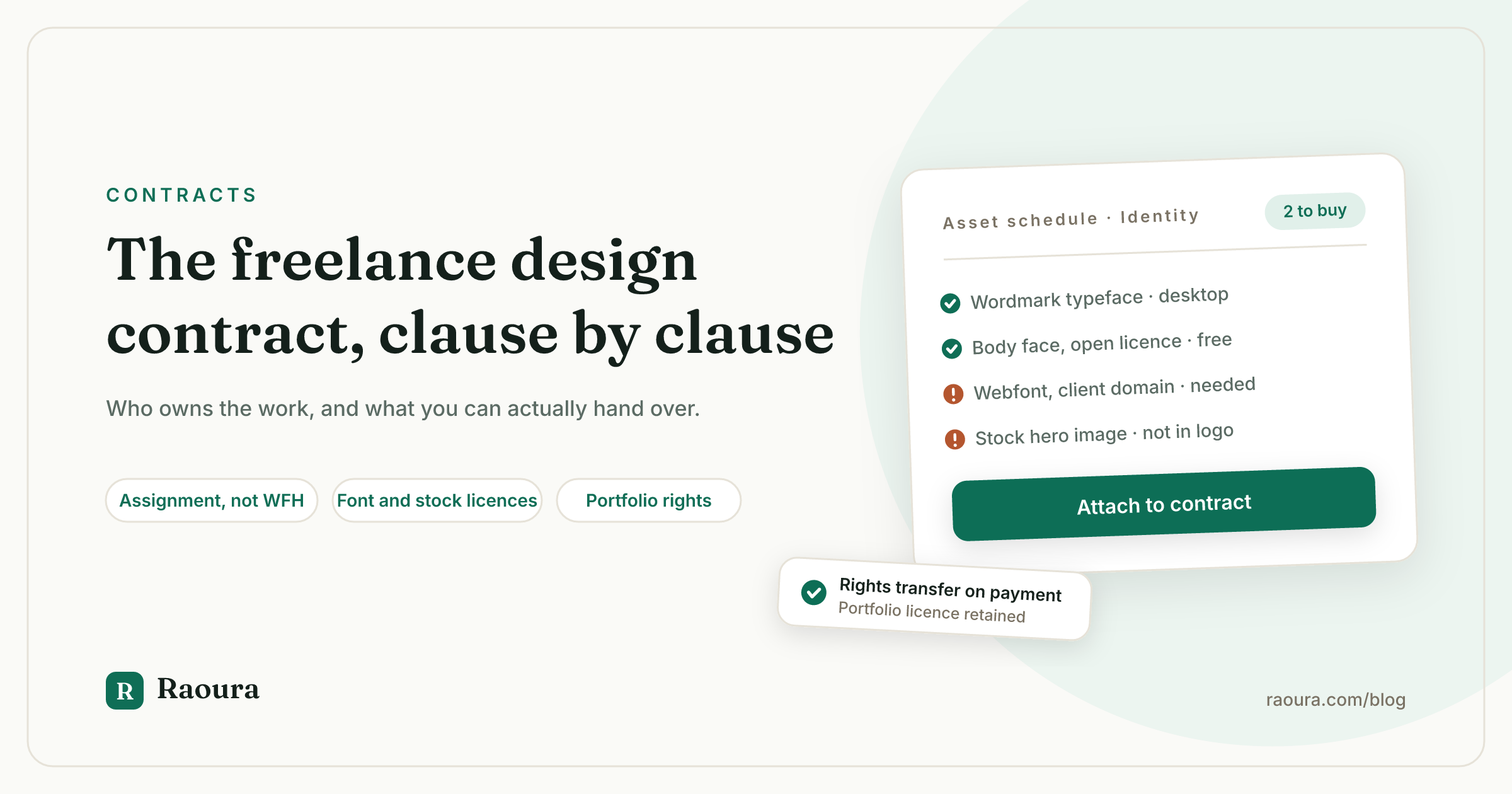
Before writing this we fetched the seven pages ranking for "freelance design contract" and its close variants in July 2026, and read every clause each one ships.
Two of them state the central rule of design copyright incorrectly. A website builder's guide tells you that "typically, the company hiring the freelancer gains ownership of the final product," and points you at a work-for-hire clause as the vehicle. A contract vendor's template appoints you "on an independent contractor and work for hire basis," then, four clauses later, says all intellectual property stays with you until payment in full. Those two statements cannot both be true, and the template does not notice.
But the bigger problem is what none of them have.
Every one of the seven promises the client will own the deliverables. Not one of them contains a clause about the fonts and stock images embedded in those deliverables, which in most cases you are not permitted to hand over at all. You can sign a perfectly drafted assignment and still deliver a logo the client has no right to edit, a website whose typeface stops rendering when your subscription lapses, and a hero image that cannot legally be part of their trademark.
That is the gap. Here is the whole document, clause by clause.
What the seven ranking pages actually contain#
We scored the seven ranking pages against 21 clauses a design contract needs, and across all seven only 58 of 147 possible slots were filled, with a single free PDF accounting for 19 of them.
We counted a clause as present only if it appears in operative contract text, not in the marketing copy or advice article wrapped around it. Partial credit went to clauses that are discussed but not drafted, or drafted so loosely that they do not do the job.
| Clause | Present (of 7 pages) | Partial |
|---|---|---|
| IP ownership or assignment | 2 | 2 |
| Work-made-for-hire framing | 1 | 2 |
| Transfer conditioned on payment | 2 | 1 |
| Portfolio or showcase rights | 4 | 2 |
| Source files vs deliverables | 1 | 2 |
| Moral rights | 1 | 1 |
| Revision limits | 5 | 1 |
| Kill fee | 1 | 2 |
| Deposit | 5 | 2 |
| Late fee or interest | 2 | 2 |
| Limitation of liability | 2 | 2 |
| Indemnification | 3 | 1 |
| Client-supplied asset warranty | 4 | 0 |
| Font or stock licence pass-through | 0 | 1 |
| Third-party costs and expenses | 4 | 1 |
| Termination | 7 | 0 |
| Independent contractor status | 2 | 1 |
| Confidentiality | 5 | 1 |
| Credit or attribution | 2 | 0 |
| Acceptance and approval mechanics | 5 | 0 |
| Reference to state freelancer payment law | 0 | 0 |
| **Total** | **58 of 147** | **24** |
Per page, the spread is brutal. The AIGA Standard Form of Agreement for Design Services scores 19 of 21. The best commercial template scores 11. Then 10, then 8, then 5, then 3, then 2.
Strip out AIGA and the six commercial pages fill 39 of 126 slots between them.
Three findings worth stating plainly.
Zero of seven have a font or stock licence clause. AIGA gets partial credit for a general third-party materials provision, which is closer than anyone else gets and still not a pass-through mechanism.
Zero of seven mention state freelancer payment law. Not New York, not Illinois, not California, not Los Angeles, not Columbus. These statutes impose a written-contract duty on your client above a dollar threshold and hand you double damages, which changes what belongs in the document.
The only page that gets copyright right is a 40-page PDF from a professional association. AIGA is ungated, free, and correct, and it is losing the SERP to vendor lead magnets because it is a PDF and it does not fill in blanks.
Four of the seven are published by e-signature or contract SaaS companies. One is a sponsored article that links to a freelance tool with an affiliate parameter. Their goal is a signup, not a legal update motion, which is why none of them mentions a statute enacted after 2023.
Who owns a design by default#
You do, from the moment you make it, and ownership moves to the client only through a signed written assignment. Payment alone does not move it.
US copyright vests in the author on creation (17 U.S.C. 201). You are the author of the logo, the layout, the illustration, and the interface. A transfer of copyright ownership "is not valid unless an instrument of conveyance, or a note or memorandum of the transfer, is in writing and signed" by the owner (17 U.S.C. 204(a)).
So a contract that is silent on IP leaves the copyright with you. The client gets an implied licence to use what they commissioned and paid for, and nothing more.
That is a much better default than the SERP suggests. One gated template page frames it as: "you need to be prepared to sign away property rights of your designs. It's worth asking if you can still use the design in your portfolio!" You are not signing anything away unless you sign it away, and what you get back is a matter of negotiation, not a favour.
Why "work made for hire" usually fails for design#
Commissioned design almost never fits the nine statutory categories, so a work-made-for-hire clause on its own frequently transfers nothing at all.
There are two routes to a work made for hire under 17 U.S.C. 101. The first is work by an employee within the scope of employment, which does not describe you. The second requires all three of the following: a specially ordered or commissioned work, a signed written agreement designating it as a work made for hire, and a fit into one of nine enumerated categories.
The nine categories are: a contribution to a collective work, a part of a motion picture or other audiovisual work, a translation, a supplementary work, a compilation, an instructional text, a test, answer material for a test, and an atlas.
A logo is none of those. A brand identity system is none of those. A website design is none of those. An illustration commissioned for a magazine can qualify as a contribution to a collective work. A diagram drawn to accompany someone else's text can qualify as a supplementary work. Most design work you are asked to sign a work-for-hire clause over does not qualify.
AIGA, alone on this SERP, says so directly, and warns that its own work-for-hire option "should not be used unless your work actually qualifies as work made for hire under the statutory requirements listed above."
Why this matters to you, in one sentence: a failed work-for-hire clause leaves the copyright with you, which sounds like a win until the client discovers it three years later and sues over a rebrand nobody can complete.
The clause that actually transfers a design#
Use a present-tense assignment, conditioned on payment, with the work-for-hire language kept only as a recital.
Designer hereby assigns to Client all right, title, and interest, including all copyright, in the Final Deliverables, such assignment to take effect automatically upon Designer's receipt of payment in full of all amounts due under this Agreement. Until such payment is received in full, Designer grants Client a revocable, non-exclusive licence to review and internally evaluate the Final Deliverables only, and any public, commercial, or production use before payment in full is unlicensed. To the extent any Final Deliverable qualifies as a work made for hire under 17 U.S.C. 101, it shall be so treated; to the extent it does not, this assignment shall apply. Designer shall execute any further documents reasonably required to perfect this assignment.
Four things are doing work there.
- "Hereby assigns" is a present transfer, not a promise to transfer later. One ranking template says only that the client "will own the final Graphic Design Deliverables" on completion, which is an agreement to assign, and an agreement to assign is not the signed instrument section 204(a) asks for.
- "Upon receipt of payment in full" is your leverage. Only two of the seven pages condition transfer on payment. This is the clause that gets designers paid.
- The unlicensed-use sentence turns a payment dispute into a copyright problem for the client, which is a different and much more uncomfortable conversation for them.
- The fallback structure means you do not have to be right about the work-for-hire question. If the recital fails, the assignment catches it.
Check that your IP clause and your payment clause agree#
This is the cheapest audit in this article and nobody teaches it.
One of the ranking templates appoints the designer "on an independent contractor and work for hire basis" in clause 2.1, then in clause 6.1 vests all intellectual property in the designer until payment in full. If the work-for-hire designation worked, the client would own the work from the instant of creation, which would gut clause 6.1 and the entire payment-security mechanism the template is built around.
Read your own contract's IP clause and payment clause back to back and ask one question: at what exact moment does ownership move, and does every clause in this document give the same answer?
If two clauses disagree, you have handed a future dispute a choice of arguments.
The licensing you are silently promising#
Zero of the seven ranking pages contain a clause about fonts or stock imagery, while all seven promise the client will own the deliverables, which means every one of them ships a contract that can only be honoured by breaching somebody else's licence.
Here is the concrete version. You buy a single-seat desktop licence for a typeface, draw a logo with it, outline the type, and deliver an SVG plus the editable source file. What have you actually conveyed?
The outlined artwork, fine. The font software, no. Monotype's desktop agreement grants a "non-exclusive, non-assignable, non-transferable" licence and permits transfer only if you "destroy all copies of the Font Software" first. You cannot keep working with a font and also hand it over.
Adobe is more explicit about the client's position. Its font licensing FAQ says a client does not need a separate licence for "rasterized or properly embedded font data, such as PDFs, JPEGs, or PNGs," but that "if your client needs to edit the design and access the fonts directly, they will require their own licence." And Adobe Fonts cannot be packaged with a file at all: "The Terms of Use don't permit the fonts to be transferred to another user or computer, so they cannot be packaged with the file."
Web fonts are stricter still. Adobe's web font page states that a client's "website must load Adobe Fonts through their own Creative Cloud subscription," and that "the client needs to set up their Creative Cloud subscription before the web font project can be transferred."
So the website you built stops rendering correctly the day your subscription lapses, unless somebody dealt with this in writing.
What triggers which font licence#
| Use in the deliverable | Licence usually required | Who should hold it |
|---|---|---|
| Logo drawn then outlined, delivered as vector or image | Desktop | You, to create it; client needs their own to edit the source |
| Editable source file handed to the client (.ai, .fig, .psd) | Desktop, one seat per person who will open and edit it | Client, in their own name |
| Font served on the client's website via @font-face | Webfont, usually metered by monthly page views and tied to one domain | Client, or bought in the client's name |
| Font embedded in an iOS or Android app binary | App or mobile licence, bought from the foundry | Client |
| Font embedded in an interactive PDF, ebook, or HTML5 ad | Electronic document or digital ad licence | Client |
| Font used by a web app to generate end-user output (personalised products, generated PDFs) | Server licence | Client |
| Any of the above with an SIL Open Font License typeface | None beyond the OFL itself | Nobody pays |
Two clarifications that come up constantly.
Outlining does not remove the obligation. It changes what you may do with the resulting artwork, not whether you needed the licence to make it. MyFonts states that "minimally a Desktop licence would be required to use a font in a logo," and that when the font file itself will not be embedded on a site, you buy Desktop rather than Webfont. That is a redirection to a different licence, never to no licence. Adobe permits modifying outlined type and trademarking the result, while still forbidding you from altering the font file or building a font from converted outlines.
Open source fonts are the clean answer. Under the SIL Open Font License 1.1, anyone may "use, study, copy, merge, embed, modify, redistribute, and sell modified and unmodified copies," subject to one real restriction: the fonts may not be sold by themselves, and a modified version may not reuse a Reserved Font Name. Google's font FAQ answers the question the foundries hedge on: "Can I use the font in a logo? Yes, you can use Google Fonts within any logo," on any surface, commercially.
If a client will not budget for a licence, an OFL typeface is not a compromise. It is the version with no downstream liability.
Stock images: three vendors, three different answers#
This is where "just buy it and bill it back" quietly goes wrong, because the three biggest libraries have genuinely different rules about buying on a client's behalf.
| Transfer or buy for a client? | Use inside a logo or trademark | Seat rules | |
|---|---|---|---|
| [Shutterstock](https://www.shutterstock.com/license) | No. The licence is "non-transferable"; the only carve-out is a one-time transfer to a printer or manufacturer | Prohibited outright, at every tier | Single seat, "no other persons (including employees, co-workers or independent contractors) may access your account" |
| [Adobe Stock](https://stock.adobe.com/license-terms) | Yes, once. You may "transfer the licence to your client or employer," but not "to more than one employer or client, unless separately licensed for each" | Registering a mark using the asset is barred; Adobe does not expressly address logo use itself | Assets from an Unmetered or Unlimited plan may not be used in client work at all |
| [Getty Images](https://www.gettyimages.com/faq/licensing) | Yes, at checkout. Name the client in the Licensee field. "Licences purchased with prepaid packs or subscriptions are not transferable" | Content may not be "the distinctive or distinguishing feature of a trademark, design mark, tradename, business name, service mark or logo" without a custom licence | Standard licence and subscriptions are single user |
Shutterstock's help documentation is unusually blunt about the logo question: "not even our strongest licences (Enhanced and Premier) allow photos, illustrations or vectors to be used as a logo, as part of a logo or as a trademark."
Read that sentence again if you have ever built an identity around a stock illustration.
Adobe Stock's Enhanced licence, worth knowing because it is routinely mis-sold, only removes the 500,000 reproduction cap. It does not unlock merchandise. Extended does.
The clause nobody on this SERP ships#
Put the pass-through in writing, as its own section, and make it a line item on the estimate.
Third-Party Assets. Certain Deliverables may incorporate fonts, stock imagery, plugins, or other third-party materials that are licensed rather than owned. Designer's assignment of the Deliverables does not convey any right in such third-party materials. Designer will identify each third-party asset, its licensor, and the licence tier required for Client's intended use in an Asset Schedule delivered with the Final Deliverables. Where the licensor permits, Designer will procure the licence in Client's name at Client's cost, subject to Client's prior written approval of any cost exceeding [$X]; where the licensor does not permit transfer, Client is responsible for obtaining its own licence. Designer's warranty of non-infringement does not extend to Client's use of any third-party asset beyond the scope of the licence identified in the Asset Schedule.
The Asset Schedule is the part that matters. It is a table with four columns: asset, licensor, licence tier, who holds it. It takes ten minutes at handover, it makes the invoice for a webfont licence self-explaining, and it converts an absolute non-infringement warranty into a defensible one.
It is also the single clearest way to look more professional than the agency you lost the last pitch to.
Source files vs deliverables#
"Deliverables" is not a defined term unless you define it, and the .ai, .fig, or .psd file is the most common thing freelance designers and clients fight about after the invoice.
Only AIGA distinguishes final working files from preliminary concepts and rejected directions. Every commercial template on this SERP says "deliverables" and leaves the question open.
Define three tiers in the contract.
- Final Deliverables. The approved, production-ready output in the formats listed in the scope. This is what the assignment covers.
- Working Files. The layered, editable source. Included only if the scope says so, and priced accordingly.
- Preliminary Works. Concepts, explorations, and rejected directions. These stay yours, always, and the client gets no licence to use them.
That third tier is the one people forget, and it is the one that stops a client from taking the runner-up concept to a cheaper designer.
We wrote the pricing side of this up separately in should freelancers hand over source files, including what a source file buyout is worth relative to the project fee.
Portfolio rights, and the two clauses that quietly kill them#
Four of the seven pages mention portfolio rights, and one ships a contract whose confidentiality and return-of-materials clauses silently cancel portfolio use without ever mentioning it.
That template requires the designer, on termination, to "return all the Client content, materials, and all copies of Deliverables to the Client" within thirty days, and pairs it with a broad confidentiality clause. There is no portfolio provision anywhere in either of its two contracts. Following it to the letter means deleting your own copies of your own work and treating the project as confidential.
Assignment plus NDA plus no carve-out equals no portfolio. That is the arithmetic, and it happens silently.
Ask for the carve-out explicitly.
Notwithstanding the assignment above, Designer retains a perpetual, non-exclusive, royalty-free licence to reproduce and display the Final Deliverables in Designer's portfolio, case studies, and marketing materials, and to identify Client as a client, in each case excluding any information designated as Confidential. Where Client requires an embargo, Designer will not display the work before [date].
One point in your favour that only AIGA raises: even where the client owns the copyright, you have a fair use argument for showing final published work in a portfolio. Do not rely on it. Negotiate the clause, and use the embargo option when the client's objection is really about launch timing rather than secrecy.
Moral rights, done correctly#
Under US law moral rights cannot be assigned, only waived in a signed writing, and one ranking template gets this wrong in both directions in the same document.
17 U.S.C. 106A(e) permits waiver by the author in a signed written instrument, and states that these rights may not be transferred. One template on this SERP requires subcontractors to sign an assignment "including moral rights," which is not a thing US law allows, and elsewhere has the agency "retain all moral rights in relation to the Deliverables," which under US law is largely empty because VARA covers narrow works of visual art such as paintings, sculpture, and limited-edition prints, not commercial graphic design.
Practical takeaway, in two parts.
For US work, a moral rights waiver is boilerplate that costs you almost nothing, because you had almost nothing to waive. Attribution matters to you, so put it in a credit clause rather than hoping moral rights will carry it.
For clients in the EU, UK, or Canada, moral rights are real and are usually waived expressly. Read that clause rather than skimming it, and note that in several of those jurisdictions attribution rights are personal and durable in ways US law does not replicate.
Revisions, kill fees, and change orders#
Five of the seven pages limit revisions. One names a kill fee.
Revision limits are the easy part, and most templates do them adequately: a stated number of rounds at each stage, a definition of what counts as a round, and an hourly or per-round rate for anything beyond. The trap is defining a round as "a set of consolidated feedback delivered in a single document," because otherwise six emails over four days become six rounds you did not charge for and did not want.
The kill fee is the part almost everybody skips. Termination clauses that pay you "for work performed to date" are not kill fees. They pay you for the past and give the client a free option on your calendar.
A kill fee is a stated amount, payable on cancellation, on top of work completed. AIGA is the only page here that names the concept, calling it "often called a 'kill fee' or 'early termination fee'." Our full treatment is in kill fees for freelancers, and the mid-project version is in change orders for freelancers.
Three sentences that make cancellation survivable:
- Client may terminate on written notice.
- On termination, Client pays for all work completed and accepted, plus [X] percent of the fee for the phase in progress.
- No rights in any Deliverable transfer unless and until those amounts are paid in full.
That third sentence is the one people forget, and it is what stops a cancelled project's concepts from appearing on the client's website next quarter.
The payment clause, and the statutory leverage behind it#
Zero of the seven ranking pages mention a state freelancer payment law, even though eight US jurisdictions now require your client to give you a written contract above a dollar threshold and expose them to double damages for paying late.
This is the single largest content gap on this SERP, and it changes what your contract should say.
| Jurisdiction | In force since | Written contract required at | Payment due | Damages for nonpayment |
|---|---|---|---|---|
| [New York State](https://dol.ny.gov/freelance-isnt-free-act) | Aug 28, 2024 | $800, aggregated over 120 days | Contract date, else 30 days | Double the unpaid amount, plus attorney fees |
| [New York City](https://www.nyc.gov/site/dca/about/freelance-isnt-free-act.page) | May 15, 2017 | $800, aggregated over 120 days | Contract date, else 30 days | Double the unpaid amount, plus attorney fees |
| [Illinois](https://labor.illinois.gov/laws-rules/legal/freelance-worker-protection-act.html) | Jul 1, 2024 | $500, aggregated over 120 days | Contract date, else 30 days | Double the underpayment, plus attorney fees |
| [California (SB 988)](https://leginfo.legislature.ca.gov/faces/billTextClient.xhtml?bill_id=202320240SB988) | Jan 1, 2025 | $250, professional services only | Contract date, else 30 days | Up to double the unpaid amount, plus attorney fees |
| [Los Angeles](https://wagesla.lacity.gov/) | Jul 1, 2023 | $600, work performed in the city | Contract date, else 30 days | Up to double the unpaid amount, plus attorney fees |
| [Columbus, OH](https://columbus.legistar.com/LegislationDetail.aspx?ID=6178197&GUID=38DD3933-90AC-46E8-A275-97277A532482&FullText=1) | May 31, 2023 | $250, aggregated over 120 days | Contract date, else 30 days | City sanctions on the client |
Graphic design and web design sit squarely inside California's list of covered professional services, so the $250 threshold catches almost every project you will ever quote.
Two operational notes that matter more than the numbers.
First, the duty sits on the hiring party, not on you. Your client is the one exposed if there is no written contract, which is a useful thing to be able to say pleasantly in an email.
Second, Illinois and New York both attach separate statutory damages when the client refused a written contract after you asked for one, and in Illinois the $500 tier requires proof you requested it before starting work. So ask in writing, every time, before you begin. The email takes thirty seconds.
Our full breakdown is in freelance payment laws by state, with the state-specific mechanics in the Illinois act and the California act.
Your payment clause itself needs five things: a non-refundable deposit before work starts, milestones tied to acceptance rather than dates, a stated late fee, a right to suspend work on overdue invoices, and the assignment conditioned on payment in full. AIGA's own form uses one and a half percent per month as its late charge, which is a common and defensible figure where state usury rules permit it. See freelance late fees for the ceiling in your state, and how much deposit should a freelancer charge for the front half.
Liability, indemnity, and the client's own assets#
Two of the seven pages cap liability. Three have an indemnity, and one of those runs only in the client's favour.
Three clauses, in the order they save you money.
1. Cap total liability at fees paid#
Design work can sit inside a campaign whose budget is fifty times your fee. Without a cap, a claim is not bounded by anything you earned. Cap aggregate liability at the total fees paid under the agreement, and exclude indirect, consequential, and lost-profits damages on both sides.
2. Warrant your own work, not the client's materials#
Four of the seven pages do handle this, and it is the clause designers most often lose. You warrant that your original work does not infringe. You do not warrant the logo they sent you, the photographs they supplied, the copy they wrote, or their right to use any of it.
Client represents and warrants that it owns or has licensed all Client Materials supplied to Designer, and will indemnify Designer against claims arising from Designer's use of Client Materials as directed.
3. Make indemnity mutual, and tie it to an adjudicated breach#
A one-way indemnity that fires on any "claim" makes you pay your client's legal bills for a complaint that turns out to be nonsense. Tie your indemnity obligation to a final adjudication of your breach, and add a knowledge qualifier to any non-infringement warranty.
The knowledge qualifier is the part the licensing section above earns you. Once you have an Asset Schedule listing every third-party font and image and its licence, "to the best of Designer's knowledge" stops being a hedge and becomes a documented position.
For the full red-flag list when a client sends you their paper, see freelance contract red flags.
A minimum viable design contract#
If you take nothing else from this page, these are the clauses that carry actual financial consequence, in this order.
- Scope with exclusions. What is in, what is explicitly out, deliverable formats named, and the number of initial concepts stated.
- Revisions. Rounds per stage, consolidated feedback defined as one round, hourly rate beyond.
- Change orders. Anything outside the scope is quoted and approved in writing before it is designed.
- Payment. Deposit before work starts, milestones tied to approval, stated late fee, right to suspend on overdue invoices.
- IP. Present-tense assignment effective on payment in full, work-for-hire recital as fallback only, revocable evaluation licence until then, further assurances.
- Deliverable tiers. Final Deliverables, Working Files (priced), Preliminary Works (retained by you).
- Third-party assets. Asset Schedule at handover, licences bought in the client's name where transfer is not permitted, warranty scoped to the schedule.
- Portfolio. Perpetual non-exclusive display licence carved out of the assignment, excluding confidential information, embargo date if needed.
- Credit. Attribution where you want it, since US moral rights will not give it to you.
- Client materials. Client warrants ownership of what they supply, and indemnifies you for it.
- Liability. Capped at fees paid, no consequential damages, mutual indemnity tied to adjudicated breach.
- Termination and kill fee. Either party on notice, payment for completed work plus a stated percentage of the phase in progress, no rights transfer until paid.
- Boilerplate. Independent contractor status, confidentiality with the portfolio carve-out intact, governing law, written amendments.
Thirteen items. A good design agreement is four to six pages, not thirty.
For the general-purpose version of this checklist across all freelance work, see what should be in a freelance contract, and for the ownership question on its own, freelance IP rights. The developer-specific version, with acceptance criteria and open source disclosure, is in the freelance developer contract.
Where Raoura fits#
Disclosure: Raoura is our product. It is a $17 a month client and project tool for solo freelancers, and it is not a law firm. What it does is make the clauses above happen on every project instead of only the ones where you were paying attention.
The failure mode is rarely ignorance. It is that the good contract lives in a folder, last project's version got edited in a hurry at 11pm, and the small logo job that turned into a licensing mess was the one that went out on a two-paragraph email.
A template library fixes that by making the careful version the default version.

The payment-conditioned assignment, the portfolio carve-out, and the third-party asset clause only protect you if they are in the template you actually send.
The other half is the Asset Schedule. Font and stock licences are the costs designers most often absorb silently, because raising them after the estimate feels like a renegotiation. They stop feeling that way when they were a line on the proposal from the start, with the licence tier named next to the number.

A webfont licence billed as an approved line item is an invoice. The same licence raised at handover is an argument.
One thing worth stating plainly given the subject: Raoura never holds your money. Client payments run through your own Stripe account, directly to you, with no commission taken. We wrote about why that matters in why your client tool should never touch your money.
Verified July 2026. Primary sources: 17 U.S.C. 101, 106A, 201, and 204 via Cornell LII; AIGA Standard Form of Agreement for Design Services (2022 update); Adobe Fonts licensing FAQ (page updated 27 March 2026) and web font licensing FAQ (updated 14 November 2025); Monotype Single User License Agreement and Monotype web font EULA v220701; MyFonts licensing FAQ (updated 18 June 2026); SIL Open Font License 1.1 official text via openfontlicense.org; Google Fonts FAQ (updated 18 December 2025); Shutterstock Terms of Service (effective 19 January 2026) and Shutterstock support article on logos and trademarks (17 March 2025); Adobe Stock license terms and Adobe Stock product-specific terms (16 January 2026); Getty Images licensing FAQ (modified 10 April 2026) and the iStock content license agreement (October 2024); New York General Business Law Article 44-A and NY DOL guidance; NYC DCWP Freelance Isn't Free Act; 820 ILCS 193 and Illinois DOL guidance; California SB 988 via leginfo.legislature.ca.gov; Los Angeles Office of Wage Standards; Columbus City Council ordinance. The 21-clause audit reflects the seven pages ranking for "freelance design contract" and its close variants as read in July 2026. Getty's own EULA page did not render to a direct fetch, so the trademark wording quoted is from the iStock agreement of the same corporate group. This article is information, not legal advice.
Frequently asked questions
Who owns a logo a freelance designer creates?
The designer, by default, from the moment it is drawn. Ownership moves to the client only through a signed written assignment, because 17 U.S.C. 204(a) requires a written, signed instrument for any transfer of copyright. Payment alone does not transfer it, and a contract silent on IP leaves you the owner with the client holding an implied licence to use what they commissioned.
Does a work-made-for-hire clause work for graphic design?
Usually not on its own. For a commissioned work from an independent contractor, the statute requires the work to fall into one of nine categories, and logos, identity systems, and website designs are not among them. Illustrations for a magazine can qualify as contributions to a collective work, and diagrams accompanying text can qualify as supplementary works. Because the fit is unreliable, pair the recital with an express assignment and let the assignment do the work.
Can I give my client the fonts I used in their logo?
Generally no. Most commercial desktop licences are non-transferable, and Monotype's permits transfer only if you destroy your own copies first. Adobe Fonts cannot be packaged with files at all, and Adobe states that a client who needs to edit the design "will require their own licence." Deliver outlined artwork, list the typeface and its licensor in an Asset Schedule, and have the client buy their own licence in their own name if they need to edit or serve it.
Can I use a stock photo in a client's logo?
Not under a Shutterstock or Getty standard licence. Shutterstock prohibits using content "as a trademark, service mark, logo, or other indication of origin" at every tier including Enhanced and Premier, and Getty bars content being "the distinctive or distinguishing feature of a trademark" without a custom licence. Adobe Stock's terms bar registering a mark that uses the asset, and do not expressly address logo use, so treat that as unsettled rather than permitted. Commission or draw original artwork for identity work.
Can I buy stock images on behalf of my client?
It depends entirely on the vendor. Adobe Stock lets you transfer a standard licence to one client, but not to more than one, and forbids using Unmetered plan assets in client work at all. Getty lets you name the client in the Licensee field at checkout, but subscription and prepaid-pack licences are not transferable. Shutterstock does not permit transfer to a client at all and runs a single-seat licence, so the client must buy their own or you need a Team or Premier account.
Do I legally need a written contract as a freelance designer?
In several jurisdictions your client does. Illinois requires one at $500, New York State and New York City at $800, California at $250 for professional services, Los Angeles at $600, and Columbus at $250, each aggregated across a 120-day window. The duty sits on the hiring party, and failing it exposes them to statutory damages on top of double damages for late payment. Outside those places, a written contract is still what makes an approval date, a scope boundary, and a copyright transfer provable.
How many revision rounds should a design contract include?
There is no verifiable industry standard, and any page quoting one is quoting itself. Two rounds per stage is common for identity work and three for larger web projects, but the number matters far less than the definition. Define a round as one set of consolidated written feedback, state a rate for anything beyond, and require change orders for anything outside the approved scope. We cover the mechanics in how many revision rounds to include.
Can a client stop me showing the work in my portfolio?
Yes, if you signed an assignment and an NDA and asked for nothing back. That combination transfers the work and classes the details as confidential, and one template on this SERP goes further by requiring you to destroy your own copies on termination. Ask for an express portfolio licence carved out of the assignment and excluding confidential information, and offer an embargo date if the client's real concern is launch timing.
Do I have to hand over the source files?
Only if the contract says so. Final Deliverables and Working Files are different things, and the assignment covers what you defined as deliverables. Decide in advance whether editable source is included, price it if it is, and keep preliminary concepts and rejected directions out of the transfer entirely. See freelance source files for the pricing norms by discipline.
---
Run your client work in one place
Send a proposal, get it signed, invoice, and get paid, with a branded portal your clients will actually use. One flat plan at $17/month, and we never take a cut of your payments.
Try Raoura free for 14 daysNo credit card required. Set up in minutes.
Keep reading
Is Upwork Worth It in 2026? A Break-Even Test for Your Situation
Upwork is worth it when its fee costs less than finding the client yourself, and that is true far more often for a first project than for a repeat client. Here is the break-even math with 2026 numbers: the 0 to 15% fee, Connects, the shrinking client base, and when to wait out the 24-month rule instead of paying to leave.
The Virtual Assistant Contract: 24 Clauses, Scored Against Every Template Ranking for This Search
We scored the four pages that publish actual virtual assistant contract text against 24 clauses a VA agreement needs. Twenty-four of 96 possible slots were filled. The best single template managed 7 out of 24. Twelve clauses appear in none of them, including every clause about the thing that makes VA work different from other freelance work: you are holding your client's passwords and running their inbox. One popular template also tells you a contract fixes your independent contractor status, then mandates client-set 9 to 5 weekday hours in the same document. Here is the clause-by-clause version, with the classification test the DOL is actually applying in 2026, the data protection terms nobody drafts, and the retainer mechanics that decide whether unused hours roll over.
Stripe vs PayPal for Freelancers: Every Fee Verified (2026)
Every page ranking for this comparison either prints in-person retail rates, contradicts itself, or skips the numbers freelancers actually pay. We read the current Stripe and PayPal pricing pages line by line, ran a $3,000 invoice through every rail, and found a $1,764 per year gap between the cheapest setup and the default one.