The Freelance Consulting Contract, Written From Your Side of the Table
August 30, 2026
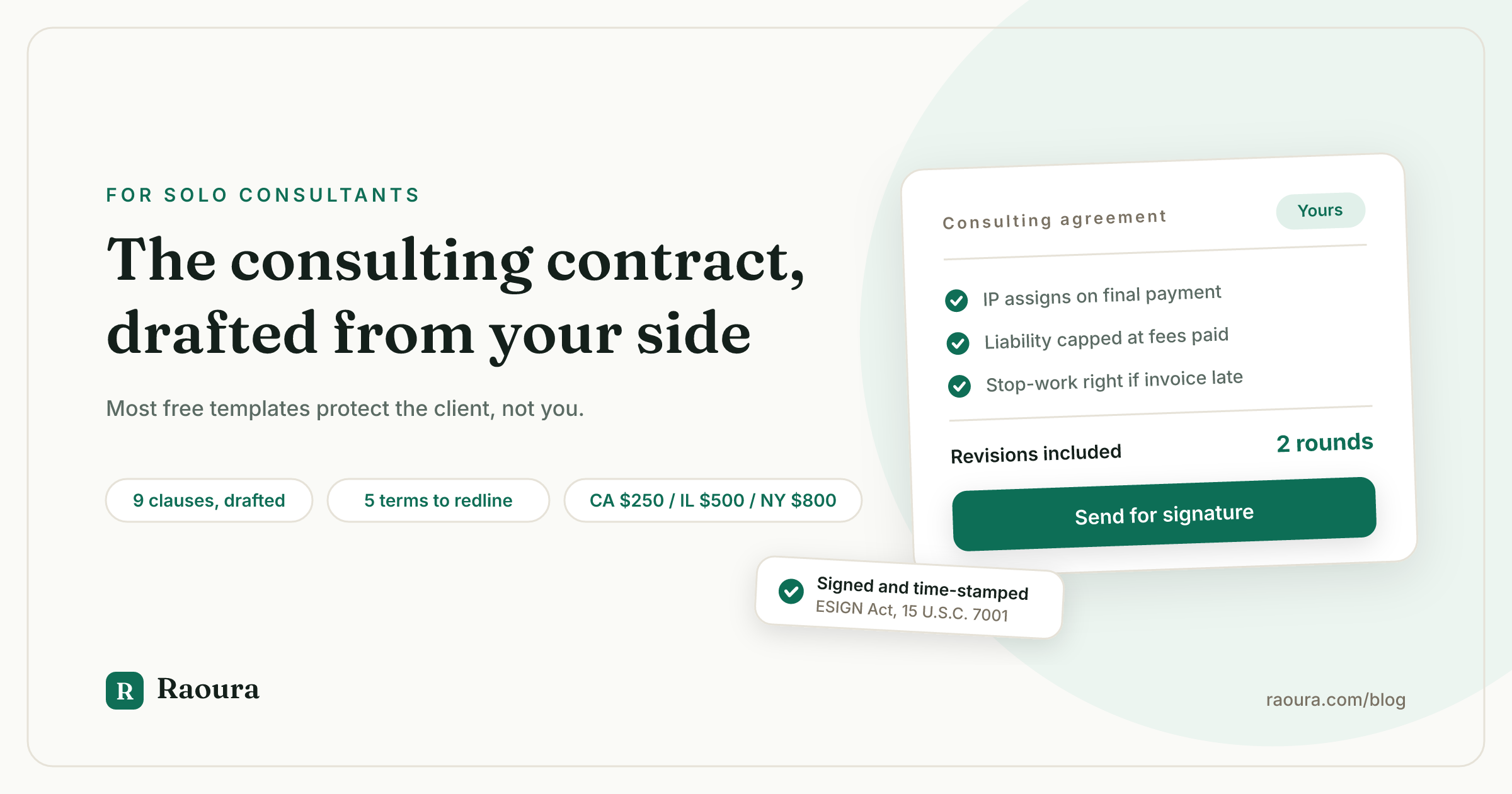
Search "consulting contract freelance" and you will get a dozen free templates in about four seconds. That is the problem.
We pulled the pages ranking for that query and its variants on July 19, 2026 and read the actual clause text. Most of them were drafted for the party on the other side of the table: the company hiring a consultant. Rocket Lawyer's page says so in its own meta description ("Protect your business when hiring a consultant"). LegalTemplates opens with "A consulting agreement lets a company bring in an expert."
The templates that look neutral are usually not. eForms' consulting agreement states, as a default, that "any work that is provided falls under the ownership of the client unless otherwise agreed," and recommends a non-compete "no matter the laws in the state." Neither of those is good guidance for you, and one of them is not accurate law.
So this is not another template dump. This is the same agreement, clause by clause, drafted from your side, with the numbers that every other page leaves blank.
The intent split nobody warns you about#
Of the eight pages ranking for consulting contract queries in July 2026, three are written explicitly for the company hiring a consultant, two look neutral but carry buyer-favorable defaults, and three are written for the consultant, one of which has not been updated since 2022.
Here is what that looks like in practice. A clause list is identical on every page: parties, scope, payment, IP, confidentiality, termination. Every page names the clause. Almost none tell you what the clause should say when you are the one selling.
That gap is the whole article.
| Page | Whose side it is drafted for | The tell |
|---|---|---|
| [Rocket Lawyer](https://www.rocketlawyer.com/business-and-contracts/business-operations/product-or-service-sales/document/consulting-agreement) | The buyer | "Protect your business when hiring a consultant" |
| [LegalTemplates](https://legaltemplates.net/form/employment-contract/independent-contractor/consulting/) | The buyer | "lets a company bring in an expert" |
| [eForms](https://eforms.com/employment/independent-contractor/consulting/) | Reads neutral, drafts buyer-favorable | Client owns work by default, uncapped consultant indemnity |
| [PandaDoc](https://www.pandadoc.com/consulting-agreement-template/) | Reads neutral, hides buyer-favorable traps | Consultant-favorable IP clause, but a client set-off clause and mandatory AAA arbitration |
| [HoneyBook](https://www.honeybook.com/freelance-consulting-contract-template) | The consultant | Treats "consultant" as a synonym for any freelancer |
| [Consulting Success](https://www.consultingsuccess.com/consulting-agreement) | The consultant | Strongest seller-side page, but outsources every template |
| [Indy](https://weareindy.com/blog/consulting-contracts-a-guide-for-freelancers) | The consultant | Genuinely seller-side, but published 2021 and last touched Dec 2022 |
| University and SEC procurement PDFs | The buyer | Institutional paper for hiring outside advisors |
If you download a template without checking which chair it was written from, you are negotiating against yourself before the client has said a word.
Do you legally need a written contract? In three states, yes, above a dollar threshold#
Three US states now require a written contract for freelance and consulting work above a threshold: California at $250, Illinois at $500, and New York at $800, all measured across a rolling 120-day period, and all three set a default payment deadline of 30 days after you finish.
These are the freelancer protection laws, and they changed the calculus. A written contract is no longer just good hygiene. In these states it is the hiring party's legal obligation, and failing to provide one carries statutory damages on top of whatever you are owed.
| State | Threshold | Payment deadline if unstated | Damages for no written contract | Damages for late or non-payment |
|---|---|---|---|---|
| [California](https://leginfo.legislature.ca.gov/faces/codes_displayText.xhtml?lawCode=BPC&division=7.&part=5.) (BPC 18100-18107, eff. Jan 1 2025) | $250 | 30 days | $1,000 | Up to 2x the unpaid amount |
| [Illinois](https://labor.illinois.gov/laws-rules/legal/freelance-worker-protection-act.html) (820 ILCS 193, eff. July 1 2024) | $500 | 30 days | $500 | 2x the underpayment |
| [New York](https://dol.ny.gov/freelance-isnt-free-act) (GBL Art. 44-A, eff. Aug 28 2024) | $800 | 30 days | $250 | Double damages |
All three also award attorney's fees and costs to a prevailing freelancer, which is the provision that actually makes these laws usable. A lawyer will take a $9,000 unpaid invoice case when fees are recoverable and will not when they are not.
Two details that trip consultants up.
First, in New York and Illinois the statutory damages for a missing contract only apply if you requested one before the work began, under 820 ILCS 193/30(b) and the equivalent New York provision. Put the request in writing, in an email, before you start.
That email is the evidence.
Second, California's law contains a clause that reads like it was written after watching a scope creep argument. Under BPC 18102(b), the hiring party may not condition timely payment on you accepting less money, or providing more services or more IP rights than you agreed to. That is a statutory ban on the "we will pay once you also do X" move.
An original observation from this run, because it says something the vendor pages will not. Illinois published its first statutory report on the law on July 1, 2025, covering the Act's first year. It received 24 complaints in twelve months, and lacked jurisdiction over 14 of them.
Twenty-four, in a state with hundreds of thousands of independent workers. Meanwhile the state's free model contracts were downloaded more than 2,000 times.
Read that how you like, but the honest reading is: the law exists, almost nobody is using the enforcement path, and the contract is still doing the real work.
We cover the state-by-state detail in freelance payment laws by state, and each of the three laws separately in the California and Illinois guides.
The nine clauses, drafted from your side#
A consulting agreement for a firm of one needs nine clauses, and four of them (IP on payment, capped liability, defined revisions, and a stop-work right) are the ones template sites either omit or draft backwards.
The other five are standard. Get these nine right and you can sign almost anything else that comes your way.
1. Scope, and the "not included" list#
Your scope section needs a second half that most templates do not have: an explicit list of what is out of scope. Deliverables, plus exclusions, plus the format each deliverable arrives in.
The exclusion list is what turns "can you just also..." into a change order conversation instead of an argument. Write it as a bulleted list of five to eight items, in the client's own vocabulary.
Full mechanics in our statement of work guide.
2. Fees, deposit, and the payment schedule#
Name a number, not a rate philosophy. For consulting engagements the shape that survives contact with a corporate AP department is a deposit up front, then milestone or monthly billing, never a single invoice at the end.
A 30% to 50% deposit is standard for project consulting. Net 15 beats net 30 for a firm of one, and you should assume the client will counter to net 30 and sometimes net 45. We break the tradeoffs down in freelance payment terms and how much deposit to charge.
The default is: you should never be owed more than one phase of work. That principle is the whole argument for milestone billing.
3. Late fees#
A late fee clause has to state a rate, a grace period, and the compounding basis, or it is decorative. 1.5% per month (18% annualized) is the figure most commercial contracts use, but it is a convention rather than a legal standard, and several states cap what you can charge below it.
The clause is not really about collecting the fee. It is about giving your follow-up email something to point at. See freelance late fees for the state limits.
4. IP transfers on payment, not on delivery#
This is the clause template sites get most wrong, in both directions.
The eForms template says the client owns everything by default. PandaDoc's says you keep copyright and the client gets a non-exclusive license. Neither is the arrangement you want.
The version that works for a consultant has three parts:
- You retain your background IP. Your frameworks, models, spreadsheets, code libraries, and methodology existed before this engagement and stay yours. The client gets a license to use them inside the deliverable.
- The client gets an assignment of the deliverables, effective on receipt of final payment. Not on delivery. On payment.
- You keep a portfolio right. A named right to display the work, or an anonymized version of it, in your portfolio and case studies.
The payment-contingent assignment is the single highest-leverage sentence in the document, and essentially no ranking page includes it. If the client has not paid, they do not own it, which makes non-payment a copyright problem for them rather than a collections problem for you.
Our freelance IP rights guide covers work-for-hire mechanics and why the phrase does not mean what most clients think it means.
5. A liability cap#
For a solo consultant with no errors-and-omissions policy, an uncapped indemnity is the clause that can end your business over a $6,000 engagement.
Cap your total liability at the fees paid under the agreement, and exclude consequential and indirect damages. That is a normal, defensible commercial ask, and it is the term most likely to survive client legal review without a fight because their own vendor contracts contain the same clause.
The eForms template hands you unlimited, one-way indemnity with a client right to withhold funds. Do not sign that.
6. Revisions, with a number#
Two rounds of revision included, then an hourly rate. Write the number.
"Reasonable revisions" is not a term, it is a future argument. Scripts for the conversation are in scope creep scripts, and the paperwork for it is in change orders for freelancers.
7. A stop-work right#
One sentence: if an invoice is more than X days overdue, you may suspend work until it is paid, and timelines shift accordingly.
Without it, pausing work is arguably your breach. With it, it is a contractual remedy. This is the difference between leverage and exposure, and it is covered in full in stopping work over an unpaid invoice.
8. Termination and a kill fee#
Either party may terminate on written notice. What matters is what happens to money.
For consulting, the workable formula is: all work performed through the termination date is billable at your rate, the deposit is non-refundable, and any in-flight milestone is billed at a stated percentage. See kill fees for freelancers.
9. Governing law, and skip the arbitration clause#
Name your own state. If the client insists on theirs, that is a real concession you can trade for something.
Be careful with mandatory arbitration. PandaDoc's template imposes AAA arbitration with fees split equally, which sounds fair and is not. Arbitration filing fees on a small commercial claim can approach or exceed the amount you are chasing.
For a solo consultant, small claims court is usually the better forum under your state's limit, and it does not require a lawyer. See small claims court for a freelance invoice.
When the client sends their paper instead#
Most consulting engagements with a company above about 50 people will run on the client's MSA, not yours, so the more useful skill is redlining five specific terms rather than defending your own template.
You will not win the "use my contract" fight with a client that has a procurement function. You do not need to. You need to change five things.
- Uncapped indemnity. Ask to cap total liability at fees paid and exclude consequential damages. Highest priority, most commonly granted.
- Blanket IP assignment. Ask for a background-IP carve-out and for the assignment to trigger on final payment.
- Payment terms beyond net 45. Counter to net 30 with a deposit. If they cannot move the terms, move the price.
- Unlimited revisions or vague acceptance. Ask for a numbered revision cap and a deemed-acceptance window: if they do not respond within 7 or 10 business days, the deliverable is accepted.
- Broad non-solicit or non-compete. Narrow it to the specific client account and a defined term. California voids them almost entirely under Bus. & Prof. Code 16600, and Minnesota banned new ones outright under Minn. Stat. 181.988, which makes the eForms advice to include one "no matter the laws in the state" actively bad.
Our contract red flags piece is the longer version of this list.
Are you actually an independent contractor?#
The IRS applies three common-law categories to worker classification (behavioral control, financial control, and type of relationship), and explicitly states there is no set number of factors that decides it.
This matters more for consultants than for other freelancers, because consulting engagements tend to be long, on-site or in-meetings, and often dominated by one client.
The IRS classification page, last reviewed May 19, 2026, is the primary source. Its quotable line:
"There is no 'magic' or set number of factors that 'makes' the worker an employee or an independent contractor and no one factor stands alone in making this determination."
Notably, "type of relationship" explicitly includes whether there are written contracts. Your consulting agreement is evidence in the classification analysis, which is a second reason to have one.
If a determination is genuinely contested, either party can file Form SS-8, though the IRS says it may take at least six months.
One 2026 change worth knowing, because it will confuse people this January. The 1099-NEC filing threshold rose from $600 to $2,000 for payments made after December 31, 2025, under the One Big Beautiful Bill Act, per the IRS instructions for Forms 1099-MISC and 1099-NEC, which also note that the $600 figure had stood since 1954.
That is the payer's filing trigger, not an income exemption, so you still report every dollar.
It just means smaller engagements will stop generating a form, so your own records become the only record.
Does a signature have to be wet ink?#
No. Under the ESIGN Act, a contract cannot be denied legal effect solely because an electronic signature was used to form it, and that has been federal law since October 1, 2000.
The statutory language at 15 U.S.C. 7001(a)) is direct:
"a contract relating to such transaction may not be denied legal effect, validity, or enforceability solely because an electronic signature or electronic record was used in its formation."
UETA, approved in 1999, covers the state-law side and has been enacted in 49 states plus DC and the US Virgin Islands. New York is the holdout, using its own Electronic Signatures and Records Act instead.
What actually matters for enforceability is not the signature graphic. It is the audit trail: who signed, from what IP address, at what timestamp, against which exact version of the document.
Any tool that stores that is fine. Full detail in are e-signatures legally binding.
Where the contract has to live to be useful#
The nine clauses above are worth nothing if the signed document is not findable eighteen months later, which is when a written contract's advantage actually pays off: in California a written agreement gives you four years to sue instead of the two you get on an oral one.
That is the operational failure mode for solo consultants. The contract is in a Dropbox folder, the SOW is in a Google Doc, the invoice is in accounting software, and none of them agree about the revision count.
The terms in the signed document also have to be the same terms as the invoice you send.
Disclosure: Raoura is our product, and this is our blog. We built it because a firm of one should not need four tools to keep one engagement straight. Contract templates, e-signature, proposals, and invoices sit in the same place, and the signed contract stays attached to the client record and the project it belongs to.

The template library is the practical answer to clause drift: your capped-liability and payment-on-assignment language lives in one place instead of being retyped per client.

The audit trail is the part that makes an e-signature enforceable, and it is the part that has to still exist when a dispute starts eighteen months later.
Raoura is one flat plan at $17 per month, with no cut of your payments (they go to your own Stripe account). Whether you use us or a folder system you build yourself, the rule is the same: one place, one version, retrievable.
If you are also weighing where clients see their documents, we compared 12 options in client portals for consultants.
Frequently asked questions
Do I need a lawyer, or is a template enough?
For engagements under roughly $25,000 with standard commercial terms, a well-drafted template you understand is usually proportionate. Pay for an hour of a lawyer's time once, to review your standard agreement, and then reuse it. The moment you cannot explain what a clause does, that is the clause to ask about.
What if the client refuses to sign my contract?
Most large clients will insist on their own paper. That is normal and is not a red flag by itself. Refusing to sign anything at all is a red flag, and in California, Illinois, and New York it is also a legal problem for them above the state threshold.
Is a signed proposal enough, or do I need a separate contract?
A proposal with terms attached and a signature on it can form a binding contract. The practical question is whether it contains the nine clauses above. Most proposals contain three. See proposal vs contract.
Can I put the work in my portfolio?
Only if the contract says so. Blanket IP assignment plus a confidentiality clause can, read strictly, prevent you from naming the client at all. Ask for an explicit portfolio right, with anonymization as the fallback.
Do I need a separate NDA?
Usually not. A confidentiality clause inside the consulting agreement covers the same ground with less paperwork. A standalone NDA makes sense when the client wants confidentiality before there is an engagement to contract for.
What happens if they cancel at 60% complete?
Whatever your termination clause says. With no clause, you are arguing about quantum meruit. With a clause, you bill work performed through the termination date, keep the deposit, and bill the in-flight milestone at the stated percentage.
Which state's law should I name?
Yours, if you can get it. Governing law determines which state's contract rules and limitation periods apply, and it also affects how practical small claims court is for you. In California, for example, a written contract carries a four-year limitation period versus two years for an oral one under CCP 337 and 339, so the written agreement literally doubles your window to sue.
How long should the agreement be?
Four to six pages for a typical consulting engagement, with the SOW as a separate exhibit you can replace per project without re-signing the master terms.
---
All statutes, thresholds, and IRS figures in this article were verified against primary sources in July 2026. State freelancer protection laws are new and actively expanding, so re-check your state before relying on a threshold.
Related reading: what should be in a freelance contract, freelance contract template, and freelance retainer agreement template.
Run your client work in one place
Send a proposal, get it signed, invoice, and get paid, with a branded portal your clients will actually use. One flat plan at $17/month, and we never take a cut of your payments.
Try Raoura free for 14 daysNo credit card required. Set up in minutes.
Keep reading
Is Upwork Worth It in 2026? A Break-Even Test for Your Situation
Upwork is worth it when its fee costs less than finding the client yourself, and that is true far more often for a first project than for a repeat client. Here is the break-even math with 2026 numbers: the 0 to 15% fee, Connects, the shrinking client base, and when to wait out the 24-month rule instead of paying to leave.
The Virtual Assistant Contract: 24 Clauses, Scored Against Every Template Ranking for This Search
We scored the four pages that publish actual virtual assistant contract text against 24 clauses a VA agreement needs. Twenty-four of 96 possible slots were filled. The best single template managed 7 out of 24. Twelve clauses appear in none of them, including every clause about the thing that makes VA work different from other freelance work: you are holding your client's passwords and running their inbox. One popular template also tells you a contract fixes your independent contractor status, then mandates client-set 9 to 5 weekday hours in the same document. Here is the clause-by-clause version, with the classification test the DOL is actually applying in 2026, the data protection terms nobody drafts, and the retainer mechanics that decide whether unused hours roll over.
Stripe vs PayPal for Freelancers: Every Fee Verified (2026)
Every page ranking for this comparison either prints in-person retail rates, contradicts itself, or skips the numbers freelancers actually pay. We read the current Stripe and PayPal pricing pages line by line, ran a $3,000 invoice through every rail, and found a $1,764 per year gap between the cheapest setup and the default one.